About Kinixys spekii Gray, 1863
Common Name & Carapace Size
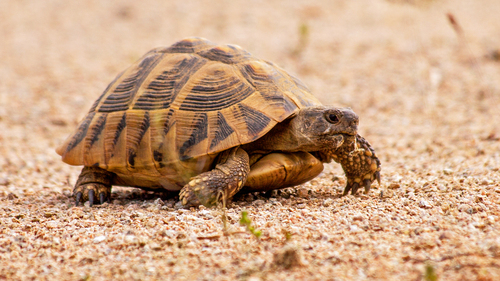
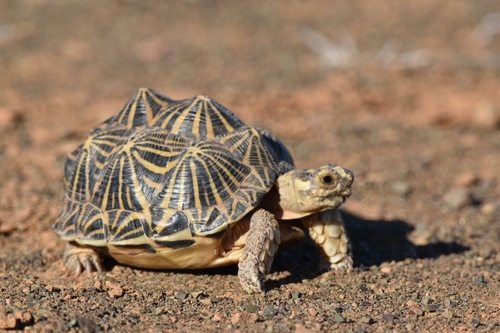
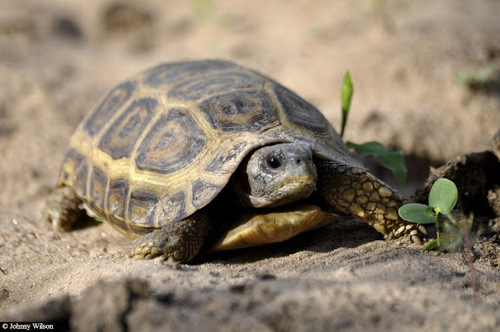
Kinixys spekii, commonly called Speke's hinge-back tortoise, has an elongated, distinctly flattened carapace that reaches up to 20 cm (7.9 in) in straight length.
Carapace Shape Function
This flattened shape lets the tortoise seek refuge in rock crevices and under logs; the co-occurring pancake tortoise has an even flatter shell.
Carapace Keel & Marginal Scutes
The carapace has a weak, broken medial keel, and its posterior marginal scutes are neither strongly serrated nor turned backward.
Upper Shell Hinge
This species has a well-developed hinge at the back end of the upper shell, which lets it protect its retracted rear legs.
Sexual Dimorphism - Tail
Males of this species have a notably longer tail than females, and the tails of both sexes end in a spine.
Sexual Dimorphism - Plastron
Females have a flat plastron, while males have a more concave plastron.
Geographic Range - East Africa
Speke's hinge-back tortoise is found in East Africa, ranging from Uganda and Kenya south to Eswatini, adjacent to Mozambique and Zululand.
Geographic Range - West Extension
Its range extends west as far as the coast of Angola.
Primary Habitat
K. spekii lives in savannahs and dry bushlands with rocky areas.
Seasonal Habitat Shifts
It tends to occupy more wooded areas during the dry season, and moves out into open savannahs when summer rains arrive.
Reproduction - Clutch Details
Female K. spekii lay small clutches of two to four eggs in the summer.