About Homopus areolatus (Thunberg, 1787)
Species Overview
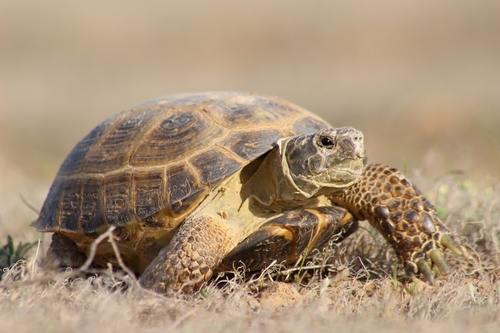
The common padloper, scientifically named Homopus areolatus, is a small, relatively flat tortoise.
Shell Characteristics
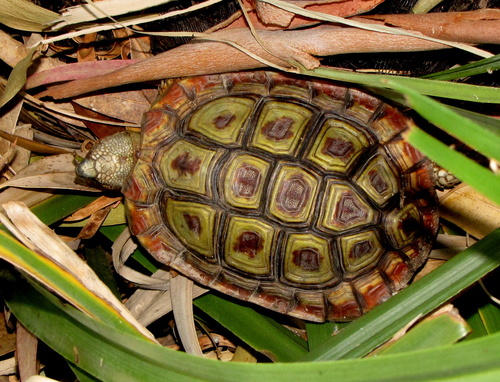
Its shell usually has variable coloration ranging from olive-green to brown. The scutes (shields) of its upper shell (carapace) are flat, with large raised areolae, and thin black edging.
Limb Features
Like its larger relative the greater padloper, and unlike other padloper species, it has only four toes on both its front and hind feet.
Adult Size
Its average adult length is 110 mm, and females grow larger than males. Adult common padlopers weigh between 140 and 300 g.
Beak Trait
They have a sharp, distinctly hooked beak.
Sexual Dimorphism
Males are smaller than females, and can be told apart by their slightly longer tails and characteristic head shape: males have larger heads, a larger beak, and a more pointed snout. During the breeding season, the noses of dominant males turn bright orange or red.
Color Differences Between Sexes
Males are often uniformly orange to light brown in color, while females are typically a deeper olive brown. Males also have lighter-colored lower shells (bellies), but do not have the concave plastron seen in many other tortoise species.
Geographic Range
This species is endemic to the Republic of South Africa, found specifically in the Western Cape and Eastern Cape Provinces.
Habitat Preferences
It favors coastal lowlands, particularly along the south coast, where it inhabits fynbos, strandveld, albany thicket and valley bushveld. The mild local climate lets it remain active year-round.
Arid Tolerance
It is generally intolerant of the arid conditions found further inland, though small populations survive in more inland areas where conditions are favorable.
Inland Population Locations
In the Western Cape, inland populations occur at Sutherland and Nieuwoudtville. In the Eastern Cape, the species' range extends inland as far as Cradock at one point.
Abundance
Unlike other padloper species, Homopus areolatus is relatively abundant across its range, which is why it is called the common padloper.
Predation Risk
Because of its very small size, the common padloper is heavily preyed on by crows, ostriches, jackals, baboons, dogs, and a wide range of other predators.
Hiding Behavior
As a result, it spends most of its time hiding under rocks, foliage, and other types of cover.
Reproduction
Females lay clutches of 2–4 eggs, which hatch after 150–320 days of incubation, usually on a misty, overcast day.