About Hippocampus erectus Perry, 1810
Taxonomy and Etymology
The lined seahorse (Hippocampus erectus) was first described and named by George Perry in 1810. The genus name Hippocampus comes from ancient Greek, translating to "horse or sea monster".
Activity Pattern
This species is diurnal.
Size
Adults typically measure between 12 cm and 17 cm in length, with a maximum reported length of 19 cm.
Sexual Dimorphism
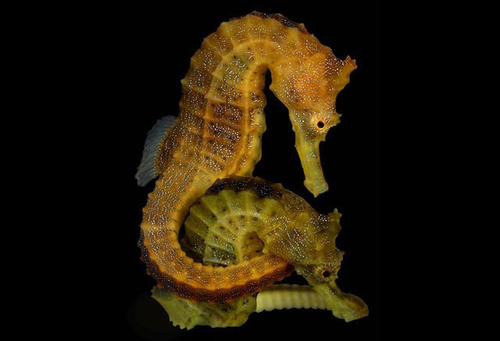
Lined seahorses are sexually dimorphic, with clear physical differences between males and females. The most notable difference is the brood pouch on the male's abdomen, which is used for reproduction. Males are also slightly larger than females and have longer prehensile tails.
Lifespan
In the wild, their lifespan ranges from one to four years; in captivity, they usually live the full four years, which is the maximum recorded age for the species.
Coloration
Their coloration covers a wide spectrum, including black, grey, brown, green, orange, red, and yellow, and they are typically paler on their front side. Their color can change in response to changes in their environment, diet, stress, anxiety, or mood.
Body Shape and Skeleton
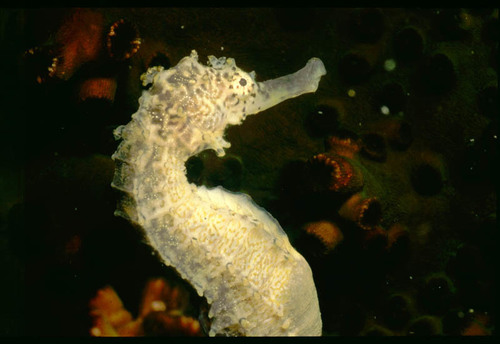
Lined seahorses have a stout, upright body shape. Their body is covered in an armor-like structure made of around 50 bony plates that form their external skeleton.
Distinguishing Markings
The species commonly has white lines outlining its neck area, which gives it its common name "lined seahorse", and small white dots on its tail.
Tail Structure
Its prehensile tail is made up of many rings; the first, third, fifth, seventh, and eleventh rings often protrude further outward than the rest. The seahorse uses its prehensile tail, structured along the bony plates, to grasp onto surrounding elements like seaweed and coral.
Tail Behavior
The tail curls forward and is rarely held straight. When lined seahorses are very young (between two and four weeks old), their tail is extremely flexible.
Head and Snout Features
The snout of a lined seahorse is approximately half the length of its head. The cheek spines, which sit diagonally downward from each eye, may be single or double.
Body Rings and Fin Rays
In total, this species has 11 trunk rings, 34–39 tail rings, 16–20 dorsal fin rays, and 14–18 pectoral fin rays.
Fin Placement
The pectoral fin sits level with the eye on each rear side of the head. The dorsal fin is located on the back of the skeleton, level with the stomach-chest region.
Sexual Fin Differences
Female lined seahorses have slightly larger dorsal fins than males, and their dorsal fins are positioned lower on the back.
Eye Function
The eyes of the lined seahorse can either focus together or move independently of one another.
Sexual Maturity
Lined seahorses can reach sexual maturity as early as four months old, but most mature around eight months. The minimum size of a sexually mature individual is 5.6 cm.
General Range
The range of the lined seahorse extends from waters south of Nova Scotia down to southern Venezuela in South America.
Confirmed Distribution Areas
It is found along the U.S. East Coast in Connecticut, Delaware, Florida, Georgia, Louisiana, Maryland, New Jersey, New York, Rhode Island, Virginia, North Carolina, and South Carolina, as well as in waters around Mexico and the Caribbean.
Unconfirmed Distribution Records
Records of this species from Brazil may actually belong to a different species, and more research is needed to confirm this. The lined seahorse is native to the United States, Bermuda, Cuba, Mexico (Veracruz and Yucatán), Haiti, Saint Kitts and Nevis, Belize, Honduras, Nicaragua, Costa Rica, Panama, Guatemala, and Venezuela.
Azores Occurrence
It has also been recorded near the Azores, but it is unclear if an established permanent population exists there.
Habitat Types and Depth Range
The species occupies marine intertidal and marine neritic habitats, and can be found at depths up to 73 meters.
Swimming and Attachment Behavior
Adult lined seahorses may swim freely in the water column or attach to stationary objects, while juveniles typically swim near the surface.
Vegetation Habitat
Their habitat includes marine vegetation such as floating Sargassum, seagrass, sponges, and mangroves.
Seasonal Habitat Variation
Depending on the season, they can be found in shallow or deep waters along beaches, oyster beds, vegetation-covered banks, bays, and salt marshes. They are also commonly found with their tails wrapped around crab pots. In winter, lined seahorses are more often found in deeper water; in warmer months, they are typically found in shallow water attached to vegetation.
Temperature Effects
The water temperature of their habitat varies by latitude, and temperature affects gonad development, brood size, and juvenile development and survival. Adults experience daily temperature fluctuations from tide cycles, seasonal changes, and precipitation or runoff, and can migrate to deeper water during cold seasons.
Optimal Captive Temperature
Captive studies show that juveniles have the highest survival and growth rates at 28 to 29 degrees Celsius.
Salinity Tolerance
Salinity levels also vary widely across the species' range, with the most common salinity falling between 25 and 35 ppt; in captivity, this species is most often kept at 35 ppt.
Chesapeake Bay Presence
Hippocampus erectus is the only seahorse species native to the Chesapeake Bay.
Reproductive Strategy
Like all seahorses, lined seahorses reproduce sexually, and females lay eggs each breeding season. Males are the parent that cares for developing and newborn seahorses.
Courtship Process
Reproduction begins with a multi-day courtship process, during which both the male and female often turn pale. The male enlarges his brood pouch to signal his interest in the female. Through courtship dances and clicking sounds, the pair becomes established as monogamous mates before mating occurs.
Mating Process
During mating, the female deposits her eggs into the male's brood pouch, where the eggs are fertilized and the pouch is sealed.
Clutch and Brood Size
A female's clutch size can be 1,000 eggs or more, and a male's brood can hold between 97 and 1,552 eggs. The number of eggs a female produces depends on her size. A single male can carry up to 650 eggs at one time.
Egg Characteristics
Each egg measures 1.5 mm in diameter.
Pouch Physiology During Incubation
While eggs incubate inside the male's pouch, an extensive network of capillaries supplies oxygen to the embryos. This system also adjusts sodium and calcium levels to maintain homeostasis within the pouch. As embryos near birth, the environment inside the pouch becomes very similar to seawater.
Gestation Period
The gestation period lasts 20–21 days.
Birth Process
When labor begins, the male anchors his prehensile tail to a supportive object and bends back and forth repeatedly to push developed seahorses out of the pouch. He continues this movement until all young seahorses have emerged.
Post-Birth Male Risk
If unhatched dead eggs remain inside the pouch, they produce gas that causes the male to float to the surface, making him easy prey for other marine animals.
Newborn Size and Development
Newborn juveniles are approximately 11 mm long for their first three days, and are considered embryos until they can swim on their own. Juveniles do not reach full adult size until they are 8–10 months old.
Juvenile Survival Rate
Scientists estimate that only around two juveniles survive to adulthood out of the hundreds that hatch.
Captive Juvenile Growth Rate
In captivity, this species grows vertically at a rate of 0.55 mm per day for the first 100 days.
Juvenile Development
Male juveniles develop their brood pouches when they are 5–7 months old. Juveniles quickly develop the characteristic features of adult lined seahorses.
Breeding Cycle Timing
After birth, the breeding and courtship cycle begins again. In the Chesapeake Bay, breeding occurs from May through October. In Florida, the population of lined seahorses peaks in July.