About Phycodurus eques (Günther, 1865)
Taxonomy and Etymology
Leafy seadragons, with the scientific name Phycodurus eques (Günther, 1865), share close relation to seahorses, and their common name comes from their resemblance to the mythical dragon.
Size
Though not large, they grow slightly bigger than most seahorses, reaching a total length of 20–24 cm (8–9.5 in).
Diet and Feeding Mechanism
They feed on plankton, small crustaceans, and larval fish, sucking prey in through their long, pipe-like snout. Common prey includes amphipods and mysid shrimp.
Camouflage via Body Appendages
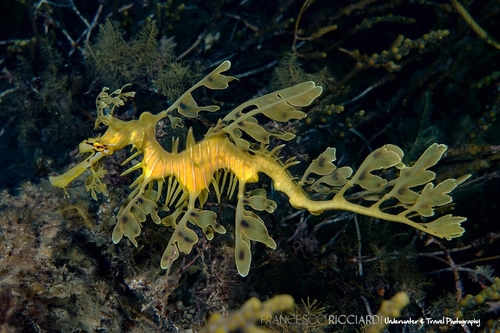
The fleshy, leaf-like lobes of skin that grow across the leafy seadragon’s body work as camouflage, making the animal look just like seaweed. This illusion holds even when swimming, as the leafy seadragon moves through the water the same way a loose piece of floating seaweed does.
Color Change Ability
Leafy seadragons can also change their body colour to better blend into their surroundings, but this ability depends on the individual’s diet, age, location, and stress level.
Taxonomic Placement
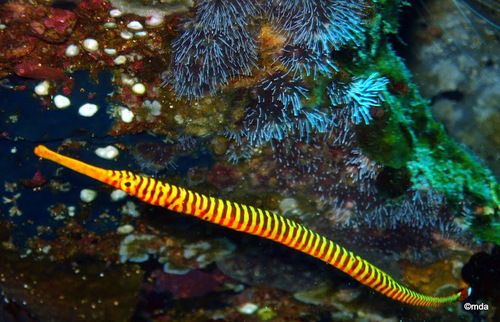
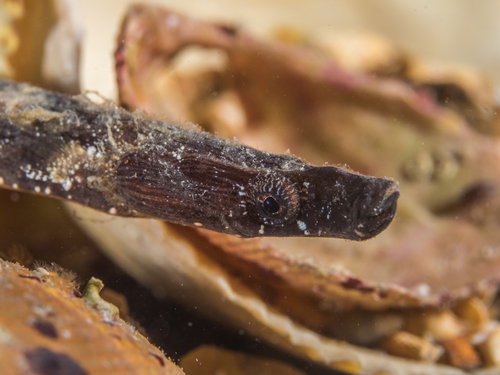
Leafy seadragons are related to pipefish and belong to the family Syngnathidae, the same taxonomic family that includes seahorses.
Differences from Seahorses
They differ from seahorses in overall appearance, how they move through water, and in that their tails cannot coil or grasp objects.
Comparison to Weedy Seadragons
The related weedy seadragon is smaller than the leafy seadragon, has multiple different colours, and grows weed-like fins rather than the leafy seadragon’s leafy skin lobes.
Unique Gill Structure
One unique trait of the leafy seadragon is its small, circular gill openings that cover tufted gills; this is very different from the crescent-shaped gill openings and ridged gills found in most fish species.
Geographic Range
The leafy seadragon is endemic to southern Australian waters, with a range that extends westward from Wilson's Promontory in Victoria (its eastern limit) to Jurien Bay, 220 km (140 mi) north of Perth in Western Australia.
Common Sight Locations
It is commonly spotted by scuba divers near Adelaide in South Australia, particularly at Rapid Bay, Edithburgh, and Victor Harbor.
Habitat and Depth
Leafy seadragons most often live over sand patches in areas with kelp-covered rocks and seagrass clumps, at depths up to 50 m (160 ft).
Movement and Home Range
Researchers originally thought leafy seadragons had very small home ranges, but later work found they actually travel several hundred metres away from their usual sites, and can return to the same location using a strong sense of direction.
Social Structure
Leafy seadragons typically lead a solitary lifestyle.
Breeding Behavior
When breeding season arrives, males court females, and pairs form to breed.
Maturation
Individuals are fully independent immediately after hatching, and reach full adult size and sexual maturity by two years of age.
Male Egg Care
Like seahorses, male leafy seadragons are responsible for caring for developing eggs.
Egg Deposition
A female produces up to 250 bright pink eggs, which she deposits onto the male’s tail using her ovipositor, a long tube-like structure. The eggs attach to a specialized brood patch on the male’s tail that supplies them with oxygen.
Incubation Period
Over the 9-week incubation period, the eggs change colour, ripening to purple or orange before hatching. The exact length of incubation depends on water conditions.
Hatching Process
To help the young emerge, the male pumps, shakes, and rubs his tail against seaweed and rock, and the hatching process takes 24 to 48 hours total to complete.
Egg Survival Rate
Only around 5% of the deposited eggs survive to hatching.
Newborn Nourishment
Every newborn leafy seadragon has a small yolk sac attached externally to its body that provides nourishment for its first few days of life.
Newborn Feeding Behavior
Even with this initial food source, most newborns instinctively hunt and catch prey right after hatching, and become fully self-sufficient before the yolk sac is used up. Newborns feed on small zooplankton until they grow large enough to hunt mysid shrimp.