About Gompholobium glabratum DC.
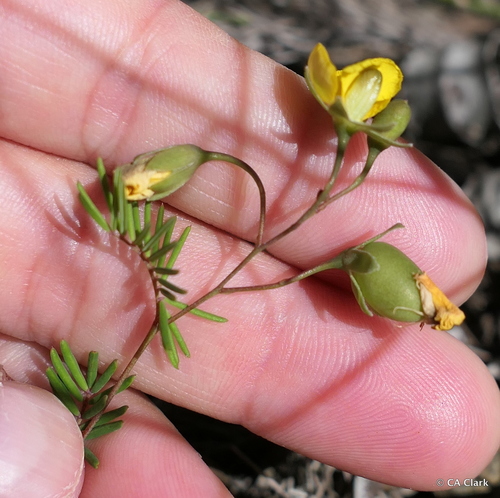
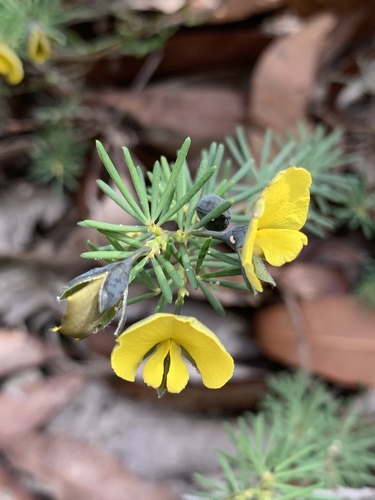
Gompholobium glabratum, commonly known as dainty wedge-pea, is a low-lying or ascending shrub that usually reaches 5 to 40 centimeters (2.0 to 15.7 inches) in height. Its stems have a pimply texture. The leaves are pinnate, with between five and seven leaflets per leaf. The leaflets are linear to narrow lance-shaped, measuring 10 to 15 millimeters (0.39 to 0.59 inches) long and 0.5 to 1.5 millimeters (0.020 to 0.059 inches) wide. The plant is more or less glabrous, and the edges of its leaflets curve downward or roll under. Flowers grow in small groups at the ends of branchlets. Each individual flower sits on a pedicel 4 to 10 millimeters (0.16 to 0.39 inches) long, and has sepals that grow up to around 8 millimeters (0.31 inches) long. Petals measure 8 to 10 millimeters (0.31 to 0.39 inches) long overall: the standard petal and wings are yellow or greenish-yellow, while the keel is dark brown to greyish. Flowering takes place from August to October. After flowering, the plant produces an oval pod 8 to 10 millimeters (0.31 to 0.39 inches) long. This species grows in forest and heath habitats, found on the coast and tablelands of New South Wales from south of Forster to the far north-eastern corner of Victoria.