About Acacia fasciculifera F.Muell. ex Benth.
Nomenclature and habit
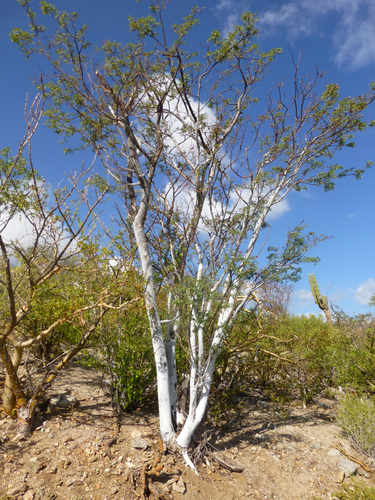
Acacia fasciculifera F.Muell. ex Benth., commonly called scrub ironbark, is a tree that typically grows to a height of around 10 m (33 ft) and develops a dense canopy. Its branchlets are pendulous and usually glabrous.
Phyllode characteristics
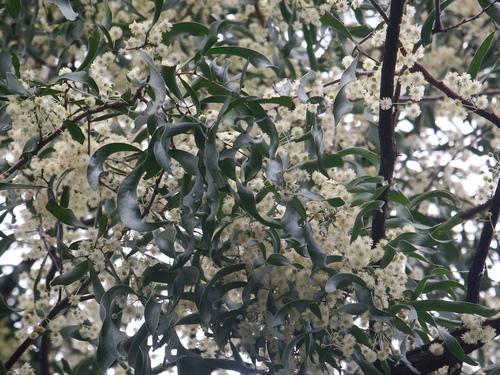
The phyllodes range in shape from narrowly oblong to narrowly elliptic, are 40–150 mm (1.6–5.9 in) long and 7–20 mm (0.28–0.79 in) wide, and are slightly leathery with a prominent midrib and marginal veins.
Inflorescence structure
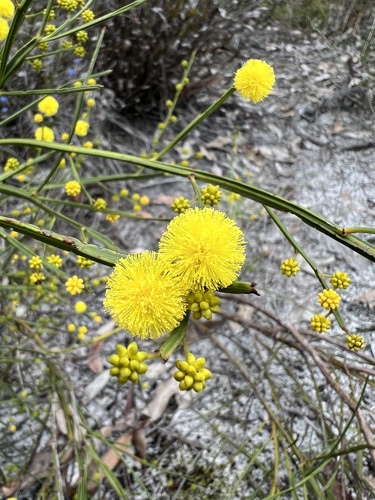
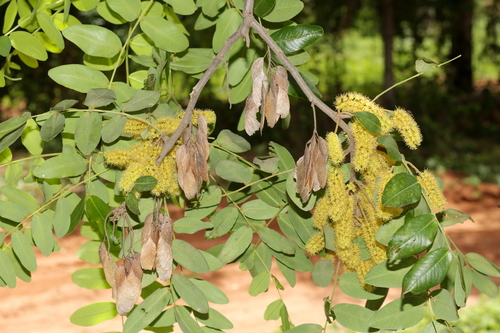
Flowers are arranged in two to eight spherical heads held in racemes that are 1–3 mm (0.039–0.118 in) long; the clusters often form in leaf axils, and each flower cluster grows from a peduncle 10–29 mm (0.39–1.14 in) long. Each spherical head contains 20 to 40 cream-coloured flowers.
Flowering period
Flowering typically occurs in summer.
Seed pod characteristics
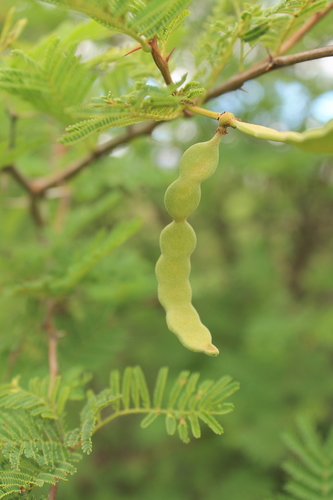
After flowering, the species produces thinly leathery seed pods that grow up to 125 mm (4.9 in) long and are usually 10–13 mm (0.39–0.51 in) wide, with a prominent marginal vein.
Seed characteristics
The seeds are oblong to round, flat, usually 6–7 mm (0.24–0.28 in) long, slightly shiny dark brown, and have a small aril.
Distribution range
This species is mainly distributed from near Boonah in southern Queensland north to near Rockhampton, with a small number of scattered populations extending further north to near Bowen.
Habitat
It grows on ridges and along creeks, occurring in Eucalyptus forest or in association with Brigalow (Acacia harpophylla).
Human use
This wattle species is sometimes logged for its timber.