About Lespedeza leptostachya Engelm. ex A.Gray
Scientific Name and Growth Form
Lespedeza leptostachya Engelm. ex A.Gray is a long-lived perennial herb that reaches up to 1 meter in height.
Leaf Structure
Its leaves are compound and pubescent, each formed of three linear or linear-oblong leaflets.
Foliage Pubescence and Appearance
Whitish hairs cover the entire above-ground plant, giving it a distinctly silvery appearance.
Inflorescence and Flower Characteristics
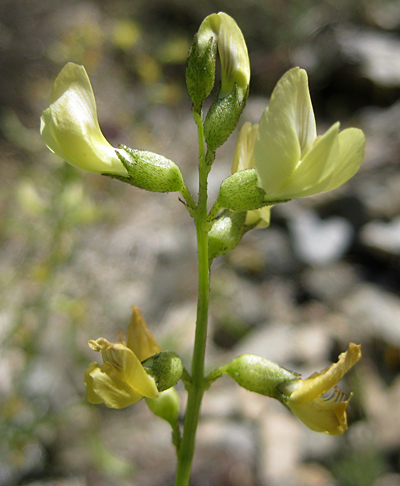
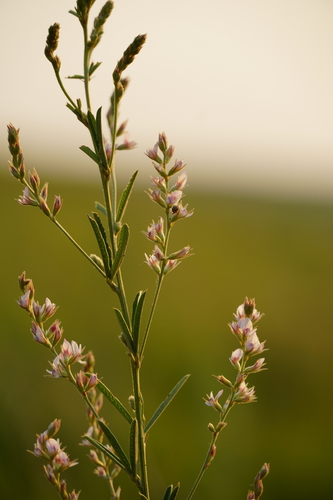
Its inflorescence is a terminal spike holding flowers that range in color from cream to yellowish or pale pink; each individual flower is only half a centimeter long.
Flower Types
This species produces two types of flowers: cleistogamous flowers that never open, and chasmogamous flowers that open to allow insect access.
Seed Production Capacity
Both flower types are capable of producing seed.
Blooming Period
Blooming occurs from July through September, with peak blooming in mid-July.
Maturity Requirement for Flowering
The plant does not flower until it reaches maturity, when it is 6 to 9 years old.
Fruit Characteristics
The fruit is a legume pod; a single plant can produce over 500 pods, but many of these do not contain viable seeds.
Geographic Distribution
This species is endemic to the Upper Midwest of the United States, occurring in the Upper Mississippi Valley in the states of Minnesota, Iowa, Wisconsin, and Illinois.
Population Concentration
Most of its populations are located in northern Iowa and southern Minnesota, and it is rare across its entire known range.
Conservation Status
It is federally listed as a threatened species in the United States.
Habitat Type
It grows exclusively in tallgrass prairie, primarily in dry locations.
Preferred Soil Characteristics
Its typical soils are gravelly, sandy, and/or calcareous, and are generally well-drained.
Slope Preference
It prefers north-facing sloped areas.
Associated Prairie Species
It grows in association with many other prairie plant species, including Andropogon gerardi, Schizachyrium scoparium, Sorghastrum nutans, Bouteloua curtipendula, Sporobolus heterolepis, Stipa spartea, Carex pennsylvanica, Carex bicknellii, Carex muhlenbergii, Euphorbia corollata, Phlox pilosa, Amorpha canescens, Liatris aspera, Dalea purpurea, Solidago speciosa, S. graminifolia, Gentiana puberulenta, Lithospermum canescens, Sisyrinchium albidum, Baptisia leucophaea, Ionactis linariifolius, Symphyotrichum sericeum, Echinacea pallida, Polygala polygama, Viola pedatifida, and Viola pedata.
Related Sympatric Species
It can be found growing near its relative Lespedeza capitata, which has shorter, denser flower spikes and wider leaflets.
Interspecific Hybridization
Rare hybridization between the two species has been recorded, producing hybrid plants with intermediate flower spike lengths and leaf widths.