About Erythrina vespertilio Benth.
Tree Size and Form
Erythrina vespertilio Benth. is typically a small, straggly tree that grows to a height of 6 to 10 metres (20 to 33 ft). Its trunk reaches an approximate diameter of 0.3 m (1.0 ft), and bears thorns along with deeply furrowed, corky, creamy-grey bark; thorns also grow on the tree’s branches.
Foliage Phenology
This species is deciduous, losing all its leaves during the dry season.
Leaf Structure
Its leaves are either bifoliolate or trifoliolate, and measure 10 to 15 centimetres (4 to 6 in) in total length. The leaflets are broad and wedge-shaped with three lobes, a form that resembles a bat’s open wings. Individual leaflets are 7 to 12 cm (2.8 to 4.7 in) long and 5 to 12 cm (2.0 to 4.7 in) wide.
Flowering Period
Flowering occurs between August and September, usually when the tree is leafless.
Inflorescence and Bloom Traits
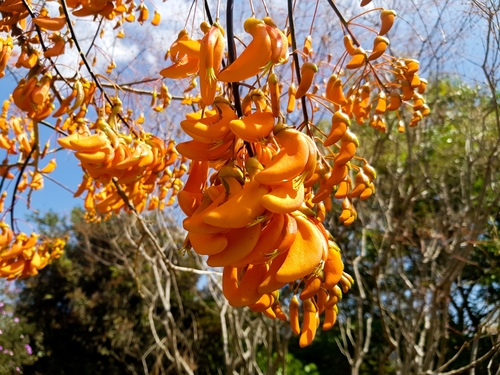
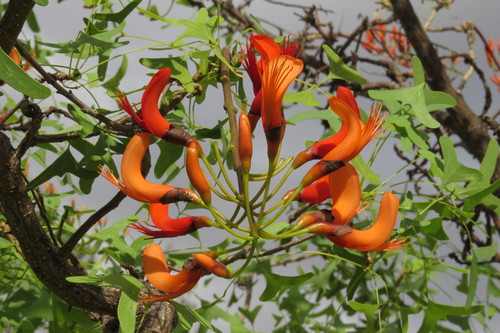
The blooms are scarlet to orange-red pea-shaped flowers 3 to 4 cm (1.2 to 1.6 in) long, borne on terminal racemes that are 5 to 25 cm (2.0 to 9.8 in) in length. Each flower has a calyx 1.5 to 2.5 cm (0.59 to 0.98 in) long, petals roughly 3 cm (1.18 in) long, and usually ten stamens.
Fruit and Seed Characteristics
After flowering, the tree produces elongated pods 6 to 12 cm (2.4 to 4.7 in) long and 1.5 to 1.8 cm (0.59 to 0.71 in) wide, which contain bean-like seeds around 1.2 cm (0.47 in) long that range in colour from orange to dark yellow.
Broad Distribution Range
This species is distributed across all mainland Australian states except Victoria.
General Habitat
It grows mainly in open woodlands, and can also extend into arid areas and rainforest margins.
Detailed Regional Distribution
In Australia, it occurs in the Kimberley, Pilbara and northern Goldfields-Esperance regions of Western Australia, across most of the Northern Territory and Queensland, in northern South Australia, and in north eastern New South Wales.
Altitude Range
It grows at altitudes from near sea level up to 800 metres (2,625 ft).
Growing Conditions
It tolerates a wide range of soil types, provided the soil has good drainage and the tree receives full sun.
Traditional Use Context
Aboriginal Australian communities in Central Australia have traditionally used this species widely.
Wood Craft Uses
The Warlpiri, Anmatyerr, Arrernte and Alyawarr peoples use its wood to make shields for both warfare and ceremonial use, and these shields can also be used for friction fire starting. The wood is also used to make woomeras and coolamons.
Traditional Medicinal Use
The bark is recognized to have traditional medicinal properties.
Phytochemical Content
The fruit of this tree contains alkaloids, and the stem contains isoflavonoids. At high doses, the flavonoid phaseollidin from this species has shown cytotoxic activity in vitro against prostate cancer cell lines.
Seed Use
The seeds are used to make decorations.