About Gloydius himalayanus (Günther, 1864)
Dorsal Base Coloration
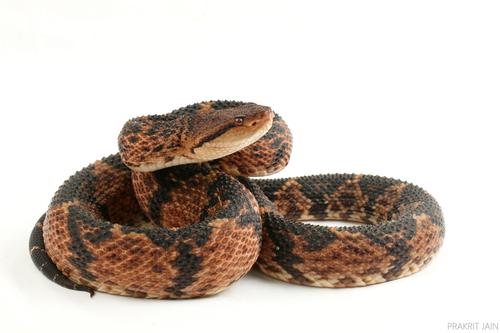
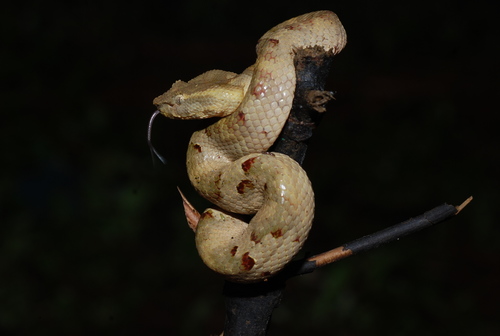
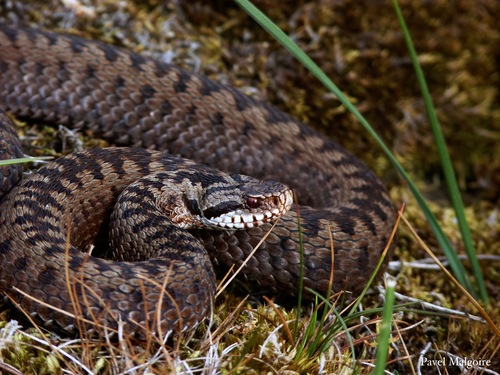
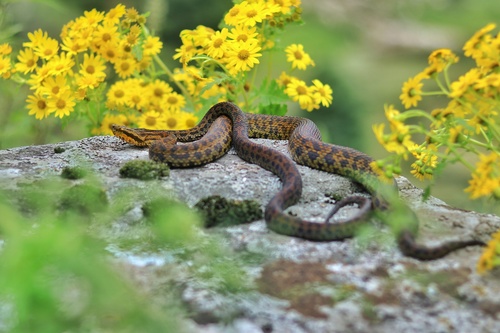
Gloydius himalayanus (Günther, 1864) has a body base color of light brown or dark brown, with an overall brownish dorsum. The upper side of the body features long, interconnected infarct marks that appear intertwined because the marks lie very close together.
Dorsal Spot Pattern
There is a slightly larger lateral row of spots that matches the color of the dorsal infarct marks. The dorsum is also mottled or variegated to form a pattern of transverse bars.
Head Morphology
The head has dark spots, and is distinctly wide and elongated, covered with symmetrically arranged large scales. An elongated postocular stripe extends anteriorly to separate the eye from the supralabials.
Ventral Coloration
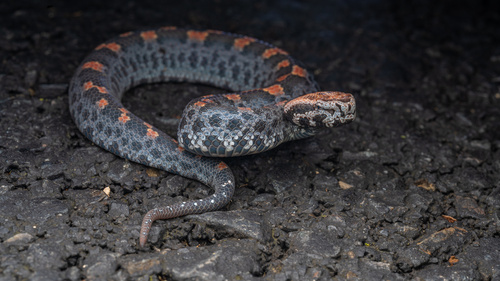
The abdomen is light gray with small dark spots; ventral scales may also be white with black and red dots or speckles.
Adult Body Length
Average adult body length for this species ranges from 0.76 to 0.90 metres (2.5 to 3.0 ft).
Dorsal Scale Row Count
The dorsal scale row count follows the formula (20 to 23) - 21 (19 to 23) - 17 (15): there are 20 to 23 rows of dorsal scales just behind the head, 21 rows at midbody (occasionally 19 or 23 rows), and 17 rows just before the vent (occasionally 15 rows). Dorsal scales are strongly keeled.
Geographical Range
This species occurs along the southern slopes of the Himalayas, ranging from northeastern Pakistan through northern India (Jammu and Kashmir, Punjab, Ladakh and Uttarakhand) to Nepal. Claims of its presence in Sikkim, India, have not been confirmed.
Regional Occurrence Note
It is the only species of pit viper that is found in Pakistan.
Altitudinal Habitat
Gloydius himalayanus is a highland snake native to the mid and western Himalayas, where it inhabits altitudes between 2,100 and 4,900 m (6,900 and 16,100 ft).
Shelter Sites
It takes shelter under fallen timber, in crevices, in or under rocks, beneath boulders, ledges, and stones, and under fallen leaves.