About Trimeresurus erythrurus (Cantor, 1839)
Species Nomenclature
This species, Trimeresurus erythrurus (Cantor, 1839), has sexually dimorphic maximum body size.
Male Size
Males reach a maximum total length of 575 millimetres (22.6 in), with 120 millimetres (4.7 in) of this total being tail length.
Female Size
Females grow to a maximum total length of 1,045 millimetres (41.1 in), with a tail length of 165 millimetres (6.5 in).
Dorsal Scalation
For scalation: dorsal scales form 23–25 longitudinal rows at midbody; the first upper labial scale is partially or completely fused to the nasal scale; there are 9–13 upper labial scales, with 1–2 rows of scales separating the upper labials from the suboculars; 11–14 scales lie in a line between the supraoculars; supraoculars are rarely divided; temporal scales are small and strongly keeled;
Ventral and Subcaudal Scalation
ventral scales number 153–174 in males and 151–180 in females; subcaudals number 62–79 in males and 49–61 in females, and are usually paired, with occasional unpaired shields appearing within the paired series.
Body Coloration
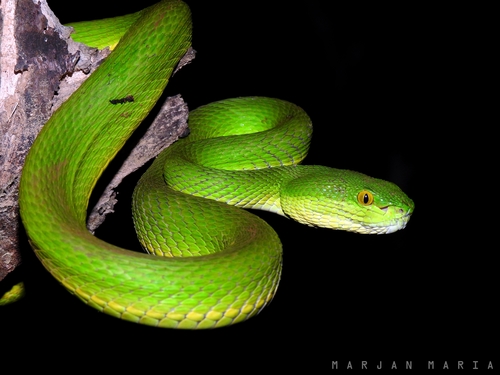
Its color pattern is as follows: the head is uniform green, the dorsum is bright green, a light ventrolateral stripe is present in males, and is either present or absent in females.
Ventrolateral Stripe Literature Accounts
Maslin (1942:23) reports that the ventrolateral stripe is absent, while M.A. Smith (1943:523) states it is present in males and its presence is variable in females.
Tail and Hemipenis Features
The tail is spotted with brown, and hemipenes have no spines.
Geographic Range
This species is found in eastern India (Assam, Sikkim, Mizoram, Manipur), Bangladesh, Myanmar, Bhutan, and Nepal.
Type Locality
Its original given type locality was "Delta Gangeticum", the Ganges Delta, located in West Bengal State, eastern India.
Type Locality Literature Account
Boulenger (1896) also gave the type locality as "Ganges Delta".