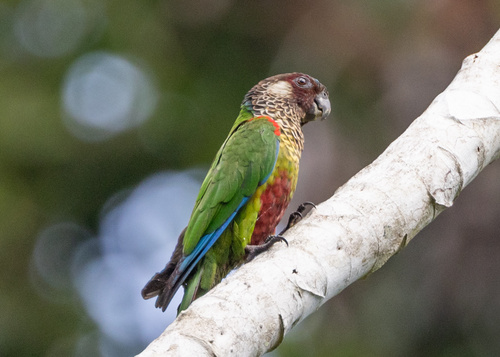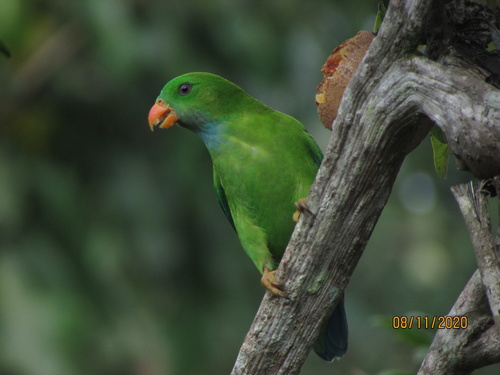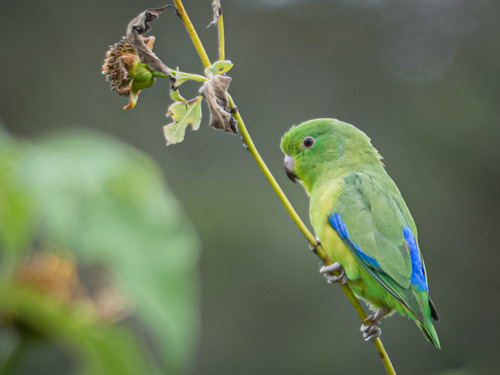
About Forpus xanthopterygius crassirostris (Taczanowski, 1883)
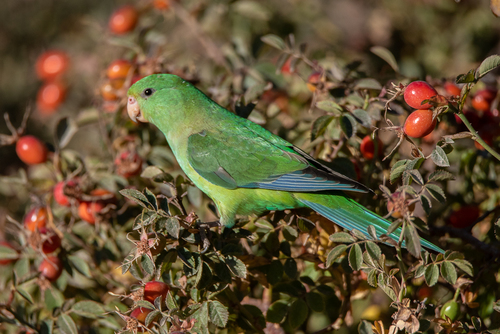
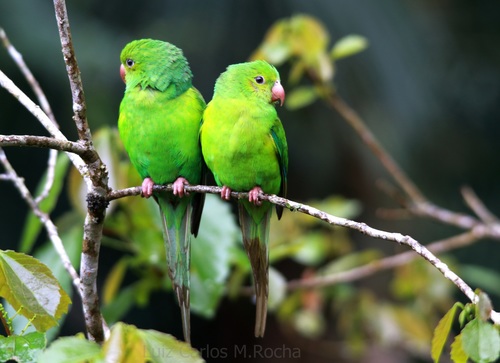
The cobalt-rumped parrotlet (Forpus xanthopterygius), also called the blue-winged parrotlet, is a parrot species belonging to the family Psittacidae. This species has two recognized subspecies: Salvadori's cobalt-rumped parrotlet (F. x. flavescens) and Hellmayr's cobalt-rumped parrotlet (F. x. flavissimus).
Distribution
Cobalt-rumped parrotlets are found across most of central and northern South America, with their range divided between the two subspecies. The species is generally common and widespread across its range, though it has a more localized distribution in the Amazon Basin.
Habitat Preferences
They mainly inhabit lowland areas, and do not occur at altitudes above 1,200 metres (3,900 ft). Their typical habitats include dry woodlands, riparian woodlands, cerrado, caatinga, palm groves, semi-arid scrubland, savanna, and pastures. They tend to avoid densely forested areas.
Movement Patterns
Most cobalt-rumped parrotlet populations are non-migratory. However, populations in Argentina make local movements aligned with the flowering seasons of the plant species they eat, and populations in the Brazilian Atlantic Forest are altitudinal migrants.
Breeding Season
The typical breeding season for cobalt-rumped parrotlets runs from May to August, but occupied nests have been observed in July, January, and March across different parts of the species' range. Females lay between 3 and 7 small, white, roughly spherical eggs.
Rufous Hornero Nest Interactions
Some cobalt-rumped parrotlets have been observed scraping clay nests built by rufous horneros with their beaks. The reason for this behavior is not fully clear, but cobalt-rumped parrotlets do use abandoned rufous hornero nests to raise their own broods. This has led to the suggestion that the parrotlets may be 'taste-testing' the nest material to check if it is suitable for their needs.
Clay-Licking Hypothesis
Similar studies on other Forpus parrot species have concluded that clay-licking provides important minerals that the birds cannot access through other food sources.