About Psilopsiagon aurifrons (Lesson, 1830)
Nomenclature
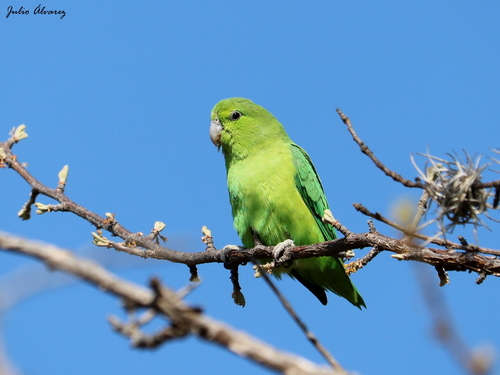
This species is a small parrot with a scientific name of Psilopsiagon aurifrons (Lesson, 1830), commonly called the mountain parakeet.
Size and Weight
It reaches about 18 cm (7 in) in length and weighs around 45 g (1.6 oz).
Nominate Subspecies Male Plumage
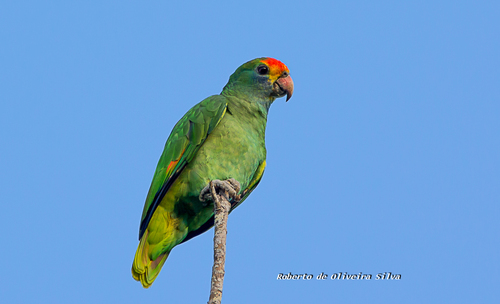
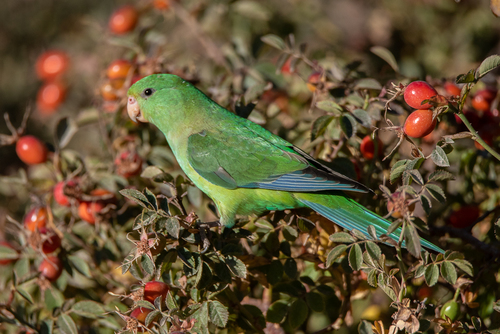
For the nominate subspecies, P. a. aurifrons: the male has green colouring on its head, mantle, back, and tail. Its green primary feathers have blue outer webs, with yellow colouring on the face, throat, and breast that fades gradually to yellowish-green on the belly.
Nominate Subspecies Soft Parts
The eye is brown, and the bill is horn-coloured.
Nominate Subspecies Female Plumage
Females of this subspecies are similar to males but have a yellow forehead.
Nominate Subspecies Juvenile Traits
Juveniles resemble females but have shorter tails.
P. a. margaritae Traits
Both sexes of the subspecies P. a. margaritae are similar to female P. a. aurifrons, but they are larger, have shorter tails, and females of this subspecies have grey bills.
P. a. rubrirostris Plumage
The subspecies P. a. rubrirostris matches P. a. margaritae in base colour, but its head, breast, and belly are a darker shade of green with a blue tinge.
P. a. rubrirostris Bill Coloration
In this subspecies, the male's bill is pinkish-buff and the female's bill is grey.
P. a. robertsi Traits
Males and females of P. a. robertsi resemble P. a. aurifrons, but they have a darker green belly and brighter yellow colouring on the chin and throat.
Altitudinal Range and Distribution
The mountain parakeet is found in the Andes at altitudes between 1,000 and 4,500 metres (3,300 and 14,800 ft), with a range covering Peru, Chile, Bolivia, and Argentina.
Natural Habitat
Its typical habitat includes vegetation near rivers, bushy slopes, scrub areas, rough grassland with cacti and brush, and agricultural land.
Anthropogenic Habitat
It also lives in man-made environments such as parks and gardens.
Subspecies Range Segregation
The four subspecies each occupy separate, non-overlapping parts of the species' total range.
Movement Patterns
This species is non-migratory, but individual birds move to higher altitudes in summer and lower altitudes in winter.