About Pyrrhura picta (Statius Muller, 1776)
Common Name and Length
Pyrrhura picta, commonly called the painted parakeet, measures 20 to 23 cm (7.9 to 9.1 in) in length.
Nominate Subspecies Weight
The nominate subspecies weighs between 46 and 85 g (1.6 to 3.0 oz).
Sexual Dimorphism
All subspecies have identical appearance between males and females.
Adult Nominate Crown Coloration
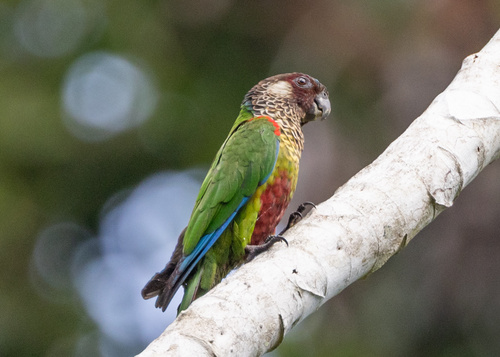
For adult nominate subspecies painted parakeets, the area from the forehead to the hindcrown is blue, which transitions to deep maroon on the hindcrown and nape.
Nape Collar
A narrow blue collar sits below the nape.
Face Features
The face is maroon, with a ring of bare grayish skin around the eye, and whitish ear coverts.
Upperparts Coloration
Most upperparts are green, with dull red coloration on the lower back and rump.
Neck and Breast Pattern
The sides of the neck and the breast are buff, with a reddish brown scalloped pattern.
Underparts Coloration
The center of the belly is dull red, and the rest of the underparts are green.
Wing Structure and Color
The wing is mostly green, with a red carpal area and blue primaries.
Tail Coloration
The tail is mostly maroon, with a green base.
Iris Color
The iris is dark.
Immature Plumage
Immature painted parakeets resemble adults, but lack the red carpal area and have a whitish eye ring.
Perija Parakeet Comparison
The Perija parakeet, a related form, resembles the painted parakeet, but differs by having a blue forecrown that becomes brown with a blue tinge on the hindcrown, a pale iris, pale gray-brown ear coverts, a dark red belly patch, and a maroon-red tail.
Subandean Parakeet Comparison
The Subandean parakeet differs from the painted parakeet in having a dull blue and red forehead, a bright maroon-red face, a buff and gray scalloped breast, a green carpal area (sometimes with a small number of red feathers), and a deep red tail.
Species Distribution
The painted parakeet is distributed from southeastern Venezuela to the Guianas and northern Amazonian Brazil.
Habitat Types
It inhabits terra firme forest, várzea forest, forested savanna, and coastal sand-ridge forest.
Elevation Range
It occurs mostly in lowland areas, but can be found at elevations as high as 1,800 m (5,900 ft).