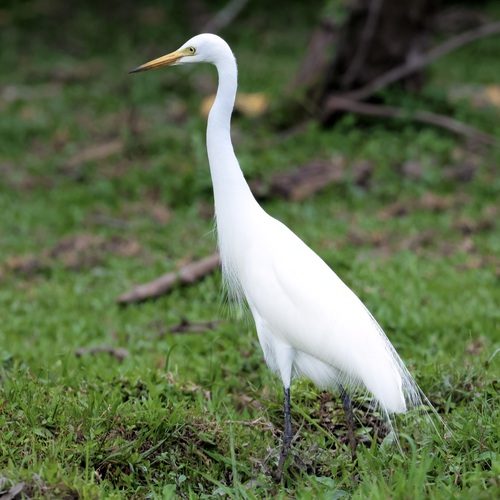
About Egretta vinaceigula (Sharpe, 1895)
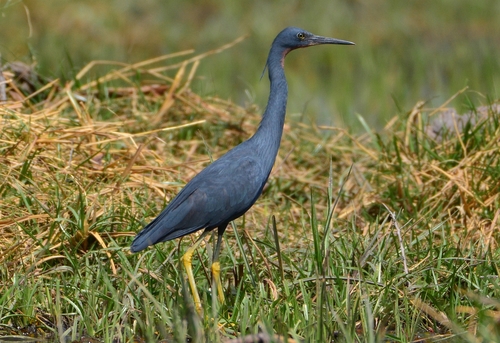
Until 1971, the slaty egret (Egretta vinaceigula) and the more widespread black egret (Egretta ardesiaca) were thought to be colour morphs of the same species. Consistent features now separate the slaty egret from the black egret: it has yellow legs and a vinous brown throat that extends down onto the belly in immature birds. The slaty egret also does not exhibit the characteristic 'mantling' behaviour of the black egret.
Native Range
The slaty egret is native to south-central Africa.
Largest Populations
The largest populations occur in Zambia and Botswana.
Zambia Population Details
Zambia holds an estimated 500 to 1,000 individuals, mainly found at Liuwa Plain National Park, Kafue Flats, and Lake Bangweulu in some years, with no confirmed breeding records recorded there.
Botswana Population Details
Northern Botswana has an estimated population of over 2,000 birds, concentrated around the Okavango Delta and Chobe River, where at least 10 colonies are known.
Namibia Population Details
This population extends into northern Namibia, where an estimated 300 birds occur on the Chobe floodplain and Caprivi Strip.
South Africa Nesting Record
There is only one confirmed report of unsuccessful nesting in South Africa’s Nylsvley Nature Reserve, Limpopo Province.
Nomadic Range
When not breeding, the species is nomadic, and has been recorded in the Democratic Republic of Congo, Zimbabwe, and rarely in northern South Africa.
Unconfirmed Range
Its presence on Mozambique’s Zambezi Delta has not been confirmed, and it may also occur in Angola and possibly Malawi.
Global Population Estimate
Slaty egrets almost always occur in small numbers (rarely more than around 100 individuals at a site), and the total global population is estimated to be between 3,000 and 5,000 individuals.
Primary Habitats
The slaty egret lives in floodplains, freshwater marshes, and temporary shallow wetlands.
Water Level Preference
It prefers areas where water levels are receding after peak seasonal rains.
Vegetation Preference
It is most commonly found in areas with dense cover of low emergent vegetation such as Cynodon dactylon and Panicum repens.
Floodplain Associations
Larger numbers of slaty egrets have been observed on floodplains that have been burned, and the species is often found alongside the red lechwe antelope (Kobus leche).
Foraging Depth Preference
It prefers to forage in shallow water less than 10 cm deep.