About Botaurus stellaris (Linnaeus, 1758)
Botaurus stellaris (Linnaeus, 1758), commonly called the Eurasian bittern or great bittern, is a species of thickset bittern, which are a type of heron. This is the largest bittern species, as its alternative name suggests, and males are noticeably larger than females.
Size Measurements
It measures 69–81 cm (27–32 in) in total length, has a wingspan of 100–130 cm (40–50 in), and has a body mass ranging from 0.87–1.94 kg (1 lb 14+1⁄2 oz – 4 lb 4+1⁄2 oz).
General Plumage Color
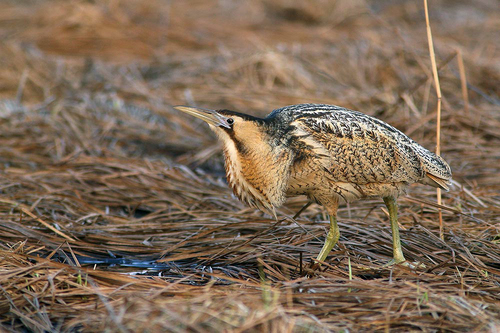
Its plumage is bright, pale buffy-brown, covered with dark streaks and bars. The crown and nape are black, with long, loosely arranged individual feathers tipped with buff that is narrowly barred with black.
Head and Neck Markings
The sides of the head and neck are a more uniform tawny-buff, marked with irregular black bars. The mantle, scapulars, and back are a similar color but more heavily barred, with individual feathers having black centers and black barring.
Facial Stripes
The head has a yellowish-buff superciliary stripe and a brownish-black moustachial stripe. The sides of the neck are rusty-brown with faint barring.
Throat and Underside Markings
The chin and throat are buff, with central throat feathers marked by longitudinal rusty-brown stripes. The breast and belly are yellowish-buff, with broad brown stripes along the sides and narrow brown stripes down the center.
Tail and Wing Markings
The tail is rusty-buff with black streaks in the center and black mottling near the edge. The wings are pale rusty-brown, marked with irregular black bars, streaks, and mottling.
Plumage Texture
The plumage has a loose texture, and elongated feathers on the crown, neck, and breast can be erected.
Bill and Eye Features
The bird has a powerful greenish-yellow bill, with a darker tip on the upper mandible. The iris is yellow, and the eye is surrounded by a ring of bare greenish or bluish skin.
Leg and Foot Features
The legs and feet are greenish, with some yellow on the tarsal joint and yellow soles on the feet. Juveniles have similar plumage to adults, but are somewhat paler with less distinct markings.
Nominate Subspecies Range
The nominate subspecies B. s. stellaris has a breeding range across temperate Europe and Asia, stretching from the British Isles, Sweden, and Finland eastward to Sakhalin Island in eastern Siberia, Korea, and Hokkaido Island in Japan. Its northern range boundary is around 57°N in the Ural Mountains and 64°N in eastern Siberia.
Southern Range Boundary
Its southern boundary reaches the Mediterranean Sea, the Black Sea, Iran, Afghanistan, Kazakhstan, Mongolia, and Hebei Province in northern China. Small resident breeding populations also exist in Morocco, Algeria, and Tunisia.
Breeding Habitat Preferences
This species typically inhabits Phragmites reed beds, swamps, lakes, lagoons, and sluggish rivers fringed with dense rank vegetation. It sometimes nests alongside ponds in agricultural areas, and even quite close to human settlements when suitable habitat is available, but prefers to breed in large reed beds of at least 20 hectares (50 acres).
Migratory Patterns
Some populations are sedentary, remaining in the same area year-round. Most northerly populations migrate to warmer regions, though some individuals often stay behind.
European Migration Routes
Northern European birds generally move south and west to southern Europe, and northern and central Africa. Northern Asian birds migrate to parts of the Arabian peninsula, the Indian sub-continent, and the provinces of Heilongjiang, Jilin, and Inner Mongolia in eastern China.
Non-Breeding Habitat
Outside of the breeding season, the species has less strict habitat requirements; in addition to reed beds, it can be found in rice fields, watercress beds, fish farms, gravel pits, sewage works, ditches, flooded areas, and marshes.
Southern African Subspecies
The subspecies B. s. capensis is endemic to southern Africa, where it occurs sparingly in marshes near the east coast, the Okavango Delta, and the upland foothills of the Drakensberg Mountains. This population is entirely sedentary.
2024 Kashmir Sighting
In November 2024, the species was recorded at Wular Lake for the first time in recorded Kashmir history.