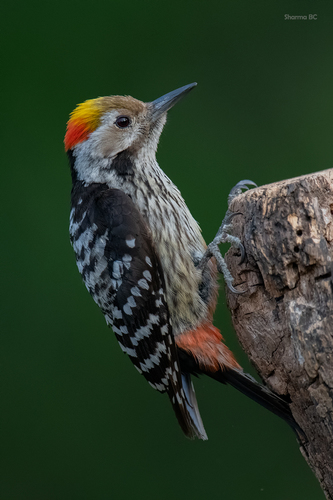
About Dendrocopos atratus (Blyth, 1849)
Adult Size
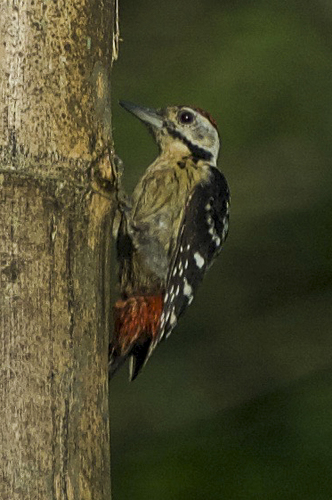
Description: Adult stripe-breasted woodpeckers measure between 21 and 22 cm (8.3 and 8.7 inches) in length.
Upper Body Plumage
Their upper body is black with heavy white barring, except for the unbarred mantle. The upper tail is black, with small white markings on the outer tail feathers.
Sexual Head Dimorphism
Males have red crowns and napes, while females have black crowns and napes.
Facial Markings
Their face is whitish, marked with a black moustachial stripe that connects to a stripe along the edge of the breast.
Underpart Plumage
The throat, breast, and belly are greyish-yellow or greyish-buff, with bold black streaks. The under tail coverts are red.
Soft Part Coloration
The iris is chestnut in color, the beak is grey, long, and sharply pointed, and the legs and feet are bluish-grey.
Juvenile Traits
Juveniles have greyer underparts than adults, and their under tail coverts are pink or orange; young males have a duller red crown than adult males.
Geographic Range
Distribution and habitat: The stripe-breasted woodpecker (Dendrocopos atratus) is native to southeastern Asia. Its range stretches from northeastern India to Vietnam, and also includes Yunnan Province in southwestern China.
Conservation Status
This is a fairly uncommon species, but its population is considered stable. The International Union for Conservation of Nature has assessed its conservation status as least concern.
Habitat Type
It primarily lives in montane evergreen forests, especially pine and oak forests, but can also be found at deciduous forest edges and more open areas with scattered trees.
Elevational Range
Its altitudinal range is roughly 800 to 2,800 m (2,600 to 9,200 ft), and it mostly occurs at elevations above 2,000 m (6,600 ft).
Foraging Behavior
Behaviour and ecology: The stripe-breasted woodpecker forages for insects, particularly ants and beetle larvae, in the middle to upper sections of the forest canopy. It often forages in pairs or small family groups.
Breeding Season
Across most of its range, breeding starts in February; in India breeding occurs from March to May, and in Myanmar it takes place from April to May.
Nest & Clutch Details
The nest is a cavity excavated in a rotten stump or tree, located well above the ground. Clutch size is typically four or five eggs.
Incubation Observation
On one recorded occasion, an adult male and an adult female were observed incubating the eggs together.