About Colaptes campestris (Vieillot, 1818)
Size and Weight
The campo flicker (Colaptes campestris) is approximately 30 cm (12 in) long and weighs about 150 g (5.3 oz).
Sexual Dimorphism
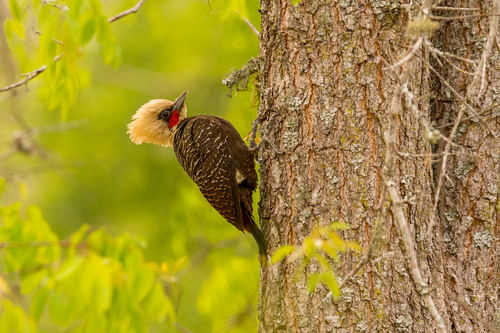
Males and females share identical plumage except for facial markings: males have a red malar stripe, while females have a black malar stripe.
Adult Head Plumage
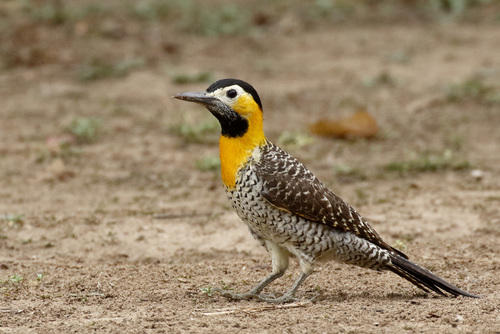
Adults of both recognized subspecies have a black crown and a yellow face, with white coloring surrounding the eye.
Subspecies Throat Difference
The only difference between the two subspecies is throat color: the nominate subspecies C. c. campestris has a black throat, while C. c. campestroides has a white throat.
Upperparts Plumage
The upperparts of both subspecies are brown marked with dull white bars, and the rump is white with a small number of narrow dark bars.
Flight Feathers
Their flight feathers are brown with yellow shafts.
Upper Tail Plumage
The upper surface of the tail is black; the central and outermost tail feathers have thin paler bars.
Lower Tail Plumage
The tail is brown with white bars on the outermost feathers.
Underparts Plumage
Their underparts are white with brown bars.
Soft Part Features
This species has a long gray bill, reddish brown irises, and gray legs.
Juvenile Plumage
Juveniles are very similar to adult campo flickers, but have lighter yellow plumage.
Nominate Subspecies Range
The nominate subspecies of campo flicker has several separate disjunct populations. Three small populations are located in southern Suriname and the northern Brazilian states of Pará and Amapá. The fourth, far more extensive population ranges from Maranhão in eastern Brazil south and west into Mato Grosso do Sul (Brazil), central Paraguay, and northern and eastern Bolivia.
C. c. campestroides Range
Subspecies C. c. campestroides occurs from central and southern Paraguay, Rio Grande do Sul in Brazil, and Uruguay, south into northeastern and eastern Argentina as far as Río Negro Province.
Subspecies Interbreeding
The two subspecies interbreed in their contact zone across Paraguay and southern Brazil.
Habitat Types
The campo flicker lives in a wide variety of landscapes, most of which are semi-open to open. These habitats include savanna, the Pampas, scrub, gallery forest, the edges of denser forest, Pantanal grasslands, and cerrado, as well as human-altered landscapes such as parks, farmland, and heavily grazed pasture.
Elevation Range
Across different parts of its range, it occurs at elevations from as low as 80 m (260 ft) up to 1,700 m (5,600 ft).