About Jynx torquilla Linnaeus, 1758
Species Nomenclature and Length
Eurasian wryneck (Jynx torquilla Linnaeus, 1758) measures 16–18 cm (6.3–7.1 in) in total length.
Subspecies Weight
The nominate subspecies weighs 23 to 52 g (0.81 to 1.83 oz), while subspecies Jynx torquilla tschusii weighs 26 to 50 g (0.92 to 1.76 oz).
Body Shape
This is a slim, elongated bird with a body shape more similar to a thrush than a woodpecker.
Upperparts Coloration
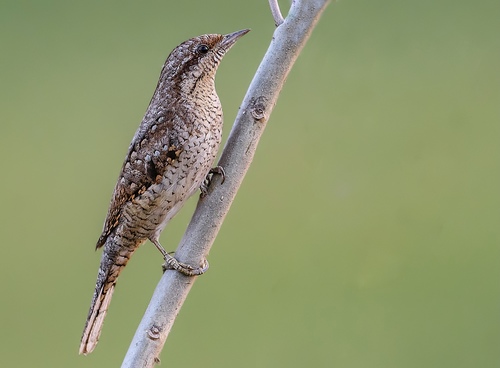
Its upperparts are barred and mottled in pale brown shades, with rufous and blackish bars and wider black streaks. The rump and upper tail coverts are grey, marked with brown speckles and irregular brown bands.
Tail Appearance
The rounded tail is grey with brown speckles, faint greyish-brown bands, and a few clearer brownish-black bands.
Head and Throat Coloration
The cheeks and throat are buff with brown barring.
Underparts Coloration
The underparts are creamy white with arrowhead-shaped brown markings, which reduce to spots on the lower breast and belly. The flanks are buff with similar markings, and the under-tail coverts are buff with narrow brown bars.
Wing Feather Coloration
The primaries and secondaries are brown with rufous-buff markings.
Beak Characteristics
The beak is brown, long and slender, with a broad base and sharp tip.
Iris and Leg Coloration
The irises are hazel, and the slender legs and feet are pale brown.
Toe Structure
The first and second toes are shorter than the other toes; the first and fourth toes point backwards, and the second and third point forwards, an arrangement well suited for clinging to vertical surfaces.
Juvenile Plumage
Juveniles have plumage similar to adults, but their patterning is slightly duller and less contrasting.
Primary Call
The call of the Eurasian wryneck is a series of repeated harsh, shrill quee-quee-quee-quee notes that last for several seconds, and is reminiscent of the call of the lesser spotted woodpecker or a small falcon such as a hobby.
Alarm and Disturbance Calls
Its alarm call is a short series of staccato "tuck" sounds, and it hisses when disturbed while on the nest.
General Distribution
The Eurasian wryneck has a Palearctic distribution.
Nominate Subspecies Breeding Range
The breeding range of the nominate subspecies covers all of Europe as far east as the Urals, excluding Great Britain (where the species went extinct as a breeding bird in the late 20th century, though small numbers are still regularly seen during migration), Ireland, and Iceland. To the north, its range reaches the Arctic Circle, and it extends to Portugal and Spain in the southwest.
J. t. tschusii Range and Traits
In the south and east, the nominate subspecies intergrades with J. t. tschusii, a smaller subspecies that is more reddish brown, which occurs in Corsica, Italy, Dalmatia and parts of the Balkans.
J. t. mauretanica Range and Traits
J. t. mauretanica is also smaller than the nominate form, lighter in colour, with a whitish throat and breast; it is resident in Algeria and Morocco, and possibly also found in the Balearic Islands, Sardinia and parts of Sicily.
J. t. sarudnyi Range and Traits
J. t. sarudnyi is considerably paler than the nominate with fainter markings, and occurs from the Urals across a wide strip of Asia through southern Siberia and Central Asia, including the north-western Himalayas, to the Pacific coast.
J. t. chinensis and J. t. himalayana Ranges
J. t. chinensis breeds in eastern Siberia and northeastern and central China, while J. t. himalayana breeds in Pakistan and the northwestern Himalayas.
Additional Distribution Records
Eurasian wrynecks also inhabit Sakhalin Island, Japan, and the coastal areas of southern China. The species has been recorded as a vagrant on the Bering Sea islands of Alaska.
Migration Status
The Eurasian wryneck is the only European woodpecker that undertakes long-distance migration.
European and West Asian Wintering Range
European breeding populations winter south of the Sahara, across a wide strip of Africa that extends from Senegal, Gambia and Sierra Leone in the west to Ethiopia in the east, with its southern limit reaching the Democratic Republic of Congo and Cameroon. West Asian breeding populations use the same wintering areas.
Central and East Asian Wintering Range
Central and East Asian breeding birds winter in the Indian subcontinent or southern East Asia, including southern Japan.
Breeding Season Habitat
During the summer breeding season, the bird is found in open countryside, parkland, gardens, orchards, heaths and hedgerows, especially in areas with some old trees. It prefers drier habitats and avoids wet ground.
Woodland Habitat
It also lives in deciduous woodland, and in Scandinavia and Russia it also occurs in coniferous forests.