About Ctenosaura pectinata (Wiegmann, 1834)
Common Name Etymology
Ctenosaura pectinata has distinctive keeled scales on its long tail, which is the reference for its common name.
Size and Sexual Dimorphism
It is one of the larger species in the genus Ctenosaura, and can grow to a total length of 1.3 m (4.3 feet) including the tail; females are slightly smaller than males, reaching 1.0 m (3.3 ft) in total length.
Base Body Coloration
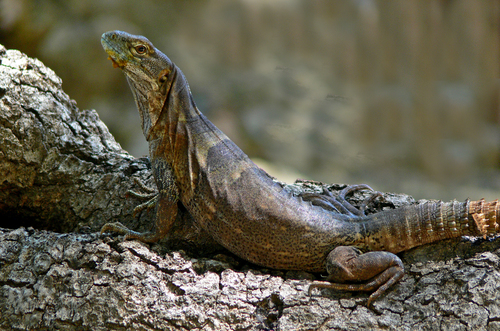
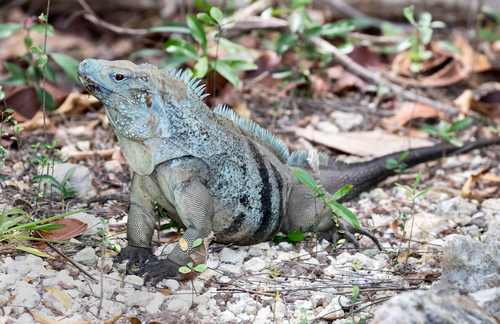
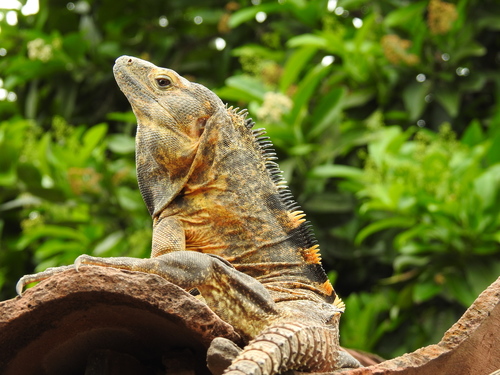
Its dorsal surface is usually brown or grey-brown, while the ventral surface is yellowish.
Dorsal Crest
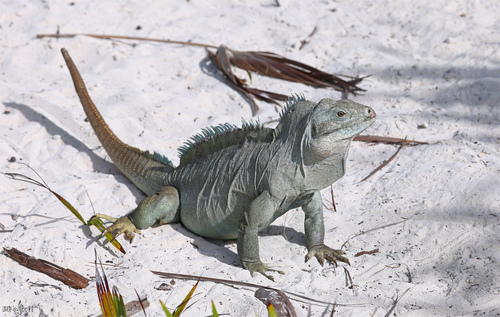
It has a crest of long spines that extends down the center of its back.
Hatchling Coloration
Hatchlings are often bright green with no body pattern, and darken as they age.
Piebald Pattern
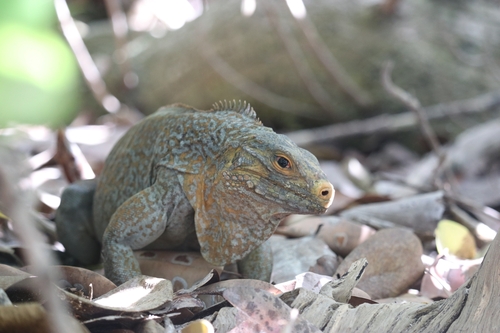
Ctenosaura pectinata often (but not always) has an irregular piebald pattern on the head or dorsal areas.
Crossband Pattern Comparison
While its tail may be banded with light and dark crossbands, C. pectinata typically lacks a clear or well-developed crossband pattern on the body, a pattern that is often present in the similar-looking and closely related species Ctenosaura similis and Ctenosaura acanthura.
Adult Body Color Variation
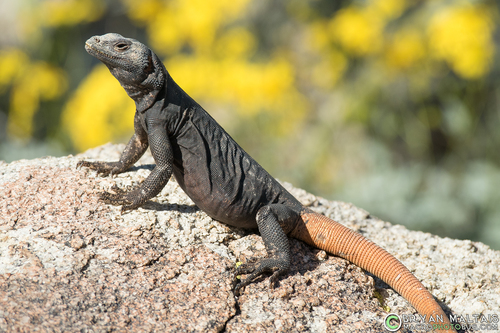
Ctenosaura pectinata's body color ranges from gray to brownish-black; some males have yellowish coloring, and females have orange coloring, on the lateral sides of the body.
Juvenile Markings
Young individuals are bright green and unmarked, except for black tail bands that are also present on adults.
Native Range in Mexico
C. pectinata is native to the coastal lowlands of western Mexico, ranging from Sinaloa to extreme western Chiapas.
Inland Distribution in Mexico
It extends through many valleys and canyons into lower elevations of the Sierra Madre Occidental and Sierra Madre del Sur, including extensive areas of the Rio Balsas Basin.
Introduced Populations in the US
This iguana has been introduced to Brownsville, Texas and South Florida, and has reproducing feral populations in the wild in multiple locations.
Southeastern Florida Range
On the southeastern Florida coast, these iguanas have been found on Key Biscayne, in Hialeah, and in Broward County.
Gasparilla Island Population
On the southwestern Florida coast, it has been reported on Gasparilla Island; in December 2007, the population there was estimated to be 12,000 iguanas, descended from pets released by a resident in the 1970s.
Nuisance Impacts on Gasparilla Island
The iguanas are considered a nuisance on Gasparilla Island because they eat ornamental flowers and shrubs, prey on nesting birds and sea turtle eggs, and have been reported to chew through electrical cables.
Burrowing Related Risks
Some residents have speculated that the iguanas' habit of burrowing tunnels in sand could cause dunes and even seawalls to collapse, depriving the island of crucial hurricane protection.
Mating Season
Mating of C. pectinata occurs in spring.
Mating Behavior
Males display dominance and interest through head bobbing, and eventually chase the female until they catch and subdue her.
Nesting and Egg Laying
Within eight to ten weeks after mating, the female digs a nest and lays clutches of up to 50 eggs in a burrow of loose soil.
Egg Incubation and Hatching
The eggs hatch after 90 days, and the bright green hatchlings dig their way out of the sand.
Hatchling Appearance Period
Bright green hatchlings first appear around July and are abundant in August.