About Cyclura lewisi Grant, 1940
Common Name and Gigantism
Cyclura lewisi, commonly known as the blue iguana, is an example of island gigantism.
Body Size (Maximum)
It is the largest native land animal on Grand Cayman, reaching a total nose-to-tail length of 5 ft (1.5 m) and weighing up to 30 lb (14 kg), making it one of the largest lizard species in the Western Hemisphere.
Genus Size Ranking
It is the largest species in the Cyclura genus, with a body length of 20–30 in (510–760 mm) and a tail of equal length.
Toe Adaptations
Its toes are specially articulated for efficient digging and tree climbing.
Adult Skin Color (Male and Female)
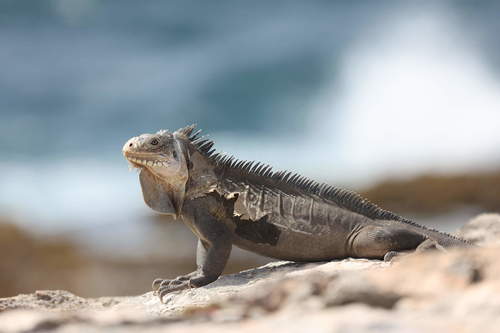
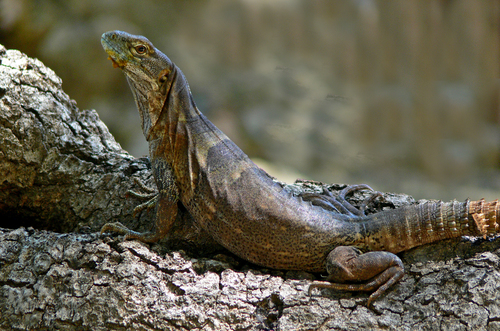
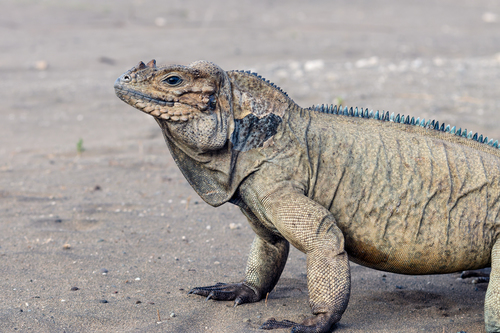
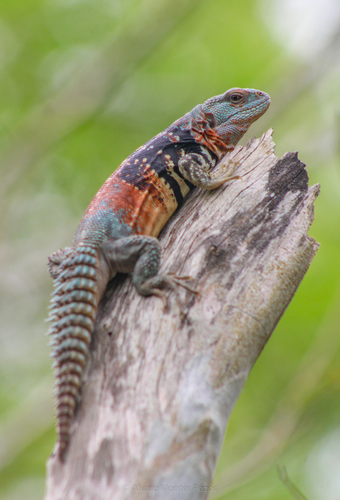
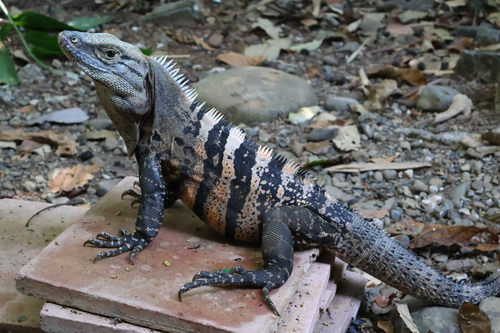
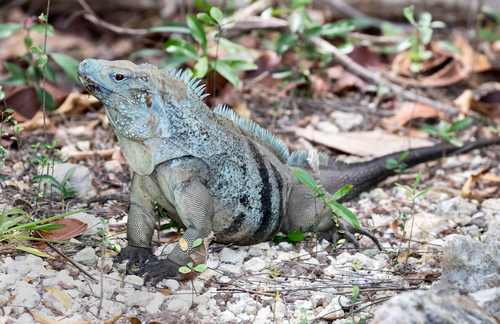
Mature male blue iguanas have skin color ranging from dark grey to turquoise blue, while females are more often olive green to pale blue.
Juvenile Skin Color
Young blue iguanas are typically uniformly dark brown or green with faint darker banding.
Neonatal Dorsal Pattern
When newly hatched neonates first emerge from the nest, they have an intricate pattern of eight dark dorsal chevrons stretching from the neck crest to the pelvic area.
Color Progression with Age
These markings fade by the time the animal is one year old, changing to mottled gray and cream before eventually shifting to blue as the iguana reaches adulthood.
Adult Camouflage Color
Adult blue iguanas are typically dark gray, which matches the karst rock of their native landscape.
Territorial Color Change
They change their color to blue when in the presence of other iguanas to signal and establish territory, and this blue color is more pronounced in males.
Distinctive Foot Color
The species has distinctive black feet that contrast with its lighter overall body color.
Eye Characteristics
Its eyes have a golden iris and red sclera.
Sexual Dimorphism (General Traits)
Blue iguanas are sexually dimorphic: males are larger, with more prominent dorsal crests and larger femoral pores on their thighs, which are used to release pheromones.
Sexual Size Dimorphism (Quantitative)
Males are one third larger in body size than females.
Endemic Range
The blue iguana is endemic to the island of Grand Cayman.
2012 Distribution Range
As of 2012, the species' population is found across Grand Cayman, excluding the urban areas of Bodden Town, Gun Bay, Seven Mile Beach, and West Bay.
Colonization Hypothesis
One hypothesis for how the species arrived on the island is that a single gravid female Cuban iguana (C. nubila nubila) drifted across the sea to Grand Cayman, possibly during a storm.
Sympatric Congener Occurrence
The Lesser Caymans iguana (C. nubila caymanensis) is occasionally found on Grand Cayman.
Historical Coastal Population Loss
Comparison with other Cyclura species in the region strongly suggests that coastal blue iguana populations once existed, but were gradually displaced or extirpated by human settlement and road construction.
Current Habitat Types
Currently, blue iguanas only occur inland in natural xerophytic shrubland, and along the interfaces between farm clearings, roads, gardens, and closed-canopy dry forest or shrubland.
Agricultural Habitat Association and Risks
Inland populations are thought to have been attracted to agricultural clearings and fruit farms, which provide opportunities for thermoregulation, herbaceous food, fallen fruit, and nesting soil, but this exposure has brought blue iguanas into contact with humans and feral animals.
Nesting Migration
Females often migrate to coastal areas to build nests.
Home Range Study Context
In 2004, blue iguanas released into the Queen Elizabeth II Botanic Park on Grand Cayman were radiotracked to measure each animal's home range.
Home Range Size (Sex-Specific)
The study found that females occupied territories of 0.6 acres (2,400 m2), while males occupied an average of 1.4 acres (5,700 m2), with overlapping common territories.
Population Density
This indicates that blue iguanas maintain a population density of four to five animals per hectare.
Shelter Use and Terrestriality
Blue iguanas occupy rock holes and tree cavities; adults are primarily terrestrial.
Climbing Behavior
While the species is not known to be arboreal, individuals have been observed climbing trees 15 feet (4.6 m) and higher.
Juvenile Arboreality
Younger individuals tend to be more arboreal.
Diurnal Activity Pattern
Blue iguanas spend very little of their daytime in a retreat, and only retreat for the day at the end of daylight hours.
Mating Season
Mating takes place from May through June.
Pre-Copulation Male Behavior
Before copulation, the male performs numerous head-bobs, then circles behind the female and grasps the nape of her neck.
Copulation Positioning
He then attempts to restrain the female to maneuver his tail under hers to position himself for copulation.
Copulation Duration and Frequency
Copulation typically lasts 30 to 90 seconds, and a pair is rarely observed mating more than once or twice per day.
Clutch Characteristics
Females lay a clutch of 1 to 21 eggs, usually in June or July, with clutch size depending on the female's size and age.
Nest Site Selection
Eggs are laid in nests excavated in pockets of earth exposed to the sun.
Nest Excavation Behavior
Females begin several exploratory nests before completing a final nest.
Nest Burrow Structure
These nesting burrows range from 16 inches (0.41 m) to over 60 inches (1.5 m) in length, with an enlarged chamber at the end that allows the female to turn around.
Incubation Conditions
In monitored nests, the internal temperature remained a constant 32 °C (90 °F) throughout the incubation period, which lasts 65 to 90 days.
Egg Size
The eggs of the blue iguana are among the largest laid by any lizard species.
Territoriality Onset
Blue iguanas are aggressively territorial starting from around three months of age.
Captive Sexual Maturity Age
In captivity, they typically reach sexual maturity after four years of age.