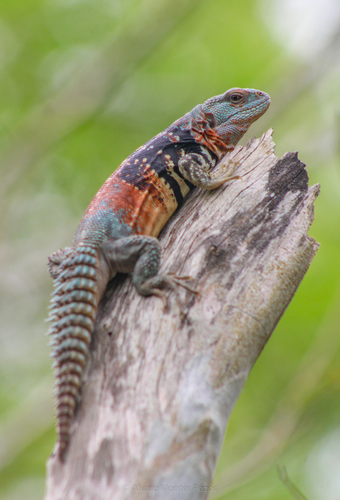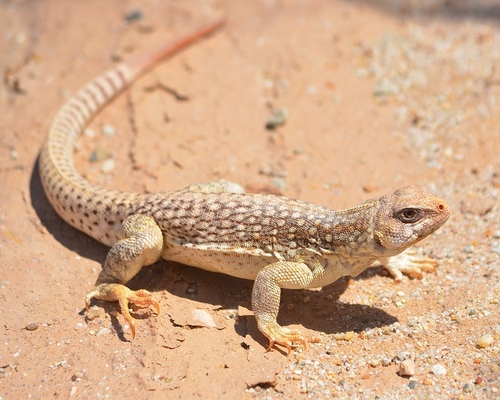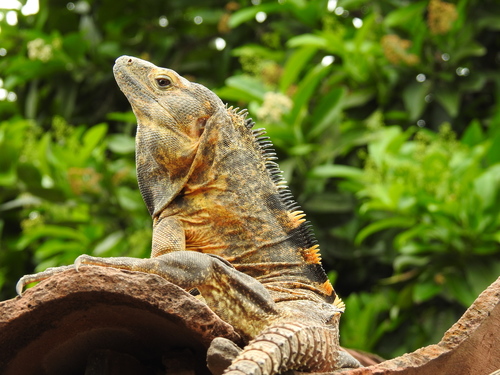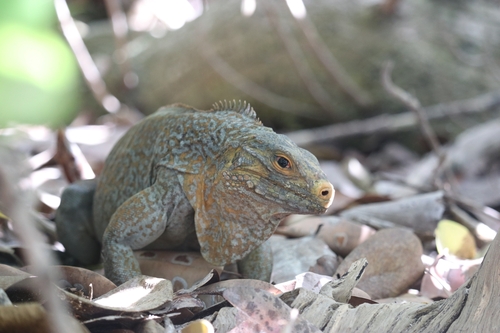
About Ctenosaura hemilopha (Cope, 1863)
Juvenile Coloration
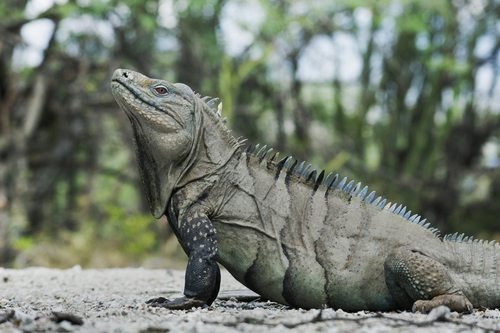
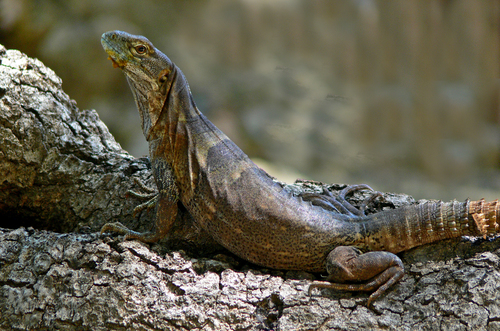
The cape spinytail iguana, Ctenosaura hemilopha, is green or yellow when young, and becomes whitish gray as it ages.
Adult Coloration
Mature individuals may be white or light gray with black chevron markings, and their color can change based on heat conditions or the individual's temper.
Size
Males reach a maximum total length of 100 centimeters (39 inches), while females are typically 30% smaller, reaching 70 centimeters (28 inches).
Sexual Dimorphism
Males grow large jowls and a dorsal crest composed of larger dorsal spines, making this species sexually dimorphic.
Introduction Origin Theory
One theory holds that cape spinytail iguanas were brought to the Baja peninsula and its nearby islands by early Seri Indian inhabitants thousands of years ago, who transported them from the mainland as a food source.
Origin Theory Supporting Evidence
This theory is supported by the observation that the species' mainland coastal distribution ends 115 kilometers south of Isla San Esteban.
Coexistence with Chuckwallas
Contrary to predictions from ecological niche theory, this species coexists with the giant San Esteban chuckwalla on San Esteban Island.
Foraging Niche Overlap
The two species forage for the same plants in the same habitat, at the same time of day, and during the same season, with neither species displacing the other.
Den Sites
Cape spinytail iguanas make their dens in old woodpecker nests inside giant columnar cacti, as well as in other tree cavities.
Den Site Selection Factors
The most important factors for a lizard choosing a cactus as a den site are the presence of other existing holes and the height of the cactus, as these refuges let lizards feed and bask on the cactus while minimizing predation risk.
Research Value
The existence of both mainland and island populations of this species has been valuable for biologists, who use these groups as study and control groups to compare the evolution of island populations.