About Cyclura carinata Harlan, 1824
Adult Size
When fully grown, the Turks and Caicos Rock iguana measures less than 770 millimetres (30 in) in length, making it one of the smallest species in the genus Cyclura.
Base Coloration
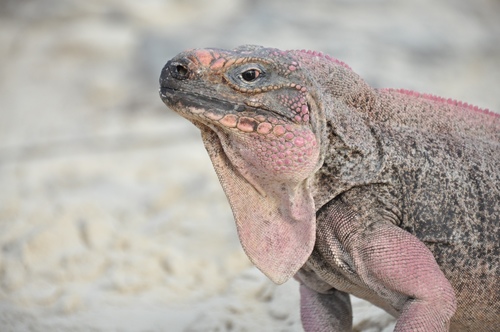
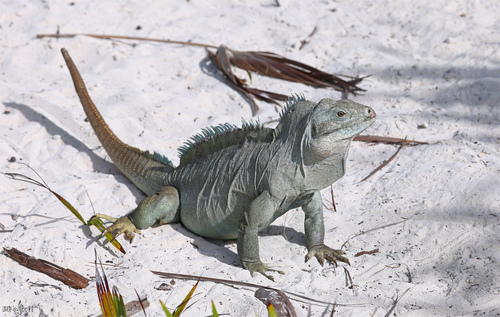
Its base body color ranges from green to brownish grey, and is usually marked with darker patterned markings.
Scale and Spine Morphology
Unlike other Cyclura species, this species does not have large scales on the upper surface of its head, and it has larger dorsal spines than other iguana species.
Sexual Dimorphism
Like other members of the genus Cyclura, this species is sexually dimorphic: males are larger than females, with twice the body mass of females, and also have larger dorsal crests and larger femoral pores on their thighs.
Primary Habitat Type
In terms of habitat and distribution, the Turks and Caicos rock iguana inhabits small cays.
Current Range Reduction
Due largely to the introduction of predators, its current range has been reduced to less than 5% of its original range.
Little Water Cay Population
Only 2,000 iguanas, the only land creatures, inhabit Little Water Cay.
Little Water Cay Tourism Measures
A boardwalk has been built across Little Water Cay to support tourism; tourists may walk the island tour along this boardwalk, but are not allowed to step off it.
Nesting Habitat Requirement
The Turks and Caicos rock iguana lives in rocky areas and sandy habitats, as sand is required for it to nest.
Activity Pattern and Shelter
This iguana is diurnal, and spends its nights in burrows it digs itself or in natural retreats within or under rocks.