About Colibri coruscans (Gould, 1846)
Species Classification and Size
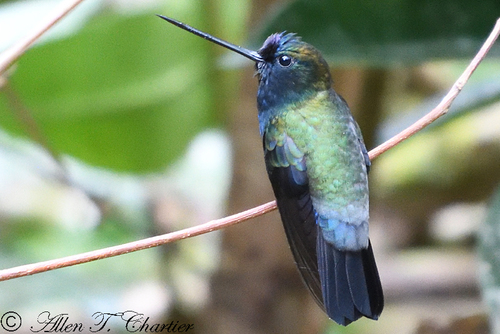
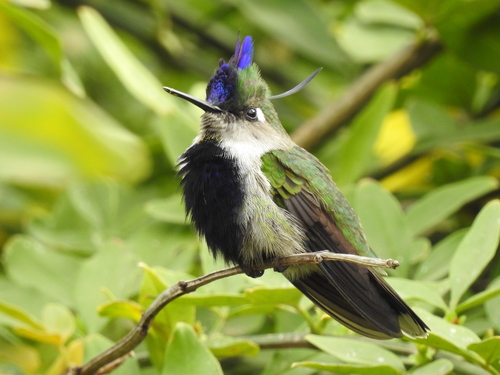
Colibri corcens, commonly called the sparkling violetear, is the largest species in the violetear group. It measures 13 to 14 cm (5 to 5.5 in) in total length. Males weigh between 5.8 and 8.5 g (0.20 to 0.30 oz), while females weigh between 6 and 7.5 g (0.21 to 0.26 oz).
Nominate Subspecies Male Plumage
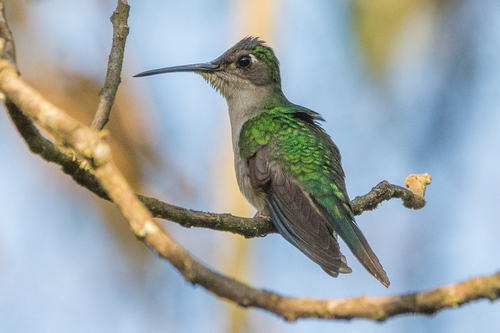
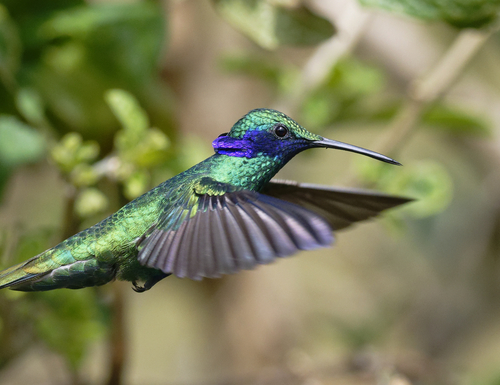
For the nominate subspecies, mature males have metallic bluish green upperparts, a bluish violet chin, a blue belly, and green underparts on the remaining areas. They have long, erectile bluish violet plumes that cover their ears, and a metallic green tail with a steely blue band near the tip.
Nominate Subspecies Female Plumage
Females have a similar appearance to males but are smaller in size, and often have a white spot behind the eye.
C. c. germanus Plumage Differences
The subspecies C. c. germanus is nearly identical to the nominate subspecies, except its forehead, underparts, and tail are somewhat more blue in color.
Nominate Subspecies Distribution
The nominate subspecies of sparkling violetear has a wide distribution. It occurs in Venezuela's Sierra de Perijá, Colombia's Sierra Nevada de Santa Marta, and the Andes mountain range that runs from Venezuela through Colombia, Ecuador, Peru, and Bolivia to northern Chile and northwestern Argentina.
C. c. germanus Distribution
C. c. germanus is found on the tepuis of southern Venezuela, western Guyana, and the adjacent Brazilian state of Roraima.
Habitat and Elevation
The species lives in a variety of open landscapes, including edges of subtropical and temperate forest, woodland, gardens, city parks, and páramo. Most individuals of the species are found at elevations between 1,000 and 4,500 m (3,300 to 14,800 ft).