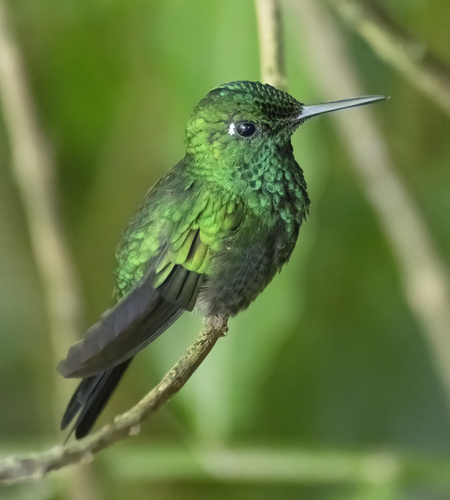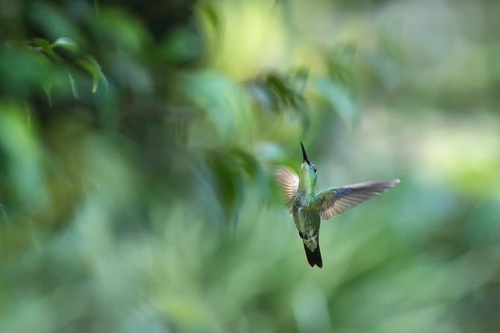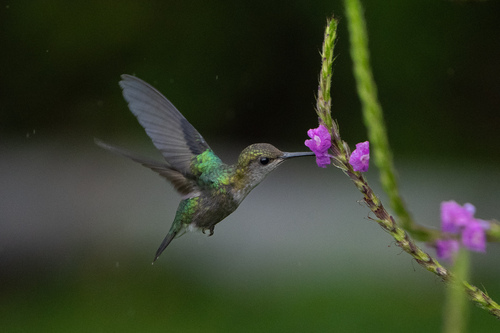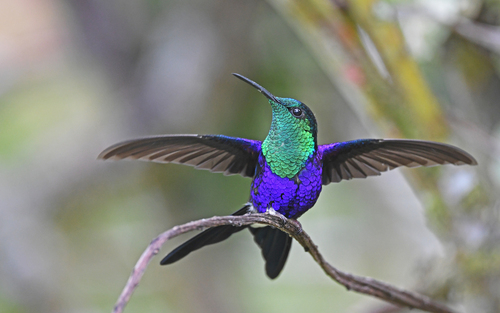
About Myrtis fanny (R.Lesson, 1838)
Nomenclature and Taxonomic History
Myrtis fanny, commonly known as the purple-collared woodstar, was first described by R. Lesson in 1838.
Size
The purple-collared woodstar measures 7.5 to 8 cm (3.0 to 3.1 in) in length and weighs 2.3 to 2.5 g (0.081 to 0.088 oz).
Shared Morphological Traits
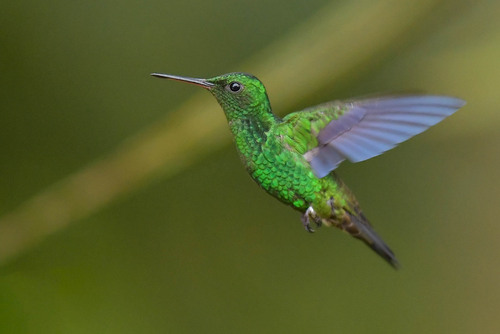
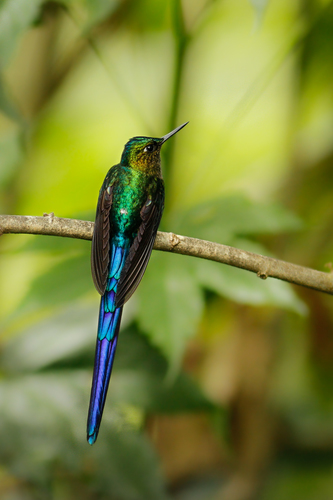
Both sexes have a short, decurved black bill, and their upperparts are bronze-green.
Male Plumage and Gorget
Males have an iridescent aquamarine gorget with a shiny violet band just below it.
Male Underparts and Tail
The remainder of a male's underparts are dirty white, and its long forked tail is dusky brown with a light green gloss.
Female Underparts
Females have buff underparts with a small amount of white on the throat and belly.
Female Tail Structure and Coloration
A female's tail is short and rounded: the central pair of tail feathers are blue-green, the next pair are blue-green with black tips, and all remaining tail feathers are black with white tips.
Subspecies Distinction
The species has two subspecies that are generally similar, differing only in that M. f. megalura has a longer tail.
Nominate Subspecies Distribution
The nominate subspecies of purple-collared woodstar occurs in western and southern Ecuador and western Peru, extending as far south as Arequipa Department.
M. f. megalura Distribution
M. f. megalura occurs in northern Peru, ranging from Cajamarca south to Huánuco.
Habitat
The purple-collared woodstar lives in open landscapes including dry coastal scrub, open woodlands, and gardens.
Elevational Range
It can be found at elevations between sea level and 3,000 m (9,800 ft); in Ecuador, however, it occurs mostly between 1,000 and 2,000 m (3,300 and 6,600 ft).