About Riccordia ricordii (Gervais, 1835)
Common Name and Sexual Size Dimorphism
Riccordia ricordii, commonly known as the Cuban emerald, has distinct size differences between males and females.
Length Measurements
Males measure 10.5 to 11.5 cm (4.1 to 4.5 in) in length, while females measure 9.5 to 10.5 cm (3.7 to 4.1 in).
Weight
The full species weighs between 2.5 and 5 g (0.088 and 0.18 oz).
Male Bill Structure
Males have a short, slightly decurved bill with a black tip; the mandible is dull black, and the maxilla is red.
Male Facial Markings
Males have a small whitish spot behind the eye.
Male Upperparts Coloration
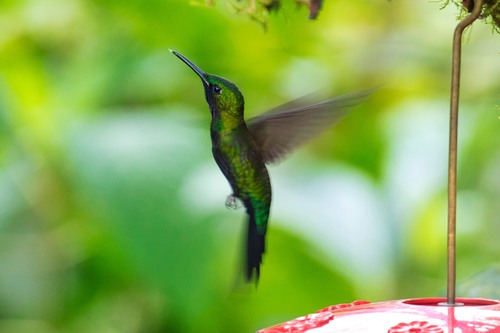
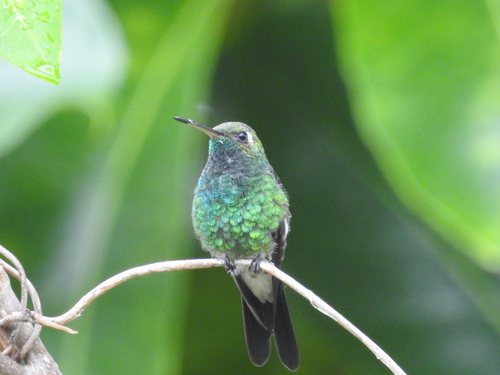
Their upperparts are dark shining green with a bronze tinge, and the crown is darker and duller.
Male Underparts Coloration
Their underparts are mostly iridescent metallic green, with white undertail coverts.
Male Tail Structure and Coloration
The male tail is deeply forked: the innermost four pairs of tail feathers are dark metallic bronze to greenish bronze, and the outermost pair has a similar color with dark brown inner webs.
Female Upperparts Coloration
Female upperparts are similar to those of males.
Female Facial Markings
Females have a longer whitish spot behind the eye.
Female Underparts Coloration
Their underparts are mostly brownish gray, with metallic green flanks and white undertail coverts.
Female Tail Structure and Coloration
The female tail is less forked than the male's, but has the same coloration.
General Distribution Range
The Cuban emerald is distributed across Cuba and the Bahamas.
Cuban Range Details
It occurs on Cuba's main island, the large Isla de la Juventud (also called the Isle of Pines), and several smaller offshore cays of Cuba.
Bahamian Range Details
In the Bahamas, it is regularly found on Grand Bahama, Great Abaco, Andros, and Green Cay, and occasionally occurs as a stray on other Bahamian islands.
Habitat Types
This species inhabits a wide variety of wooded habitats.
Regional Habitat Specifics
On mainland Cuba, it mostly occurs in both arid and humid open forest; on Grand Bahama, it occurs in pine woods and coastal scrub forest.
Anthropogenic Habitats
It can also be found in parks, gardens, and plantations.
Elevation Range
In terms of elevation, it ranges from sea level to at least 1,300 m (4,300 ft), and there are records of individuals at almost 2,000 m (6,600 ft) on Cuba.