About Doryfera johannae (Bourcier, 1847)
Scientific Name and Length
The blue-fronted lancebill, scientifically named Doryfera johannae (Bourcier, 1847), is 9.6 to 11 cm (3.8 to 4.3 in) long.
Weight
Males weigh 3 to 5 g (0.11 to 0.18 oz), while females weigh 3.3 to 6 g (0.12 to 0.21 oz).
Bill Characteristics
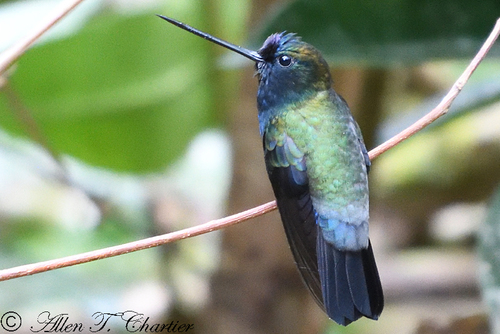
Both sexes have a long straight to slightly upcurved bill, and they often hold this bill at an upward angle.
Nominate Male Plumage
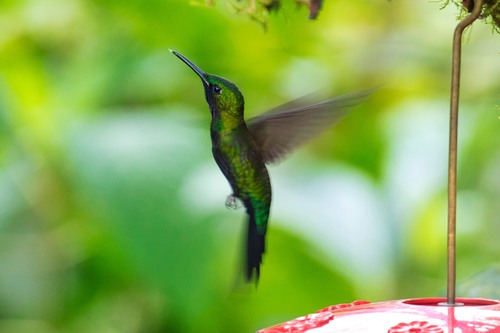
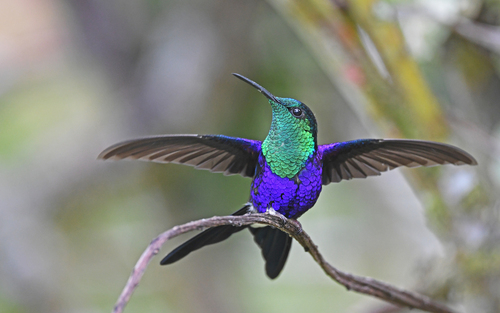
Males of the nominate subspecies have a violet forehead (or "front"), a bronze nape, and dark bronzy green upperparts across the rest of the body. Their tail is short and blue-black, and their underparts are blue-black with a bluish green gloss on the throat and breast.
Nominate Female Plumage
Females differ from males by having a greenish blue forehead and dull grayish bronzy green underparts.
D. j. guianensis Subspecies Traits
Both sexes of the D. j. guianensis subspecies have a shorter bill than the nominate subspecies, and are overall paler while sharing the same general color pattern.
Nominate Subspecies Distribution
The nominate subspecies of blue-fronted lancebill is distributed on the east slope of the Andes, from east central Colombia south through eastern Ecuador to central and southeastern Peru.
Nominate Subspecies Habitat
It inhabits wet forests on lower Andean slopes, Andean foothills, and the adjacent lowlands. It favors ravines, gorges, and rock outcroppings, and usually occurs from the forest's middle strata into the lower canopy, though it can also be found as low as the shrub level at forest edges.
Nominate Subspecies Elevation Range
In terms of elevation, it mostly ranges between 800 and 1,200 m (2,600 and 3,900 ft).
D. j. guianensis Distribution
D. j. guianensis is found in a disjunct distribution across southeastern Venezuela, western Guyana, and extends slightly into adjoining northern Brazil.
D. j. guianensis Habitat and Elevation
It inhabits tropical and subtropical forests on the tepuis of this region, mostly at elevations between 900 and 2,000 m (3,000 and 6,600 ft), and does not occur in the lowlands between these tepuis.