About Coeligena iris (Gould, 1853)
Species and Length
The rainbow starfrontlet (scientific name Coeligena iris (Gould, 1853)) is 12.5 to 14 cm (4.9 to 5.5 in) long.
Weight
Males weigh 6.7 to 8.8 g (0.24 to 0.31 oz), while females weigh 6 to 8.1 g (0.21 to 0.29 oz).
Bill Morphology
Both sexes have a long, straight, black bill; the female's bill is somewhat longer than the male's.
Head and Tail Morphology
Both sexes also have a white spot behind the eye and a forked tail, with the male's tail more deeply indented than the female's.
Subspecies Plumage Variation Overview
The species' subspecies differ significantly in plumage.
Nominate Male Forecrown and Crown
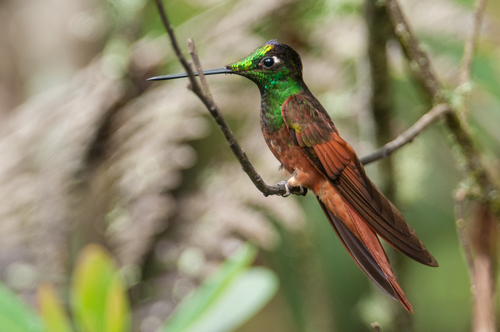
Males of the nominate subspecies (C. i. iris) have a glittering yellow-green forecrown that transitions through golden yellow to blue on the crown.
Nominate Male Upperparts
Most of their upperparts are blackish with a green sheen, and the lower back and rump are chestnut.
Nominate Male Throat and Chest
Their throat and chest are glittering emerald green, with a small violet spot on the throat.
Nominate Male Lower Body and Tail
The belly, undertail coverts, and tail are chestnut.
Nominate Female and Juvenile Plumage
Nominate females are generally similar to males but have less of a metallic sheen, and juveniles are similar to adult females.
C. i. hesperus Plumage
Males of subspecies C. i. hesperus have a dark golden-red crown with a blue stripe, a golden green back, green underparts with a violet throat spot, and bronzy tips on the chestnut tail feathers; females of this subspecies are a duller version of the male.
C. i. aurora Male Plumage
Males of C. i. aurora have a turquoise crown with golden-tipped feathers, a black hindneck, and light chestnut upperparts.
C. i. aurora Female Plumage
Their chin and throat are turquoise, and the rest of their underparts are light chestnut; females are a duller version of the male.
C. i. flagrans Plumage
C. i. flagrans is similar to the nominate subspecies but has a coppery hindneck and back.
C. i. fulgidiceps Plumage
C. i. fulgidiceps is also similar to the nominate but has a blackish neck and upper back, and darker chestnut underparts.
C. i. eva Male Plumage
Males of C. i. eva have a yellowish green forecrown, a dark violet crown, and a coppery hindneck and back.
C. i. eva Male Underparts
Their chin, throat, and breast are emerald green, and the rest of their underparts are chestnut.
C. i. eva Male Throat Feature
Unlike the other subspecies, they do not have a violet throat patch.
C. i. eva Female Plumage
The female of C. i. eva has a coppery green head and lighter underparts than the male.
Subspecies Distribution Overview
The six subspecies of rainbow starfrontlet have the following distributions: C. i. hesperus is found in Chimborazo and Azuay provinces of southwestern Ecuador; C. i. iris ranges from Azuay Province in Ecuador into the Department of Piura in northern Peru; C. i. aurora occurs in central and eastern Cajamarca Department in northwestern Peru; C. i. flagrans lives on the western slope of the western Andes in Cajamarca Department, Peru; C. i. eva is found on the eastern slope of northern Peru's western Andes, west of the Marañón River; C. i. fulgidiceps occurs in Peru east of the Marañón River, in southern Amazonas Department.
Habitat
The rainbow starfrontlet inhabits humid and semi-humid cloudforest edges, gardens, and riparian scrub.
Elevation Range
It generally occurs at elevations ranging from 1,700 to 3,300 m (5,600 to 10,800 ft), but has been recorded as high as 4,000 m (13,000 ft) in Huascarán National Park, northern Peru.