About Chrysolampis mosquitus (Linnaeus, 1758)
Size and Weight
The ruby-topaz hummingbird (Chrysolampis mosquitus) measures 8 to 9.5 cm (3.1 to 3.7 in) in length and weighs 2.5 to 5 g (0.09 to 0.18 oz). It has an almost straight, black bill that is relatively short compared to the bills of most other hummingbirds.
Male Plumage
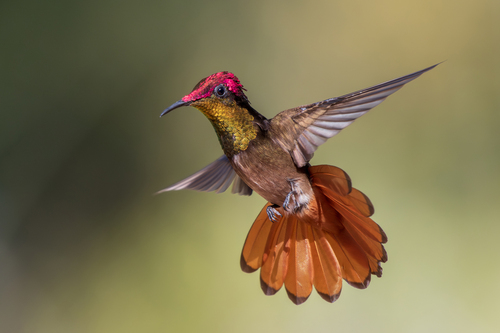
Males have dark brown upperparts with an olive gloss, a glossy ruby red crown and nape, and usually iridescent golden (sometimes emerald green) throat and breast. The rest of their underparts are brown, and their chestnut tail has black tips.
Female Plumage
Females have bronze-green upperparts and pale grey underparts. Their tail is mostly chestnut with a dark subterminal band and a white tip, and the central tail feathers are olive green.
Trinidad and Tobago Female Variation
Females native to Trinidad and Tobago sometimes have a greenish throat-streak that can appear dark.
Juvenile Plumage
Juvenile females are similar in appearance to adult females, but have a white-tipped dusky-brown tail. Juvenile males resemble juvenile females, but have a variable amount of iridescent orange on the throat.
Core Distribution Range
This hummingbird species is distributed from eastern Panama east through northern Colombia, Venezuela, and the Guianas into northeastern Brazil. From this area, its range extends through central and eastern Brazil as far south as Mato Grosso, and westward into eastern Bolivia.
Additional Distribution Locations
In Colombia, its range extends southward between the three Andes ranges; the species is also found in the ABC Islands and Trinidad and Tobago.
Vagrant Records
It has been recorded as a vagrant in Argentina and Peru, and there is at least one unconfirmed sight record from Paraguay.
Habitat
The ruby-topaz hummingbird lives in the interior and edges of open savanna-like landscapes and shrubby arid hillsides, and it also occurs in gardens and cultivated areas.
Elevation Range
It is mostly found at elevations below 500 m (1,600 ft), but can occur as high as 1,700 m (5,600 ft).