About Thalurania furcata (J.F.Gmelin, 1788)
Species Common Name
Thalurania furcata, commonly called the fork-tailed woodnymph, has the following physical description.
Size and Weight
Males are 9.5 to 12.9 cm (3.7 to 5.1 in) long and weigh 3.6 to 6 g (0.13 to 0.21 oz), while females are 8 to 10.7 cm (3.1 to 4.2 in) long and weigh 3 to 5 g (0.11 to 0.18 oz).
Bill Morphology
All subspecies of both sexes have a straight, black, medium-length bill.
Nominate Male Upperparts
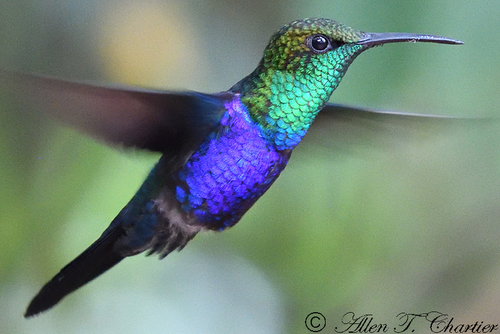
Adult males of the nominate subspecies have mostly dark bronzy green upperparts, a dark dusky bronze crown and nape, and a violet band across the upper back.
Nominate Male Underparts
Their throat is glittering green, their belly is violet, and their undertail coverts are dark steely blue with dull white edges.
Nominate Male Tail
They have a forked, blue-black tail.
Nominate Female Morphology
Nominate adult females have bright green upperparts with a duller, more bronze crown, pale gray underparts, and a tail that is green near the base and steely blue-black on the rest, with white tips on the outer three pairs of feathers.
Juvenile Male Morphology
Juvenile males are dull bronze-green above and dusky bronze-green below.
Juvenile Female Morphology
Juvenile females are more bronzy green above than adults, and some of their feathers have buffy fringes.
Subspecies Similar to Nominate
Subspecies T. f. refulgens and T. f. orenocensis are essentially identical to the nominate subspecies.
T. f. fissilis Male Trait
Males of T. f. fissilis have solid blue undertail coverts.
T. f. nigrofasciata Male Traits
Males of T. f. nigrofasciata have golden-green upperparts, a black band between the extensive green throat and violet belly, and a gap in the violet band on the upper back.
T. f. viridipectus Male Trait
Males of T. f. viridipectus also have a large green gorget with a narrow black band between the gorget and the belly.
T. f. jelskii Traits
T. f. jelskii has a blue tinge on its lower throat and breast, along with an incomplete black band.
T. f. balzani Male Traits
Male T. f. balzani have a green crown and pure white undertail coverts.
T. f. furcatoides Male Traits
Males of T. f. furcatoides are somewhat larger than the nominate and have a blackish crown.
T. f. boliviana Male Traits
Males of T. f. boliviana have a relatively small green gorget and sometimes small black patches in the area where other subspecies have a band.
T. f. simoni Traits
T. f. simoni is very similar to balzani, but has a dark stripe in the center of the vent area and on the undertail coverts.
T. f. baeri and T. f. eriphile Male Traits
Males of T. f. baeri and T. f. eriphile have glittering green foreheads and blackish crowns.
Subspecies Female Variation
Females of different subspecies differ mainly in the darkness of their gray underparts and sometimes their undertail coverts; their crowns and upperparts differ in much the same way as those of the corresponding males of each subspecies.
Subspecies Distribution Introduction
The subspecies of fork-tailed woodnymph are distributed as follows: T. f. refulgens is found on Paria Peninsula and in Sierra de Cumaná of northeastern Venezuela; T. f. furcata ranges from extreme eastern Venezuela through the Guianas to northeast Brazil north of the Amazon; T. f. fissilis occurs in southeastern Venezuela, extreme western Guyana, and Roraima in northern Brazil; T. f. orenocensis lives in the upper Orinoco basin of southern Venezuela; T. f. nigrofasciata is found in Colombia's Guainía Department, southern Venezuela's Amazonas state, and the upper Rio Negro in northwestern Brazil; T. f. viridipectus ranges across eastern Colombia, eastern Ecuador, and northeastern Peru; T. f. jelskii occurs in eastern Peru and adjoining western Brazil; T. f. simoni is found south of the Amazon in extreme eastern Peru and western Brazil; T. f. balzani occurs in north-central Brazil south of the Amazon, east to the Rio Tapajós; T. f. furcatoides is found in eastern Brazil south of the Amazon, east of the Tapajós; T. f. boliviana ranges from southeastern Peru through east-central Bolivia into Santa Cruz Department; T. f. baeri occurs across northeastern and central Brazil to southern Bolivia and northwestern and north-central Argentina; T. f. eriphile ranges from southeastern Brazil from Bahia south into Paraguay and northeastern Argentina's Misiones Province.
Habitat Types
The fork-tailed woodnymph inhabits a variety of landscapes within Amazonia.
Forest and Edge Habitat
It occurs in terra firme and várzea forests, especially at their edges and gaps; it also lives in mature secondary forest and semi-open areas such as plantations and gardens.
Scrubland Habitat
It is thought to also inhabit some scrublands, but supporting data are lacking.
Elevation Range
In terms of elevation, it ranges from sea level to about 2,000 m (6,600 ft).