About Calliphlox amethystina (Boddaert, 1783)
Taxonomy and Basic Measurements
The amethyst woodstar (Calliphlox amethystina), described by Boddaert in 1783, measures 6 to 8.4 cm (2.4 to 3.3 in) in length and weighs 2.5 to 3.2 g (0.088 to 0.11 oz).
Bill Structure
Both sexes have a medium-length, straight, black bill.
Upperpart Coloration
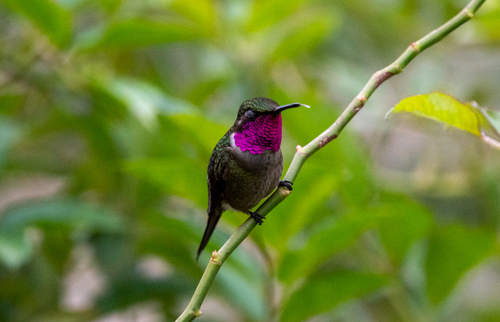
Their upperparts are dark bronzy green, with a large white spot on each side of the rump.
Facial Markings
Males have a small white spot behind the eye, while females have a thin white stripe there.
Breeding Male Gorget
Breeding-plumage males have an iridescent amethyst gorget with a whitish band below it.
Breeding Male Underparts
The rest of their underparts are greenish, with brownish lower flanks.
Breeding Male Tail
Their deeply forked tail is purplish black, with green tips on the feathers.
Eclipse Male Plumage
Non-breeding (eclipse) plumage males have a pale throat that bears some iridescent disks.
Female Underparts
Females have whitish underparts with a few green spangles on the throat, and rufous flanks and undertail coverts.
Female Tail
Their tail is short and dull green, with a black band near the end and pale feather tips.
Eastern Range Extent
The amethyst woodstar ranges from eastern Colombia, through Venezuela and the Guianas, into most of Brazil (excluding the main Amazon basin) extending south to extreme northeastern Argentina.
Western Range Extent
From there, it ranges west and north into Paraguay, and through Bolivia, Peru, and Ecuador to a small part of southern Colombia.
Habitat Types
It inhabits a wide variety of semi-open to open landscapes, including humid forest borders, forest clearings, savanna, and scrubby woodland.
Avoided Habitat
It avoids the interior of closed forest.
Elevation Range
It occurs at elevations between sea level and 1,500 m (4,900 ft).