About Chlorocebus pygerythrus (F.Cuvier, 1821)
Physical description
Overall Appearance
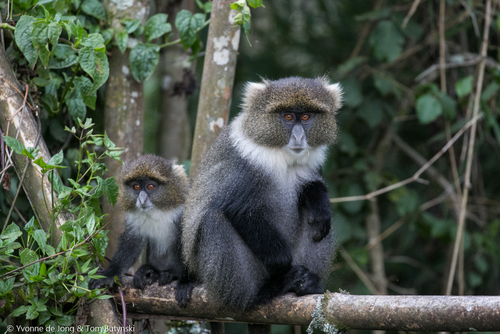
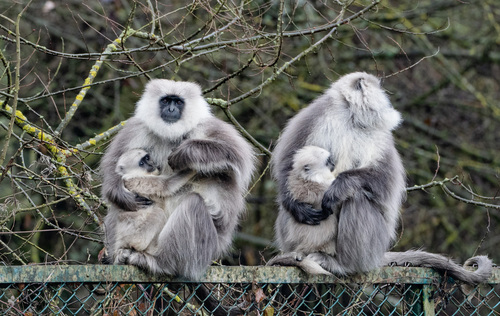
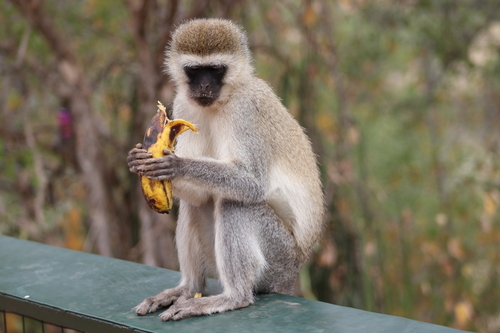
The vervet monkey (Chlorocebus pygerythrus) strongly resembles the gray langur. It has a black face with a white fringe of hair, and its overall body hair is mostly grizzled-grey.
Sexual Dimorphism
This species shows sexual dimorphism: males are larger in both weight and body length, and can be identified by their turquoise-blue scrotum.
Male Measurements
Adult males weigh between 3.9 and 8.0 kg (8.6 and 17.6 lb), with an average weight of 5.5 kg (12 lb). Their head-to-tail-base body length ranges from 420 to 600 mm (17 to 24 in), averaging 490 mm (19 in).
Female Measurements
Adult females weigh between 3.4 and 5.3 kg (7.5 and 11.7 lb), with an average weight of 4.1 kg (9.0 lb). Their body length ranges from 300 to 495 mm (11.8 to 19.5 in), averaging 426 mm (16.8 in).
Natural habitat
Geographic Range
Vervet monkeys range across most of Southern and East Africa, occurring from Ethiopia and extreme southern South Sudan all the way south to South Africa. They are not found west of the East African Rift or the Luangwa River, where they are replaced by the closely related malbrouck, C. cynosuros.
Preferred Ecosystems
Vervet monkeys inhabit savannas, riverine woodlands, coastal forests, and mountains up to 4000 m (13,100 ft) in elevation.
Adaptability to Modified Habitats
They are highly adaptable and can survive in secondary and/or heavily fragmented vegetation, including cultivated areas. They are sometimes found living in both rural and urban environments.
Population Metrics
Observed annual home ranges can reach sizes as high as 176 ha, with an average population density of 54.68 individuals per square kilometer.
Reproduction
Estrus and Social Behavior
Female vervet monkeys do not have external physical signs that indicate estrus, so elaborate social behaviors linked to reproduction do not occur in this species.
Breeding Cycle
Typically, a female gives birth once per year, between September and February, after a gestation period of around 165 days. Usually only one infant is born at a time, though twins occur rarely.
Newborn Characteristics
A healthy newborn vervet monkey weighs between 300 and 400 grams (11 to 14 oz).