About Mandrillus sphinx (Linnaeus, 1758)
General Body Morphology
Mandrills (Mandrillus sphinx) have stocky bodies, large heads and muzzles, and short, stumpy tails. Their limbs are evenly proportioned, and their fingers and toes are more elongated than those of baboons, with a more opposable big toe on the feet.
Sexual Dimorphism Overview
This species is both the most sexually dimorphic primate and the largest monkey. Females are less stocky than males and have shorter, flatter snouts.
Adult Size Measurements
For males, head-body length measures 70–95 cm (28–37 in) and body weight is 19–30 kg (42–66 lb); for females, head-body length is 55–70 cm (22–28 in) and weight is 10–15 kg (22–33 lb). Most teeth are larger in males, with canine teeth reaching up to 4.5 cm (1.8 in) long in males and 1 cm (0.39 in) long in females.
Tail Length
Both sexes have tails 7–10 cm (2.8–3.9 in) long.
Coat and Facial Hair
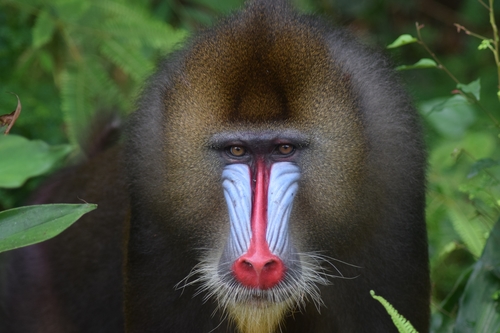
The mandrill's coat is primarily grizzled or banded olive-brown, with a yellow-orange beard and sparse, light hairs on the underside. Stiff white whiskers surround the lips, and bare white skin is present behind the ears.
Secondary Sexual Hair and Glands
Male mandrills grow a crest of long hairs on the head and neck; both sexes have chest glands covered by long hairs, and the face, rump and genitals have sparse hair.
Facial Skin Coloration
A red line runs down the center of the face, connecting to the red nose; the skin on either side of this line is blue and grooved. In males, the blue facial skin is supported by ridged bone swellings.
Female Facial Coloring Variation
Females have more subdued facial coloring, which varies between individuals, with some showing stronger red and blue hues and others being darker or almost black.
Anogenital Skin Coloration
In males, the rump and areas around the genitals have multi-colored red, pink, blue, and purple skin, with a red penis shaft and violet scrotum; the female's genital and anal areas are red.
Coloration Distinctiveness
Mandrills are among the most colorful mammals. Charles Darwin noted in The Descent of Man that no other mammal is colored as extraordinarily as the adult male mandrill.
Coloration Biological Basis
The species' red coloration comes from blood vessels near the skin surface, while blue color is structural coloration caused by parallel arrangements of collagen fibers. The blue ridges on males contrast with both their red facial coloring and the green foliage of their environment, helping them stand out to other mandrills.
Female Melanin Coloration
The darker, subdued coloring of female faces comes from melanin.
Geographic Range
The mandrill inhabits west-central Africa, including southern Cameroon, mainland Equatorial Guinea (Río Muni), Gabon and parts of the Republic of the Congo. Its range is bounded by the Sanaga River to the north and the Ogooué and Ivindo Rivers to the east.
Range Separation from Drills
The Sanaga River separates mandrills from drills, and the two species do not appear to share habitat.
Primary Habitat Preferences
Mandrills live in tropical rainforests, and generally prefer primary forests over secondary forests. They also occupy patchy gallery forests surrounded by savanna, and travel across grass areas within their forest habitats.
Additional Recorded Habitats
They have also been recorded in mountainous areas, near rivers, and in cultivated fields. They prefer thick bush dominated by perennial plants including gingers, and plants from the genera Brillantaisia and Phaulopsis.
Arboreal Behavior
They mainly stay on the ground, but feed as high up as the canopy. Both mandrills and drills are more arboreal than baboons.
Sympatric Primate Interactions
Mandrills may aggregate or compete with other primates including talapoins, guenons, mangabeys, black-and-white colobuses, chimpanzees, and gorillas.
Alpha Male Mating Success
Dominant (alpha) male mandrills achieve the most mating success. When a male gains alpha status, he develops larger testicles, redder faces and posteriors, more chest gland secretion, and fatter sides and rumps; these physiological changes are at least partially reversed when a male loses dominance.
Male Dominance Visual Traits
A male's blue facial skin maintains more consistent brightness after losing dominance. Higher-ranking males tend to have greater contrast between red and blue facial coloring.
Male Dominance Classification
Dominant males are called "fatted" males due to their fat distribution, while subordinate males are called "non-fatted" males. Canine length correlates with dominance, and males are less likely to sire offspring if their canines are under 30 mm (1.2 in) long.
Secondary Sexual Characteristic Suppression
Competition from other males can suppress the development of secondary sexual characteristics in some individuals. Male mandrills typically establish dominance through vocalizations and facial expressions, rather than fighting.
Mating Season Timing
Most mating occurs during the dry season, and female ovulation peaks between June and September. Receptive females develop sexual swellings on their posteriors, and red facial coloration can communicate a female's age and fertility.
Male Reproductive Detection
Males appear to detect a female's reproductive state using the vomeronasal organ via the flehmen response.
Dominant Male Mate Guarding
Dominant males attempt to monopolize access to females through mate guarding, where they stay with and copulate with a female for days. Dominant males sire most offspring, but cannot monopolize access as easily when many females enter estrus at the same time.
Subordinate Male Reproduction
Subordinate males are more likely to achieve reproductive success if they are closely related to an alpha male.
Female Mating Behavior
Ovulating females tend to allow the brightest colored males to approach and touch their perineum, and are more likely to groom and solicit these males. Females signal willingness to mate by positioning their posterior toward the male.
Copulation Details
Intercourse lasts no more than 60 seconds, with the male mounting the female and making pelvic thrusts.
Gestation and Birth Season
Mandrill gestation averages 175 days, and most births occur between January and March, during the wet season.
Interbirth Intervals
Interbirth intervals range from 184 to 1,159 days, with an average of 405 days, and tend to be shorter for higher-ranking females.
Newborn Characteristics
Infants are born with an average weight of 640 g (23 oz). They are mostly bare-skinned at birth, with some white hair and a tuft of dark hair on the head and along the spine.
Infant Development
Over the following two to three months, they develop their adult hair color on the body, limbs, and head, while their flesh-colored face and snout darken. Dependent infants are carried on their mother's belly.
Weaning Age
Young mandrills are typically weaned at around 230 days old.
Juvenile Sexual Dimorphism Development
Males develop increased sexual dimorphism between four and eight years old, by which point females have already started giving birth. Males begin leaving their horde once they reach six years old.
Adult Size Age Milestones
Females reach adult size around seven years old, while males reach adult size at ten years old.