About Colobus guereza Rüppell, 1835
Species Nomenclature
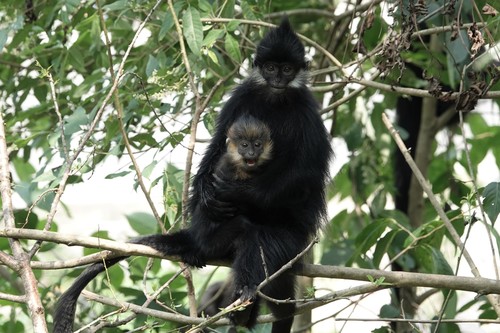
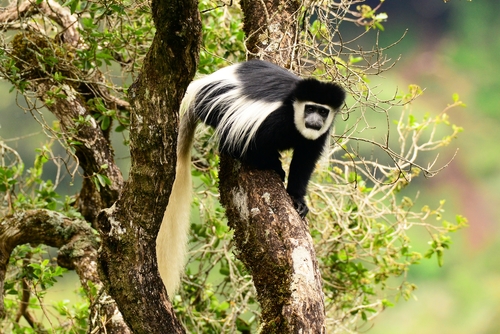
This species, the mantled guereza (scientific name Colobus guereza Rüppell, 1835), has a distinctively patterned coat that is mostly black, with long silky white fringes called a mantle running along the sides of its body and tail.
Mantle Pattern
The mantle bands start at the shoulders, extend along the back, and connect at the lower torso.
Tail Structure
The guereza has a long tail that ends in a white tuft; the proportion of the tail covered by this tuft varies across subspecies. For example, the tail of C. g. guereza is gray until the white tuft, which covers half the tail length, while the white tuft of C. g. caudatus makes up 80% of the tail.
Coat Color Variation
Mantle color can range from white to cream or yellow.
Facial and Limb Markings
The guereza’s face is framed by white hair, and it has bushy cheek hairs, plus a white stripe on the thigh.
Infant Color Development
Infants are born with pink skin and white hair; their skin and hair darken as they age, and they reach full adult coloration by three to four months, with males typically developing adult coloration earlier than females.
Weight
On average, males weigh between 9.3 and 13.5 kilograms (21 to 30 lb), while females weigh between 7.8 and 9.2 kilograms (17 to 20 lb).
Body Length
Average head and body length is 61.5 centimetres (24.2 in) for males and 57.6 centimetres (22.7 in) for females.
Thumb Morphology
Like most colobi, mantled guerezas have a small, vestigial thumb.
Dental Sexual Dimorphism
Subspecies show varying patterns of dental sexual dimorphism: in some subspecies males have larger teeth than females, in others females have larger teeth than males, and some subspecies show no significant size difference between the teeth of males and females.
Geographic Range
The mantled guereza is found across Equatorial Africa, ranging from Nigeria and Cameroon in the west to Ethiopia, Kenya, Uganda, and northern Tanzania in the east.
General Habitat Types
It inhabits both deciduous and evergreen forests, and primarily lives in forests and savannah woodlands, often extending into highland and montane forests.
Additional Habitat Types
It can also occupy other forest types including primary and secondary forests, such as riparian forests near fresh or brackish water, gallery forests, and upland forests.
Elevation Range
It is particularly common in forests near rivers and lakes and at high elevations, and can be found at elevations up to 3,300 metres (10,800 ft).
Habitat Preference
This species prefers secondary forests over old-growth forests when given a choice, likely because secondary forests have more food trees and the plant species there have weaker chemical defenses.
Unusual Habitats
Mantled guerezas are sometimes also found in swamps, and in human-made habitats such as Eucalyptus plantations, which they may visit when they have nutritional deficiencies.
Arboreal Behavior
The mantled guereza is primarily arboreal, but will sometimes descend to the ground to forage and travel, possibly more often than most other colobines.
Activity Cycle
It is diurnal, and rests for up to half of each day; foraging and travelling are the next most common daily activities.
Daily Movement Pattern
After dawn, guereza groups leave their sleeping trees, and return to them again at dusk.
Daily Activity Allocation
The species takes long rest periods between periods of moving and feeding throughout the day, while other activities including grooming, greeting, playing, and vigilance occur less frequently.
Diet Flexibility
Despite a common reputation as an exclusive leaf-eater, the mantled guereza is not an obligate folivore.
Diet Components
While it eats mostly leaves and fruit, its diet is quite variable, and can also include bark, wood, seeds, flowers, petioles, lianas, aquatic plants, arthropods, soil, and even concrete from buildings.
Diet Variation Factors
The proportion of each food type in its diet varies by location and time of year.
Food Choice Drivers
Nutritional factors including protein, tannin, and sodium levels in leaves influence the guereza’s food choices, and it will occasionally travel longer distances to reach plants with higher nutrition levels.
Leaf and Fruit Consumption
Leaves usually make up over half of its diet, though fruit may be eaten more often in some seasons.
Foraging Preference for Leaves
When foraging for leaves, mantled guerezas prefer young leaves over old leaves.
Foraging Preference for Fruit
When feeding on fleshy fruits, they prefer to eat unripe fruits, which may reduce competition with other primates that feed on ripe fruits.
Site-Specific Diet
While the guereza consumes many different plant species, only a small number of these make up most of its diet at any specific site.
Digestive Adaptation
Like all colobi, the mantled guereza can digest leaves and other plant fibers using a large, multi-chambered stomach that hosts specialized bacteria in certain regions.
Food Preference for Fiber
Like most colobines, it prefers foods with high fiber content that its specialized stomach can process easily.
Avian Predators
The mantled guereza’s main predator is the crowned hawk-eagle, but it is also hunted by other birds of prey including Verreaux's eagle.
Mammalian Predators
Common chimpanzees are known to hunt guerezas, and leopards are also counted as possible predators.
Mating System
Mantled guerezas have a polygynous, harem-based mating system.
Mating Solicitation Initiation
Both males and females initiate half of all mating solicitations.
Mating Solicitation Behavior
To solicit mating, an individual will walk near its potential partner and make low-intensity mouth clicks or lip-smacks.
Copulation Behavior
During copulation, the male holds onto the female’s ankles and body.
Mating Partner Origin
Most matings occur between individuals from the same social group, though extra-group copulations have been recorded.
Multi-Male Group Mating
In multi-male groups, more than one male may mate with the group’s females.
Reproductive Timing
The gestation period lasts 158 days, and the interbirth interval is between 16 and 22 months.
Newborn Dependency
Newborn guerezas depend on their mothers for support and must cling to them.
Infant Mobility Development
As they grow older, infants can move independently but still return to their mothers regularly.
Group Attention to Infants
Infants receive most of the attention from other group members.
Allomaternal Care
Other females in a group may handle an infant, though infants are only comfortable with their own mothers.
Male Interaction with Infants
Males usually do not pay much attention to infants until they are four to five weeks old.
Infant Weaning
Infants can eat solid food by around eight to nine weeks of age, and are fully weaned by fifty weeks, at which point they no longer need to cling to their mothers.