About Chelus fimbriata (Schneider, 1783)
Common Name and General Trait
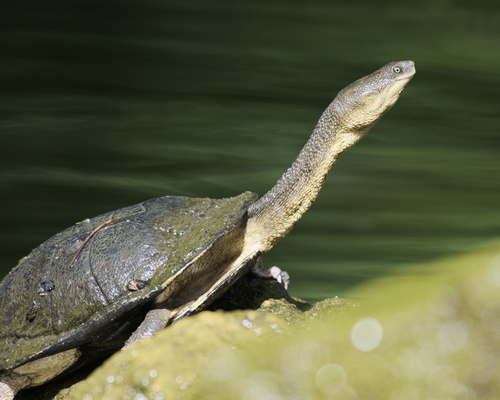
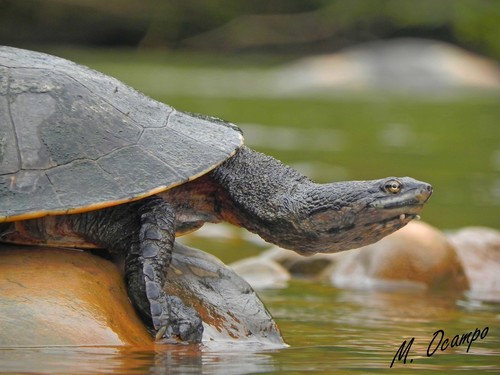
Chelus fimbriata, commonly called the mata mata, is a large, sedentary turtle species.
Head and Snout Features
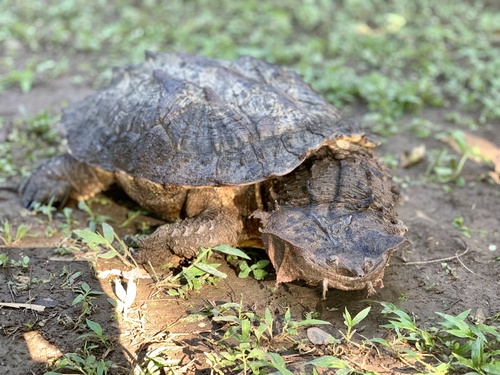
Its key anatomical features include a large triangular flattened head covered in many skin tubercles and flaps, plus a distinct spike on its long tubular snout.
Barbel and Jaw Features
Three barbels grow on the chin, and four more filamentous barbels are present on the upper jaw, which is neither hooked nor notched.
Adult Carapace Size and Weight
Adult mata mata have a brown or black oblong carapace that reaches up to 45 cm (18 in) long, with a full adult weight of 17.2 kg (38 lb).
Plastron Structure
The species' plastron is reduced, narrowed, hingeless, shorter toward the front, and deeply notched at the rear, with narrow bridges.
Camouflage Adaptation
This body shape likely helps the turtle resemble a piece of bark, camouflaging it from potential predators.
Plastron and Bridge Coloration
The plastron and bridges range in color from cream to yellow or brown.
Adult Soft Part Coloration
For adult individuals, the head, neck, tail, and limbs are grayish brown.
Neck Morphology
The mata mata's neck is longer than the vertebra beneath its carapace, and is fringed with small skin flaps along both sides.
Hatchling Coloration
Hatchlings have a pink to reddish tinge along the underside edge of their carapaces and plastrons, which gradually fades as the turtles grow.
Forefoot Structure
Each forefoot has five webbed claws.
Sexual Dimorphism
Males can be distinguished from females by their concave plastrons, and longer, thicker tails.
Geographic Distribution and Habitat Types
Mata mata inhabit slow-moving streams, stagnant pools, marshes, and swamps across northern Bolivia, eastern Peru, eastern Ecuador, southeastern Colombia, the eastern Guianas, and northern and central Brazil.
Aquatic Behavior and Water Preference
This is a strictly aquatic species, and prefers to stand in shallow water where its snout can reach the surface to breathe.
Male Reproductive Display
During reproduction, males display for females by extending their limbs, lunging their heads toward females with their mouths open, and moving the lateral flaps on their heads.
Nesting Period
In the Upper Amazon, nesting takes place from October through December.
Clutch Characteristics
Each clutch contains 12 to 28 brittle, spherical eggs, each 35 mm in diameter.