About Chaetornis striata (Jerdon, 1841)
Overall Appearance
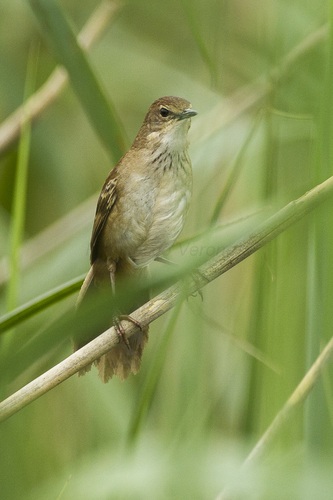
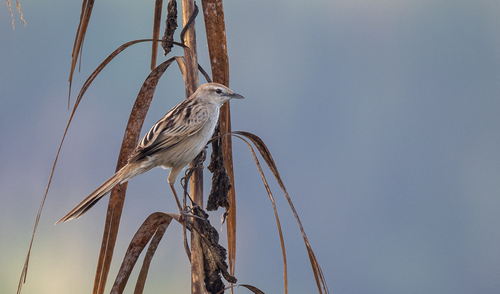
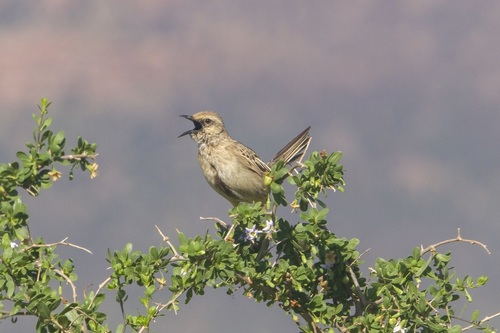
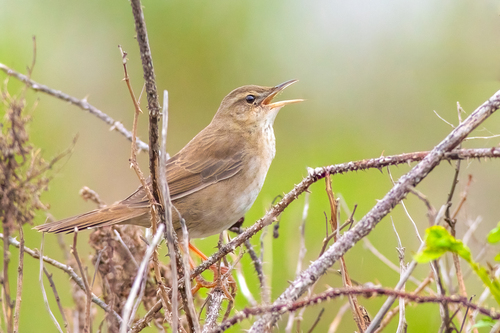
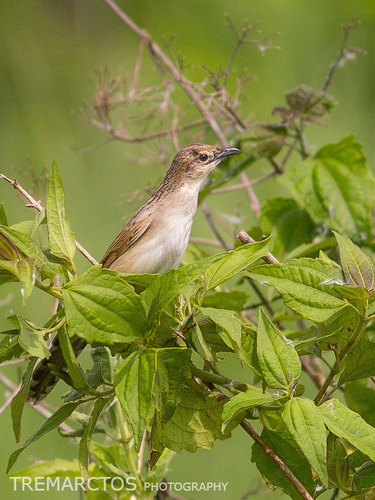
This large brownish warbler has broad dark streaks on the crown and back feathers, and can easily be mistaken for a common babbler due to its babbler-like appearance.
Tail Features
Its tail is graduated, with white tips on the feathers, dark rachis on tail feathers, and dark ribs on the feathers.
Bill and Tarsus
The species has a strong bill: the bill is black, while the lower mandible has a bluish grey tip, and the tarsus is brown.
Head and Underside Markings
It has a buff supercilium (brow) and a pale, unmarked underside.
Initial Taxonomic Placement
This species was originally placed in the genus Chaetornis within the Old World warbler family Sylviidae.
Revised Taxonomic Placement
More comprehensive studies of external morphology and DNA sequences have since led to its placement in the genus Schoenicola within the grass warbler family Locustellidae, where it is a sister species of S. platyurus.
Genus Diagnostic Feature
This genus is distinguished by a bare patch of skin in the lores, the area in front of the eyes.
Rictal Bristle Structure
A vertical row of five stiff rictal bristles arises from this bare patch and faces forward.
Bristle Function Hypothesis
The bare skin is flexible, and it is thought that the bristles protect the bird’s eye as it scampers through dense, rough grass by folding back to form a cage or visor over the eye.
Breast Feather Characteristics
The breast feathers are stiff, and in some individuals dark feather tips create a necklaced appearance.
Plumage Sexual Dimorphism
The sexes have similar plumage.
Preferred Habitat
The bristled grassbird, as this species is called, inhabits tall grass-covered marshlands.
General Distribution Range
Its distribution is mainly concentrated in the northern part of the Indian subcontinent.
Historical Distribution Records
It was formerly recorded as common in Gujarat, Andhra Pradesh, West Bengal, Orissa, Lahore (where it bred in the Rakh area), parts of Bangladesh, and Nepal.
Primary Threat
This species is threatened by the destruction of grassland and marshland habitats.
Movement and Breeding Patterns
It was originally thought to be mainly sedentary, with movements only tied to seasonal rains, but it may actually be migratory: it breeds along the riverine plains south of the Himalayas, and winters further east and south on the Indian peninsula.