About Causus maculatus (Hallowell, 1842)
General Body Form
Causus maculatus is a small, stout viper.
Size
On average, its total length including the tail measures 30–60 cm (12–24 in), and it reaches a maximum total length of approximately 70 cm (28 in), and may grow slightly longer.
Snout and Loreal Scale
Its snout is obtuse, with a rounded rostral scale, and a single loreal scale is present.
Circumorbital Ring Scales
The circumorbital ring is made up of 2–3 preoculars, 1–2 postoculars, and 1–2 suboculars.
Labial Scales
There are 6 supralabials and 9–10 sublabials, and four of these sublabials are in contact with the sublinguals.
Temporal Scales
There are 2–3 temporal scales.
Midbody Dorsal Scale Rows (Primary Count)
At midbody, dorsal scales are arranged in 17–19 rows.
Ventral Scale Sexual Dimorphism
Females have 118–137 ventral scales, while males have 124–144.
Subcaudal Scale Sexual Dimorphism
Females have 14–23 subcaudal scales, and males have 15–26.
Ventral Scale Geographic Variation
Within this species' geographic range, ventral scale counts increase from south to north and from east to west; this diagnostic information is attributed to Hughes (1977).
Scalation (Spawls and Branch 1995: Dorsal)
Spawls and Branch (1995) provide a slightly different description of the species' body scalation: they note 17–22 rows of dorsal scales at midbody, which are soft and feebly keeled.
Scalation (Spawls and Branch 1995: Ventral)
They also report 124–151 ventral scales in females and 118–154 in males, with the highest counts found in specimens from Uganda and Ethiopia.
Base Body Color
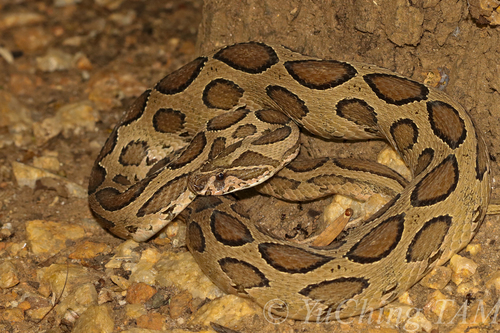
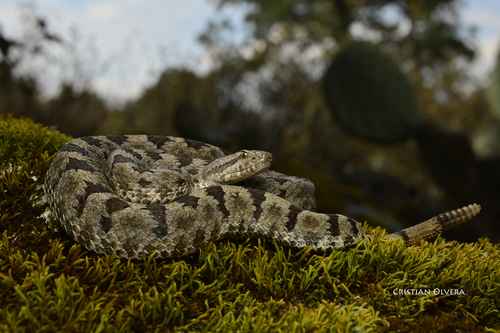
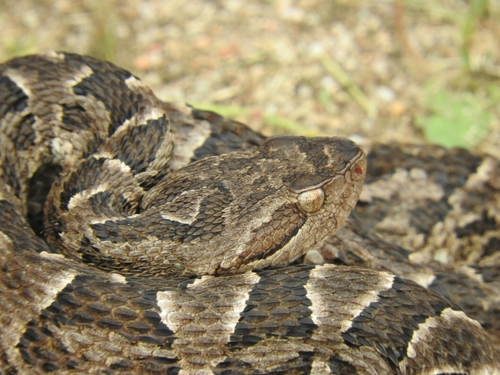
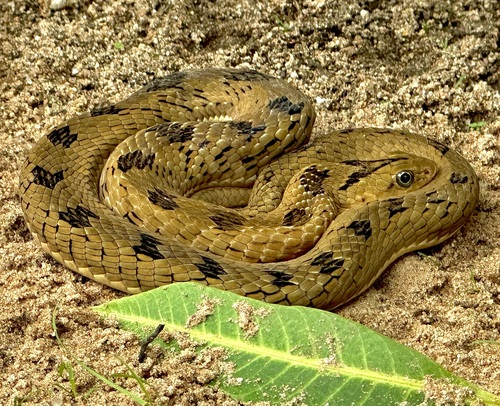
The species' color pattern typically has a brown base color, which is sometimes grayish, olive, or light green.
Dorsal Patch Pattern
A series of dark brown or blackish patches run down the back, and this pattern is less distinct on the first quarter of the body.
Flank Coloration
The flanks are sprinkled with black scales.
Dorsal Pattern Variability
There is extensive variation in the dorsal pattern.
Patternless Specimens
Some specimens, especially those from more arid regions, may have no pattern at all, which makes them difficult to identify.
DRC Specimen Coloration
Specimens from the Democratic Republic of the Congo are often uniformly brown.
Belly Base Color
The belly may be white, cream, or pinkish-gray.
Ventral Scale Color Pattern
Ventral scales are usually uniformly colored, but sometimes each scale grades from light to dark, giving the belly a finely barred appearance.
Head V-Shaped Mark
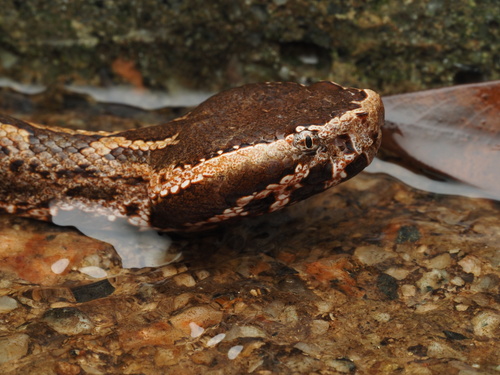
The head usually has a distinct V-shaped mark.
Head Mark Age Variation
This mark may be solid black in juveniles, but becomes brown with a black outline in adults.
Postocular Dark Line
Occasionally, a short dark line extends backwards from the back of the eye.
General Distribution Range
C. maculatus is found from Mauritania and Senegal east to western Ethiopia, and south to the Democratic Republic of the Congo and northern Angola.
Type Locality
Its type locality is listed as "Liberia, Western Africa."
Distribution (Mallow et al. 2003: Core Range)
Mallow et al. (2003) mostly cites Spawls and Branch (1995), describing the geographic range as West and Central Africa, from Senegal east to Chad, southeast to the Democratic Republic of the Congo, and northeast into southeastern Sudan.
Distribution (Mallow et al. 2003: Extended Range)
It is also found in the river gorges and low country of southwestern Ethiopia, extending southwest to northern Angola and the Democratic Republic of the Congo.
Habitat Types
This species occurs in a wide range of habitats, including forests, savanna, and even semi-desert.
Abundance and Altitude Limit
It can be quite abundant in parts of its range, and has been recorded at altitudes up to 2,400 m (7,900 ft).
Reproductive Mode
C. maculatus is oviparous.
Clutch and Hatchling Timing
An adult female typically lays a clutch of 6–20 eggs between February and April, and hatchlings emerge between May and July.