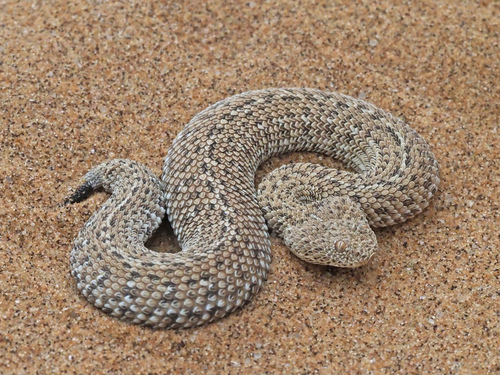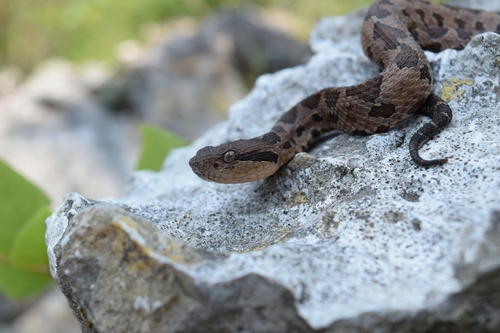
About Daboia russelii (Shaw & Nodder, 1797)
Head Shape
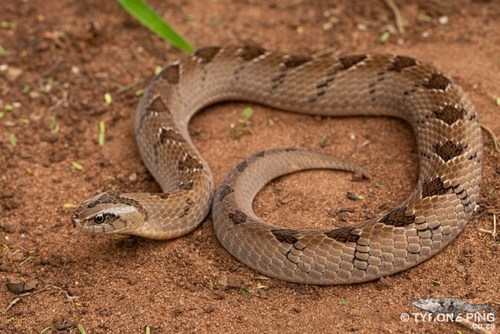
This species is Daboia russelii (Shaw & Nodder, 1797), commonly known as Russell's viper. Its head is flattened, triangular, and clearly distinct from the neck. The snout is blunt, rounded, and raised. The nostrils are large, each located in the middle of a large, single nasal scale.
Nasal Scales
The lower edge of the nasal scale touches the nasorostral scale. The supranasal scale has a pronounced crescent shape and separates the nasal scale from the nasorostral scale toward the front of the snout. The rostral scale is equally as broad as it is high. The crown of the head is covered in irregular, heavily fragmented scales.
Eye Scales
The supraocular scales are narrow, single, and separated by six to nine scales across the width of the head. The eyes are large, flecked with yellow or gold, and surrounded by 10–15 circumorbital scales. The snake has 10–12 supralabial scales; the fourth and fifth of these are significantly larger than the others. The eye is separated from the supralabials by three or four rows of subocular scales. Of the two pairs of chin shields, the front pair is noticeably enlarged.
Fangs and Body
The two maxillary bones support between two and five or six pairs of fangs at any one time: the first pair is active, while the remaining pairs are replacements. Fangs reach an average length of 16.5 mm (0.65 in) for an average-sized specimen. The body is stout, with a rounded to circular cross-section. The dorsal scales are strongly keeled; only the lowest row of dorsal scales is smooth. At mid-body, there are 27–33 rows of dorsal scales. There are 153–180 ventral scales, and the anal plate is not divided. The tail is short, making up about 14% of the snake's total length, with 41–68 paired subcaudal scales.
Coloration
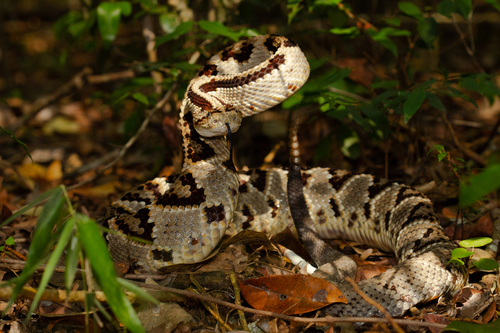
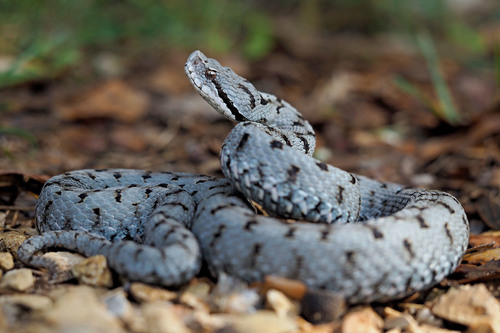
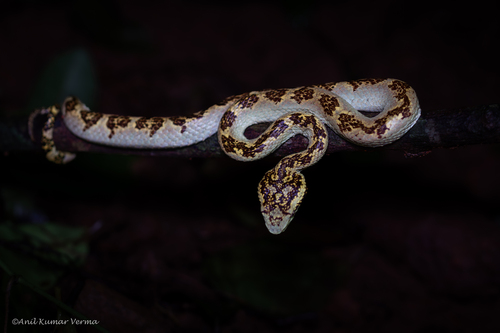
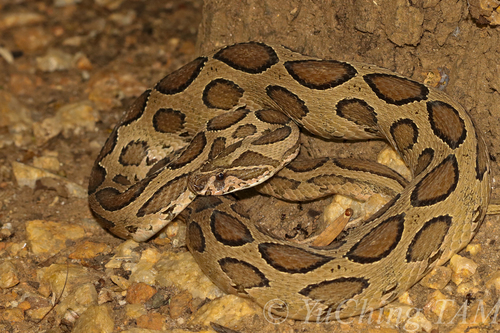
On the dorsal (upper) side, the base color is deep yellow, tan, or brown, with three lengthwise series of dark brown spots running the full length of the body. Each spot is surrounded by a black ring, whose outer edge is marked with a distinct rim of white or yellow. The dorsal spots, which usually number 23–30, may merge together, while the side spots may break into smaller separate patches. The head has a pair of distinct dark patches, one on each temple, along with a pinkish, salmon, or brownish V- or X-shaped marking that forms an apex pointing toward the snout. Behind the eye runs a dark streak, outlined in white, pink, or buff. The ventral (lower) side is white, whitish, yellowish, or pinkish, and often has an irregular scattering of dark spots.
Length
Russell's viper reaches a maximum total body and tail length of 166 cm (65 in), with an average length of about 120 cm (47 in) for individuals in mainland Asia. On islands, the average length is slightly shorter. It is more slender than most other vipers. In 1937, the following dimensions were reported for a "fair-sized adult specimen": total length 1.24 m (4 ft 1 in), tail length 430 mm (17 in), girth 150 mm (6 in), head width 51 mm (2 in), head length 51 mm (2 in).
Range
Russell's viper is found in India, Sri Lanka, Bangladesh, Nepal, and Pakistan. Populations that were previously classified as this species in Southeast Asia are now considered part of a separate species, Daboia siamensis. The listed type locality is "India"; based on inference from Russell (1796), this refers specifically to the Coromandel Coast.
Distribution
Within its range, it can be common in some areas and scarce in others. In India, it is abundant in Punjab, very common along the West Coast and its associated hills, and in southern India, especially the state of Karnataka and extending north to Bengal. It is uncommon to rare in the Ganges valley, northern Bengal, and Assam.
Habitat
Russell's viper is not restricted to any single habitat type, but tends to avoid dense forests. It is mostly found in open, grassy or bushy areas, but may also occur in second growth forests (scrub jungles), on forested plantations, and on farmland. It is most common in plains, coastal lowlands, and hills with suitable habitat.
Elevation
It is generally not found at high altitudes, but has been recorded as high as 2300–3000 m (7,500–9,800 ft). It avoids humid environments such as marshes, swamps, and rain forests. This species is often found in highly urbanized areas and rural settlements, drawn by the presence of rodents that live alongside humans.
Human Risk
As a result, people working outdoors in these areas face the highest risk of being bitten. D. russelii does not associate as closely with human settlements as cobras (Naja species) and kraits (Bungarus species).
Activity
The Russell's viper is terrestrial, and is primarily active as a nocturnal forager. However, it becomes more active during the day in cool weather. Adults are reported to be slow and sluggish, and usually do not attack unless provoked, but they are capable of striking at lightning speed. Juveniles are generally more nervous.
Threat Display
When threatened, they form a series of S-shaped loops, raise the first third of their body, and produce a hiss that is reportedly louder than that of any other snake. If further provoked, they will strike, and can exert enough force that large individuals may lift fully off the ground during the strike. This behaviour has often led to the common misconception that Russell's vipers "chase" and bite humans. They are strong and may react violently when picked up. A bite may be a quick snap, or the snake may hang on for many seconds.
Thermal Cues
Although this genus does not have the heat-sensitive pit organs common to pit vipers (Crotalinae), it is one of several viperines that can apparently react to thermal cues, which supports the idea that it also possesses a heat-sensitive organ. The identity of this sensory structure is not certain, but nerve endings in the supranasal sac of these snakes resemble those found in other heat-sensitive organs.
Reproduction
Russell's viper is ovoviviparous. Mating generally occurs early in the year, though pregnant females may be found at any time of year. The gestation period is longer than six months.
Litter Size
Young are born between May and November, with most births occurring in June and July. It is a prolific breeder. Litters of 20–40 young are common, though litters can be as small as a single offspring. The largest recorded litter size is 75.
Growth
At birth, juveniles have a total length of 215–260 mm (8.5–10.2 in). The minimum total length for a gravid female is about 100 cm (39 in). Sexual maturity appears to be reached at 2–3 years of age. In one recorded birth case, a specimen took nearly 4.5 hours to give birth to 11 young.
Diagnostic Test
Because Russell's viper venom is very effective at inducing thrombosis, it has been incorporated into a widely used in vitro diagnostic blood clotting test for hospital laboratories. This test is commonly called dilute Russell's viper venom time (dRVVT).
Clotting Mechanism
The coagulant compound in the venom directly activates clotting factor X, which converts prothrombin into thrombin in the presence of factor V and phospholipid. The venom is diluted to produce a clotting time of 23 to 27 seconds, and the phospholipid concentration is reduced to make the test extremely sensitive to phospholipid.
Sensitivity
The dRVVT test is more sensitive than the aPTT test for detecting lupus anticoagulant, an autoimmune disorder, because it is not affected by deficiencies in clotting factors VIII, IX, or XI.