About Ovophis tonkinensis (Bourret, 1934)
Sexual Size Dimorphism
This species, Ovophis tonkinensis, exhibits clear sexual size dimorphism. Adult males reach a total length of 49 cm (19+1⁄4 inches) with an 8 cm (3+1⁄8 inch) tail, while adult females reach a total length of 110 cm (43+1⁄4 inches) with a 15 cm (5+7⁄8 inch) tail.
Head Snout Characteristics
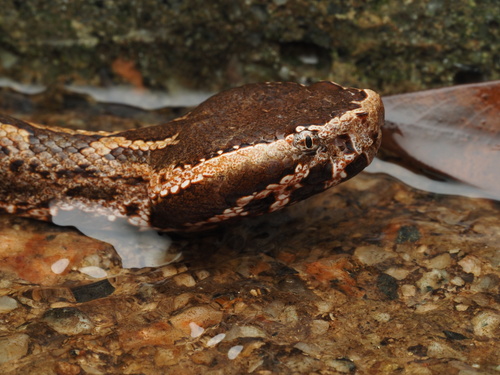
The head has a short snout that is a little more than twice the diameter of the eye. The crown is covered by small, usually smooth, feebly imbricate scales, rather than large shields.
Labial and Nasal Scales
The first upper labial scale is not fused to the nasal scale, and is completely separated from it by a suture. The supraocular scales are large, with 5 to 9 scales arranged in a line between the two supraoculars.
Internasal Scales
The internasal scales are usually not in contact with one another, and are separated by 2 small suprapostrostral scales. There are 7 to 10 upper labial scales.
Facial Pit Scale
The second upper labial is usually fused to the scale that borders the anterior edge of the facial sensory pit. The fourth and fifth upper labials sit beneath the eye, but are separated from the eye orbit by a series of 2 to 4 small scales.
Body Shape
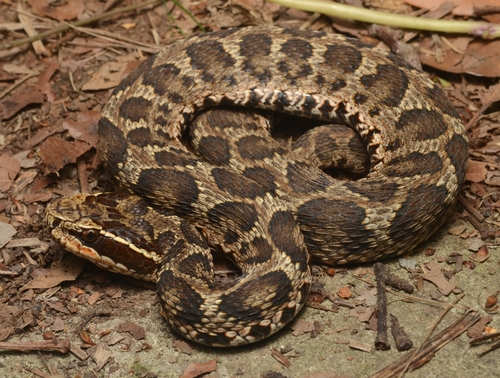
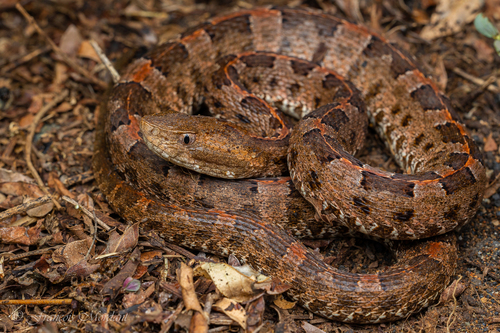
The body is stout.
Dorsal Scales
Dorsal scales are smooth or weakly keeled, arranged in 23 to 25 longitudinal rows at midbody, and occasionally occur in 19 or 21 rows instead.
Scale Counts: Myanmar, India, Adjacent Regions
Counts of ventral and subcaudal scales vary by geographic region: for populations from Myanmar, northeastern India and adjacent areas of China and Thailand, there are 137 to 176 ventral scales and 36 to 62 subcaudal scales; subcaudals are a mix of paired and single scales, and are occasionally all unpaired.
Scale Counts: Southern China, Vietnam, Laos
For populations from southern China, Vietnam, and Laos, there are 127 to 144 ventral scales and 36 to 54 subcaudal scales, following data recorded by Smith in 1943.
Scale Counts: Malaysian Peninsula
For populations from the Malaysian Peninsula, there are 133 to 137 ventral scales and 22 to 28 subcaudal scales, also following Smith 1943 data.
Geographic Distribution
This species is found across Asia, with confirmed occurrences in Nepal; India (specifically Assam, Sikkim, Mizoram, Nagaland); Bangladesh (noted in the subspecies table); Myanmar; China (specifically Zhejiang, Fujian, Sichuan, Yunnan, Tibet); Cambodia; Thailand; Laos; Vietnam; West Malaysia; and Indonesia (specifically Sumatra).
Type Locality
Its type locality is recorded as Sikkim, India.