About Canis aureus Linnaeus, 1758
Canis aureus Linnaeus, 1758, commonly called the golden jackal, resembles the gray wolf, but differs in having a smaller body, lighter weight, more elongated torso, a less prominent forehead, shorter legs and tail, and a narrower, more pointed muzzle. Its legs are long relative to its body size, with slender feet and small foot pads. Males have a body length of 71–85 cm (28–33 in), while females measure 69–73 cm (27–29 in). Males weigh 6–14 kg (13–31 lb), and females weigh 7–11 kg (15–24 lb). Shoulder height for both sexes ranges from 45–50 cm (18–20 in). For comparison, the smallest wolf subspecies, the Arabian wolf (Canis lupus arabs), has an average weight of 20 kg (44 lb).
The golden jackal's skull is most similar to that of a dingo, and is closer in structure to the skulls of the coyote (C. latrans) and gray wolf (C. lupus) than to the skulls of the black-backed jackal (L. mesomalas), side-striped jackal (L. adustus), and Ethiopian wolf (C. simensis). Compared to the gray wolf, the golden jackal's skull is smaller and less massive, with a lower nasal region and shorter facial region. The projections of the skull are prominent, but weaker than those of the wolf. Its canine teeth are large and strong but relatively thinner, and its carnassial teeth are weaker. The golden jackal is a less specialized carnivore than the gray wolf; these skull traits match its diet, which includes small birds, rodents, other small vertebrates, insects, carrion, fruit, and some vegetable matter.
It was historically believed that golden jackals develop a small horny skull growth called a "jackal's horn", which typically measured around 13 mm (1⁄2 in) long and was hidden by fur. No evidence has ever been found for this feature, but belief in it remains common across South Asia. The people of Sri Lanka once associated this supposed growth with magical powers.
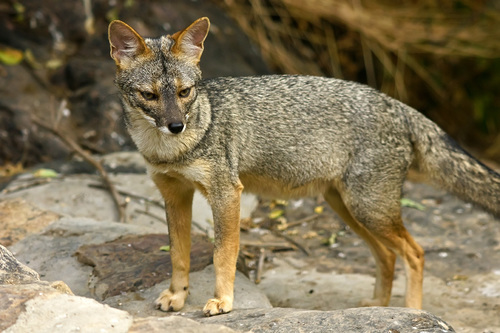
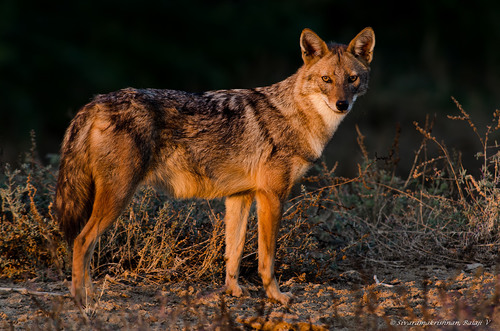
The golden jackal has coarse, relatively short fur, with a golden base color that changes seasonally, ranging from a pale creamy yellow to a dark tawny. The fur on its back is a mix of black, brown, and white hairs, sometimes forming a dark saddle marking similar to that of the black-backed jackal. The underparts are colored from a pale light ginger to cream. Individual golden jackals can be told apart by their unique light markings on the throat and chest. Jackals from high elevations typically have more buff-colored fur than lowland individuals, while jackals from rocky, mountainous areas may have grayer fur. The bushy tail has a tan to black tip. Some golden jackals have a dark-colored coat from melanism, a trait that was once fairly common in Bengal. Unlike melanism in wolves and coyotes, which comes from interbreeding with domestic dogs, melanism in golden jackals likely comes from an independent mutation that may be an adaptive trait. A possible albino golden jackal was photographed in southeastern Iran in 2012.
Golden jackals moult twice a year, once in spring and once in autumn. In Transcaucasia and Tajikistan, spring moult begins at the end of winter. If winter was warm, spring moult starts in mid-February; if winter was cold, it starts in mid-March. Spring moult lasts 60–65 days, and sick individuals only shed half of their winter fur. Spring moult starts on the head and limbs, then spreads to the flanks, chest, belly and rump, and finishes on the tail. No fur grows on the golden jackal's underparts. Autumn moult starts in mid-September, when winter fur grows in, and summer fur sheds at the same time. The autumn coat begins developing on the rump and tail, then spreads to the back, flanks, belly, chest, limbs and head, with full winter fur fully grown in by the end of November.
Golden jackals live in Europe, and Southwest, Central, South, and Southeast Asia. Their omnivorous diet lets them eat a wide range of foods, and this combined with their tolerance for dry conditions allows them to live in many different habitats. Their long legs and slender bodies let them trot long distances while searching for food. They can survive without water for extended periods, and have even been observed on islands with no fresh water. Golden jackals are abundant in valleys and along rivers, their tributaries, canals, lakes, and seashores, but are rare in foothills and low mountains. In Central Asia they avoid waterless deserts, and are not found in the Karakum or Kyzylkum Deserts, though they can occur at desert edges or in oases. In contrast, golden jackals live in India's Thar Desert. They occupy dense prickly bush thickets, reed flood-lands, and forests. They have been recorded ascending over 1,000 m (3,300 ft) up Himalayan slopes, and can tolerate temperatures as low as −25 °C (−13 °F), and sometimes as low as −35 °C (−31 °F). They are not adapted for snowy terrain, so in areas with snow they must travel along paths made by larger animals or humans. In India, they occupy the foothills above farmland, enter human settlements at night to feed on garbage, and have established populations around hill stations at 2,000 m (6,600 ft) elevation. They generally avoid mountainous forests, but may enter alpine and sub-alpine areas while dispersing. In Turkey, the Caucasus, and Transcaucasia, they have been observed up to 1,000 m (3,300 ft), especially in high elevation areas with shrubland habitat. The only golden jackal population adapted to the boreal region, in Estonia, mostly lives in coastal grasslands, alvars, and reed beds, habitats where wolves are rarely found. A single golden jackal has been trapped near Sodankylä, Finland, inside the Arctic Circle.
Golden jackals are monogamous, and pairs stay together until one partner dies. Females have only one breeding cycle per year. Breeding occurs from October to March in Israel, and from February to March in India, Turkmenistan, Bulgaria, and Transcaucasia, with the mating period lasting 26–28 days. Multiple males often pursue a female in her first estrus, and the males may quarrel with each other. As with all canids, mating produces a copulatory tie that lasts for several minutes. Gestation lasts 63 days, and birthing is timed to match the annual peak in food availability. In India, golden jackals take over dens dug by Bengal foxes and Indian crested porcupines, and also use abandoned gray wolf dens. Most breeding pairs are spaced far apart, and defend a core territory around their den. In India, den digging starts from late April to May, with dens located in scrub areas. Prime denning habitats include the banks of rivulets and gullies, and road and check-dam embankments. Golden jackals also use drainage pipes and culverts as dens. Dens are 2–3 m (6.6–9.8 ft) long and 0.5–1 m (1.6–3.3 ft) deep, and have between 1 and 3 openings. Adult jackals move young pups between 2–4 different dens. The male assists with digging the den and raising the pups. In the Caucasus and Transcaucasia, burrows are located either in thick shrub, on gully slopes, or on flat ground. In Dagestan and Azerbaijan, litters are sometimes raised in the hollows of fallen trees, among tree roots, and under stones on river banks. In Central Asia, golden jackals do not dig burrows, instead building lairs in dense tugai thickets. Jackals in the tugais and cultivated lands of Tajikistan build lairs in long grass, shrubs, and openings in reeds.
In Transcaucasia, golden jackal pups are born from late March to late April, and in northeastern Italy they are born in late April; in Nepal, pups can be born at any time of year. Litter size varies by geographic location: jackals in Transcaucasia have 3–8 pups, 3–7 in Tajikistan, 2–8 in Uzbekistan, 4–7 in Bulgaria, with an average of four pups in India. Pups are born with closed eyes, which open 8–11 days after birth; their ears become erect 10–13 days after birth. Their teeth erupt starting at 11 days old, and full adult dentition is finished developing after five months. Pups are born with soft fur that ranges from light gray to dark brown. At one month old, their natal fur is shed and replaced with a new reddish pelt with black speckles. Pups grow quickly: they weigh 0.201–0.214 kg (0.44–0.47 lb) at two days old, 0.560–0.726 kg (1.23–1.60 lb) at one month, and 2.700–3.250 kg (5.95–7.17 lb) at four months. Females have four pairs of teats, and lactation lasts up to 8–10 weeks. Pups begin eating solid meat at 15–20 days old.
Domestic dog pups begin unrestrained fighting with their siblings by two weeks old, with no serious injury only because their jaw muscles are not yet developed. This fighting shifts to play-chasing once they develop running skills at 4–5 weeks. Wolf pups already have more developed jaw muscles by two weeks old, when they first show signs of play-fighting with their siblings, with serious fighting starting at 4–6 weeks old. Compared to wolf and dog pups, golden jackal pups develop aggression at 4–6 weeks old, when play-fighting often escalates to uninhibited biting meant to harm opponents. This aggression stops by 10–12 weeks old, once a social hierarchy is established. After lactation ends, the female drives the pups away. Late-born pups stay with their mother until early autumn, then leave either alone or in groups of two to four. Females reach sexual maturity at 10–11 months old, and males reach sexual maturity at 21–22 months old.
In Russia and other former Soviet Union nations, golden jackals are considered low quality furbearers, because their fur is sparse, coarse, and has a dull, uniform color. Jackal hair has very little fur fiber, so their pelts have a flat texture. Jackals from Asia and the Middle East produce the coarsest pelts, though this can be corrected during the fur dressing process. The softest golden jackal furs come from the Elburz region of northern Iran. Jackal skins are not graded to an official fur standard, and are made into collars, women's coats, and full fur coats. In the 1880s, 200 jackals were captured annually in Mervsk; 300 jackals were captured annually in the Transcaucasus' Zakatal area in 1896. During this same period, 10,000 jackals were killed in Russia, and all their furs were sent exclusively to the Nizhegorod fair. In the early 1930s, 20,000–25,000 jackal skins were tanned annually in the Soviet Union, but they could not be used domestically, so the majority were exported to the United States. Starting in 1949, all jackal skins were used within the Soviet Union.