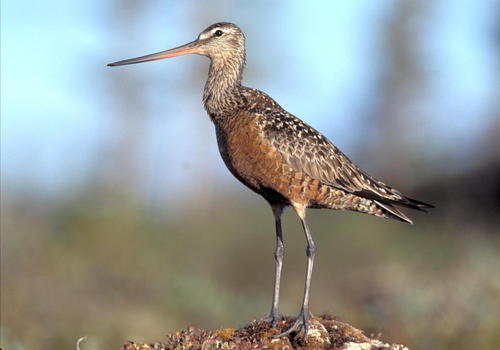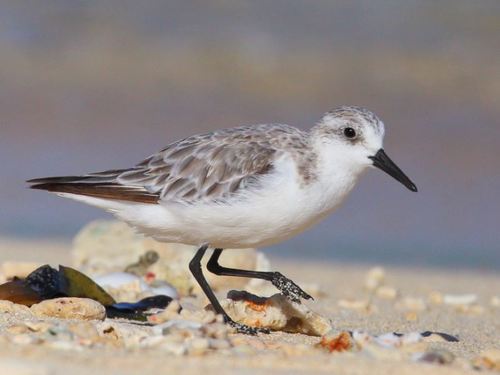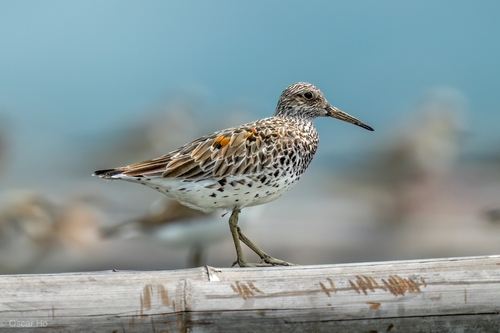
About Calidris tenuirostris (Horsfield, 1821)
Taxonomic Classification
Calidris tenuirostris, commonly known as the great knot, is classified in the genus Calidris and the family Scolopacidae, and is one of the largest species in that genus. While the ruff, C. pugnax, can have larger males due to its pronounced size-related sexual dimorphism, female ruffs are much smaller than great knots. The great knot's sister species, the surfbird C. virgata and the red knot C. canutus, are the next largest after the great knot in the genus.
Size Measurements
Adult great knots measure 26 to 30 cm (10 to 12 in) in length, have a 56 to 66 cm (22 to 26 in) wingspan, and weigh between 115 and 261 g (4.1 to 9.2 oz).
Limb and Bill Morphology
The species has short dark legs and a medium-length, thin, dark bill.
Breeding Plumage Upperparts
Breeding adult great knots have mottled greyish upperparts, with a distinct band of rufous feathers on the scapulars.
Breeding Plumage Underparts
Their face, throat, and breast are heavily spotted with black, and there are additional streaks on the rear belly.
Non-breeding Plumage
In winter, the upperparts of their plumage turn uniformly pale grey.
Breeding Plumage Identification vs Red Knot
The great knot can be distinguished from the red knot by its breeding plumage: breeding red knots have a distinctive red face, throat, and breast.
Non-breeding Plumage Identification
In other plumage stages, the great knot is identifiable by its larger size, longer bill, deeper chest, and more streaked upperparts.
Breeding Habitat
The great knot's breeding habitat is tundra in northeast Siberia, Russia.
Nesting Behavior
It nests on the ground, laying around four eggs in a ground scrape.
Migratory Pattern
The species is strongly migratory, and winters on coasts from southern Asia through to Australia.
Winter Flocking Behavior
In winter, great knots form enormous flocks.
North American Occurrence
Low numbers of the species are recorded most summers in western Alaska, United States, and small numbers winter as far west as Pakistan, Oman, and the United Arab Emirates.
Vagrant Records
It has occurred as a vagrant in Great Britain, Morocco, New Zealand, British Columbia (Canada), and three of the lower 48 states of the United States: Oregon, West Virginia, and Maine.