About Calidris alba (Pallas, 1764)
Scientific Classification and Body Form
The sanderling, scientifically named Calidris alba (Pallas, 1764), is a small, plump species of sandpiper. It measures 18–20 cm (7–8 in) in length, and weighs between 40–100 g (1+1⁄2–3+1⁄2 oz).
Winter Plumage
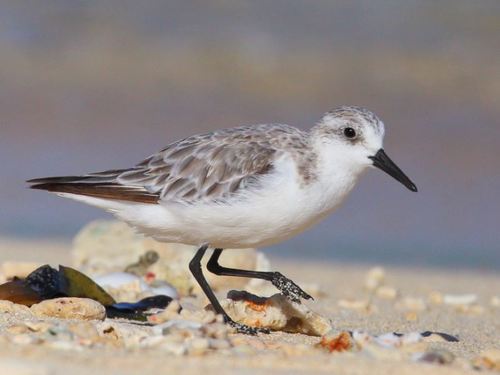
In winter plumage, the sanderling is very pale, appearing almost white aside from a dark shoulder patch; this characteristic gives the species its specific name alba, which means "white" in Latin.
Summer Plumage
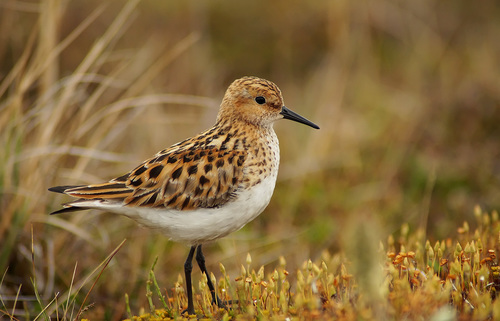
By summer, its face and throat turn brick-red.
Juvenile Plumage
Juvenile sanderlings have a black-and-white spangled pattern that is far more contrasting than the plumage of adult birds.
Similar Species Confusion
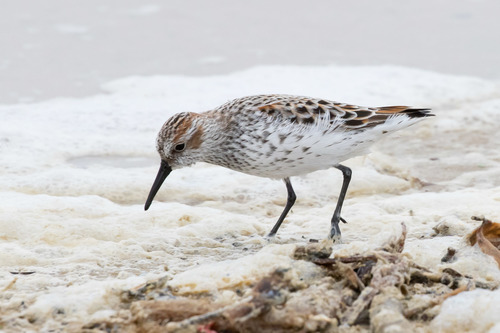
If their size is misjudged, breeding-plumage sanderlings can be mistaken for some varieties of stint, while winter-plumage sanderlings can be confused with dunlins or red knots.
Distinguishing Features
When seen clearly, sanderlings can be distinguished from other small wading birds by their lack of a hind toe, and they also have distinctive behaviour.
Breeding Range Global
Sanderlings breed in High Arctic regions across North America, Europe, and Asia.
North American Breeding Range
In North America, they breed in the Canadian Arctic Archipelago, Nunavut, and Greenland, with smaller breeding populations present in Alaska.
Eurasian Breeding Range
In Eurasia, their breeding range includes Spitsbergen and northern Russian areas stretching from the Taymyr Peninsula to the New Siberian Islands.
Winter Distribution
During the northern winter, sanderlings have an almost cosmopolitan distribution along the world's marine coasts.
Migration Distance
The species is a complete long-distance migrant, traveling between 3,000 to 10,000 km (2,000 to 6,000 mi) between its breeding grounds and wintering sites.
Long Distance Migration Traits
Individuals that travel longer distances arrive later at their destinations and leave sooner.
Southward Migration Timing
Most adult sanderlings leave the breeding grounds in July and early August, while juvenile birds leave in late August and early September.
Northward Migration Timing
Northward migration back to breeding grounds begins in March from the southern end of the species' winter distribution.
Breeding Habitat
The sanderling's breeding habitat is coastal tundra located north of the 5 °C (41 °F) July isotherm.
Nesting Site Characteristics
The species typically nests on dry stony areas near wet landscapes, at elevations ranging from 60 m (200 ft) to 800 m (2,600 ft) above sea level.
Non-breeding Habitat
During winter and migration, sanderlings are most often found on coastal sandy beaches, but they also occur on tidal sand flats, mud flats, and the shores of lakes and rivers.
Rare Non-breeding Habitat
They only appear on rocky shores infrequently.