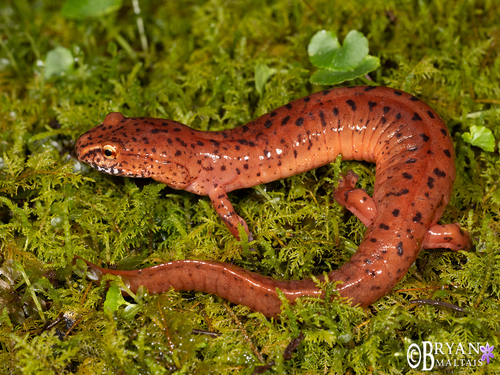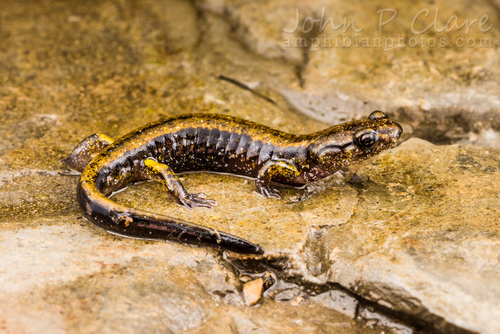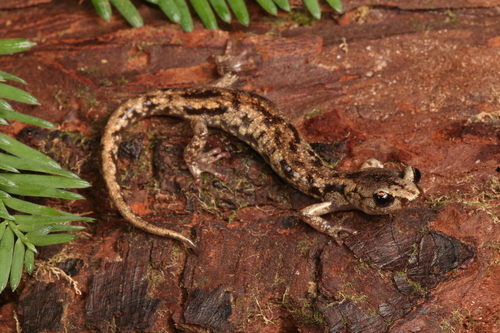
About Aneides vagrans Wake & Jackman, 1999
Common Name and Size
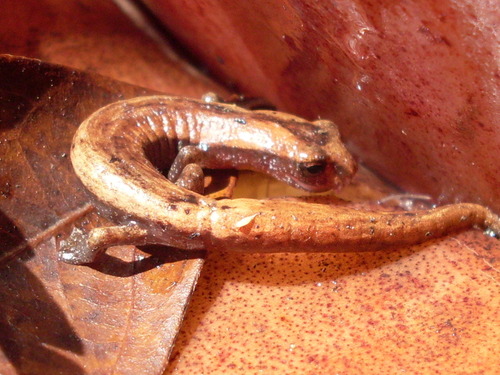
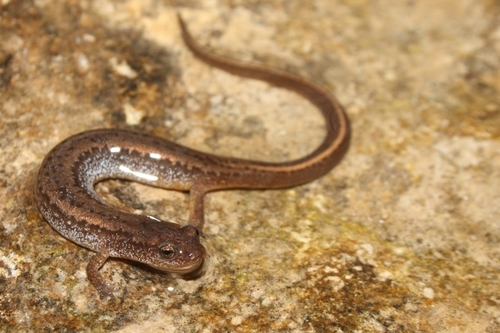
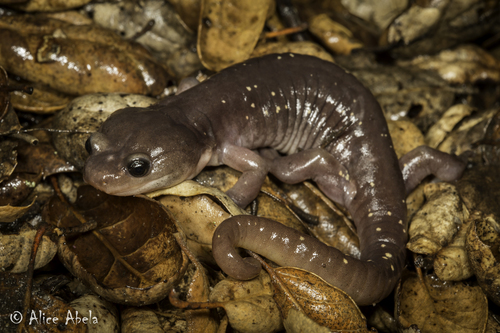
Aneides vagrans, commonly known as the wandering salamander, is a long, slender species that reaches an approximate snout-vent length of 80 millimetres (3.1 in) and a total length of 130 millimetres (5.1 in).
Coloration
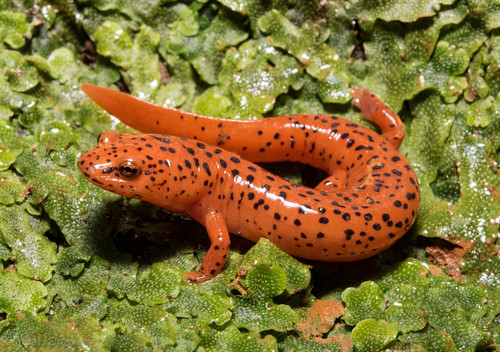
Its base color ranges from brown to light grey, with lighter bronze-grey mottling across its dorsal surface; juveniles additionally have a coppery-bronze stripe running down the spine.
Costal Grooves
This species has between 14 and 16 costal grooves, with 15 being the most common.
Sexual Dimorphism
Males have a broader, more triangular head than females.
Naso-labial Grooves
Like other plethodontid salamanders, wandering salamanders have a pair of naso-labial grooves between the nostrils and mouth that function in chemoreception.
Arboreal Adaptations
They have several adaptations suited to an arboreal lifestyle: relatively long legs, and toes with expanded terminal pads that have square cut ends to help with vertical climbing and gliding.
Tail Characteristics
Their prehensile tail is round in cross section, and assists the salamander in directing its descent when falling.
Taxonomic History
The wandering salamander is visually similar to the clouded salamander (Aneides ferreus), and the two were once classified as a single species.
Distribution
The wandering salamander has a disjunct distribution: in California, its range stretches from northern Siskiyou and Del Norte Counties, south along the Pacific coast to northwestern Sonoma County, while it is also widespread across low elevation forests of Vancouver Island and its surrounding islands.
Disjunct Range Explanations
The cause of this unusual split range is not confirmed; all existing explanations are unstudied and remain speculative.
Tanoak Bark Introduction Hypothesis
One hypothesis suggests the species was introduced to Vancouver Island in the nineteenth century, when large sheets of tanoak bark harvested in California were imported for the tanning industry.
Supporting Bark Introduction Evidence
Wandering salamanders naturally inhabit bark crevices, and multiple leather tanning facilities were built on Vancouver Island in the decades before the species was first recorded there in 1906.
Bark Importation Records
There is also documented evidence of extensive tanoak bark importation from San Francisco to Vancouver Island in the late 1800s.
Bark Harvesting Practices
Tanoak bark shipped from this region was harvested from both standing and fallen trees, and was typically not treated with harsh chemicals before shipping.
Salamander Survival During Transport
This makes it possible for salamanders to be accidentally collected in the bark and survive the journey to Vancouver Island.
Bark Introduction Limitations
Even with this circumstantial evidence for the tanoak bark importation theory, questions remain about how salamanders were able to rapidly colonize all of Vancouver Island and its surrounding islets starting from only six tanneries clustered on the southeast coast of the main island.
Log Rafting Hypothesis
A second theory proposes that the species reached Vancouver Island naturally via log rafting from California, carried north by the Davidson Current.
Davidson Current Details
This is the dominant ocean current along the Pacific coast of North America, and during winter it flows along the continental shelf from California to the nearshore waters near Vancouver Island.
Glaciation Hypothesis
Before the wandering salamander was split from A. ferreus, another hypothesis suggested the disjunct range formed due to glaciation: the species' originally continuous population was fragmented by glaciers, and surviving populations persisted in glacial refugia in both California and Vancouver Island.
Vancouver Island Glacial Refugium
Vancouver Island was indeed ice-free during the last glacial maximum, and acted as a refugium for many other species.
Glaciation Hypothesis Limitation
However, population fragmentation typically leads to genetic divergence over time, so the very close genetic similarity of California and Vancouver Island populations is surprising given the time that has passed since the last glacial period.
Elevation Range
The wandering salamander occurs at elevations ranging from sea level up to 1,700 metres (5,600 ft).
Home Range
Individuals have very small home ranges, and rarely move far from their territories.
Terrestrial Habitat
Adult wandering salamanders can live in the forest canopy, or in moist terrestrial habitats including rotting logs, bark crevices, stumps, and under rocks.
Microhabitat Preference
They are more commonly found inside bark on logs than under loose bark on the ground.
Canopy Use
Individuals can climb as high as 24 m (80 ft) into tree branches, and have been found living in the crowns of coast redwoods.
Arboreal Microhabitat Association
While little research has been done on arboreal microhabitat selection for this species, they appear to associate with epiphytic fern mats growing in the crotches of redwood branches.
Breeding Period
Breeding occurs in spring and early summer.
Egg Laying
Females lay a clutch of 6 to 9 eggs in a concealed location; eggs have been found in terrestrial sites such as under logs, as well as at the base of tree branches 30–40 metres (98–131 ft) above ground.
Parental Care
Adult salamanders have been observed guarding developing eggs.
Development
Wandering salamander eggs hatch directly into miniature adult forms, with no aquatic larval stage.