About Aneides lugubris (Hallowell, 1849)
Common Name & SVL
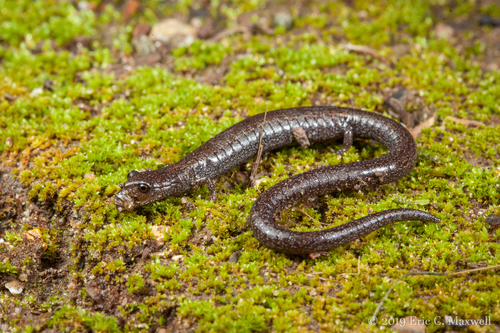
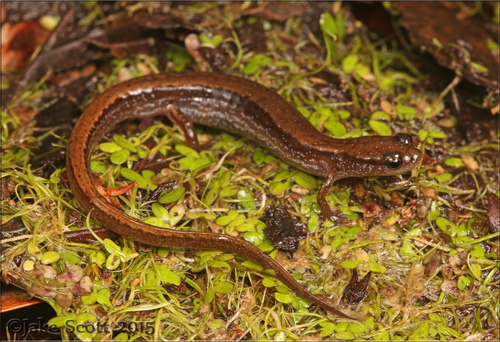
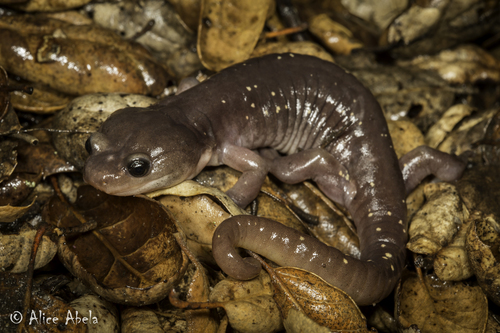
Aneides lugubris (Hallowell, 1849), commonly called the arboreal salamander, measures 6.5–10 cm (2.6–3.9 in) in snout-vent length (SVL).
Adult Coloration
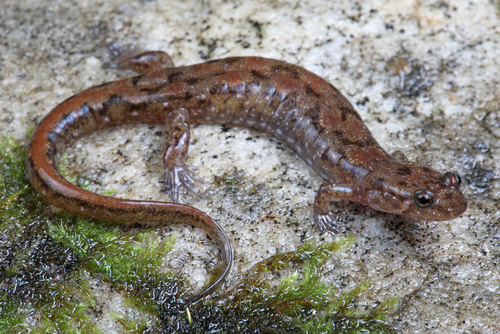
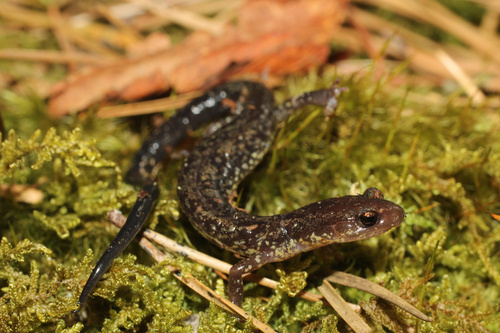
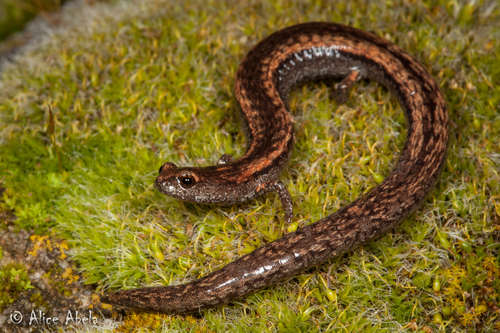
It has a plain purplish-brown base color, and is usually dorsally spotted with gold or yellow, though some individuals are unspotted.
Juvenile Coloration
Juveniles are overall dark, clouded with a greyish tone and marked with fine yellow speckling on the back.
Male Identification Traits
Males of this species can be distinguished by their broad triangular head, with the front jaw teeth extending beyond the bottom lip.
Tooth & Jaw Comparisons
Compared to most other salamanders in the order Urodela, this species has longer and sharper teeth; compared to most other plethodontid salamanders, it also has much more developed teeth and jaws.
Skull Development
After the second year of development, the anterior section of the skull becomes heavily ossified and bulbous; teeth increase in size but decrease in number to make the overall jaw more robust.
Skeletal Ossification Exception
In contrast, the body's long bones and pelvic plate never complete ossification over the salamander's entire lifespan.
Tail Trait
The tail is prehensile.
Bite Capability
Large adults can deliver a painful bite.
Respiration Adaptation
As a plethodontid (family Plethodontidae) salamander, this species is lungless, and breathes through its skin as well as membranes in its mouth and throat.
Diet
Aneides lugubris is insectivorous, and has been recorded eating beetles, caterpillars, sow bugs, ants, and centipedes.
Climbing Ability
It is an excellent climber and difficult to capture.
Activity Pattern & Shelter
It is nocturnal, and spends daylight hours and dry periods in oak tree cavities, often gathered with many other individuals of its own species.
Fall Protection Behavior
Because it primarily lives in trees, the arboreal salamander has been observed deliberately using its body to protect itself from falls.
Aerial Gliding Behavior
When falling, it can use its limbs to glide or parachute, creating a controlled, directional fall to minimize injury.
Aerial Behavior Evolution
This aerial behavior is thought to have evolved through generations of adaptation to falling from its arboreal habitat.
Water Loss Adaptations
This species has relatively low rates of water loss, which may be due to its rapid water intake and postural adaptation of curling its body and tightly coiling its tail.
Vocalization
It can produce sounds that have been compared to the faint bark of a dog.
Genus Aneides Shared Traits
All members of the genus Aneides are characterized by the loss of the aquatic larval stage common to most salamanders, as well as their unusual arboreal and climbing tendencies.
Genus Size & Range Context
Aneides lugubris is the largest species in its genus, and one of three Aneides species found in Western North America.
General Distribution & Habitats
Arboreal salamanders are nearly endemic to California, and occupy coastal woodlands, conifer forests, and shrublands.
Specific Geographic Range
They are found from Humboldt County, California down to northern Baja California, Mexico, and also live on the offshore islands of South Farallon, Los Coronados, Catalina, Ano Nuevo, and San Francisco.
Habitat Moisture Limitation
They thrive in moist terrestrial habitats, which limits their terrestrial activity to periods of elevated humidity.
Microhabitat Use
They spend most of their time under forest floor leaf litter, and retreat to tree cavities during summer to stay moist.
Reproductive Strategy Overview
This species has a unique reproductive strategy.
Egg Laying Sites & Guarding
Females lay eggs in moist burrows (or in holes of live oak trees, or under rocks, logs, or other ground cover under dirt), and eggs are laid and guarded in these burrows.
Clutch Size & Laying Period
Clutch size ranges from 5 to 24 eggs, and laying occurs in late spring or early summer.
Incubation Period
Embryos hatch after 3–4 months, in August and September.
Post-Hatchling Shelter
After hatching, hatchlings enter the moist burrows where they were laid.
Parental Care
Adult salamanders stay near their eggs to shield them from predators and environmental hazards, providing parental care that increases the hatchlings' chance of survival.
Hatchling SVL
Hatchlings measure 24 mm in SVL.
Maturity & Adult Age
Age at maturity is 2.69 years, and the average adult age is 8–11 years.
Survival Probability by Age
Annual survival probability increases with age, rising from 0.363 at age 0 to 0.783 for individuals older than 4 years.