About Gyrinophilus porphyriticus (Green, 1827)
Taxonomic Classification
Gyrinophilus porphyriticus is a species of plethodontid salamander, and like all members of the Plethodontidae family, these salamanders have a nasolabial groove.
G. p. porphyriticus and G. p. duryi Size
Two of its subspecies, G. p. porphyriticus and G. p. duryi, grow to between 4.75–7.5 inches (12.1–19.1 cm) in length, with a maximum recorded length of 9.125 inches (23.18 cm).
G. p. porphyriticus and G. p. duryi Facial Markings
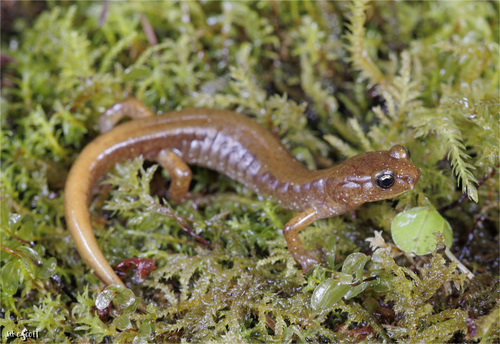
These two subspecies have a light line that runs from the eye to the nostril, bordered below by gray pigment, though these markings are not always conspicuous.
G. p. porphyriticus and G. p. duryi Dorsal Coloration
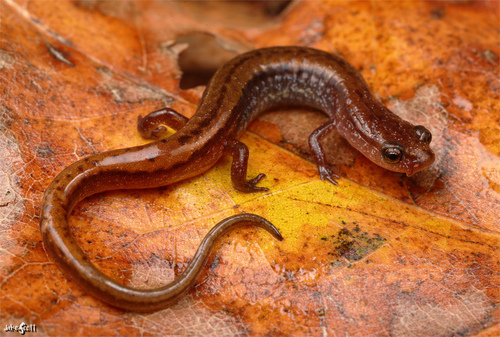
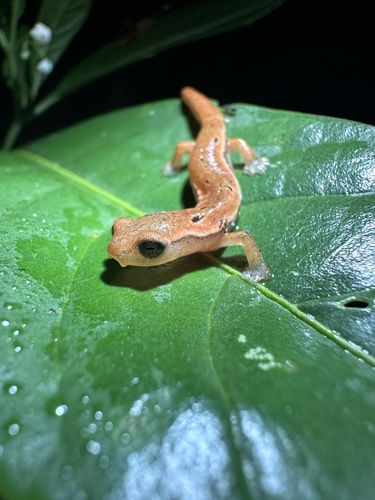
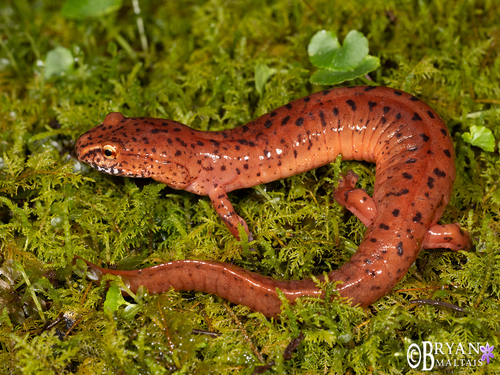
Their dorsal coloration ranges from salmon or light brownish to pink or reddish. Their base ground color has a cloudy appearance, and any darker markings are vague.
G. p. danielsi and G. p. dunni Size
The subspecies G. p. danielsi and G. p. dunni grow to between 5–7.5 inches (13–19 cm), with a maximum recorded length of 8.06 inches (20.5 cm).
Elevation Size Correlation
In populations of this species that live at higher elevations, adults reach larger sizes, because development to sexual maturity after metamorphosis is delayed in these high elevation groups.
G. p. danielsi and G. p. dunni Facial Markings
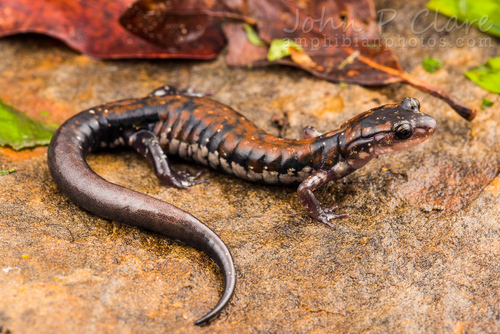
G. p. danielsi and G. p. dunni have a distinct white line from the eye to the nostril, which is bordered below by a conspicuous black or dark brown line. A dark line may also be present above this white line, and this line is often conspicuous.
G. p. danielsi and G. p. dunni Dorsal Coloration
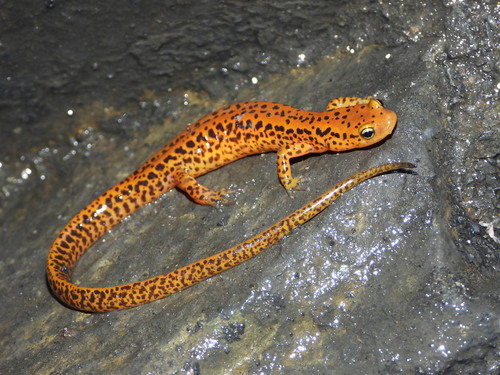
Their dorsal coloration is usually clear reddish, salmon, or orange-yellow, marked with black or brown spots or flecks.
Costal Groove Count
This species has 17 to 19 costal grooves.
Larval and Juvenile Traits
Larvae of G. porphyriticus are aquatic, with a stream-adapted morphology, and juveniles are typically more brightly colored than adult individuals.
Habitat Types
This species lives in cool springs and mountain springs, but it can also be found in any wet depression under logs, stones, or leaves in the surrounding forest.
Respiration Habitat Requirements
Since G. porphyriticus performs cutaneous respiration, it requires habitats that provide adequate oxygen and moisture.
Cold Season Behavior
During the colder months of the year, these salamanders stay in wet soil near a water source where they remain somewhat active in burrows, or occupy leaf litter near a stream or other body of water.
Overall Species Range
The overall geographic range of this species extends from southern Quebec to northern Alabama and the extreme northeast of Mississippi. There is also an isolated population in Hamilton County, Ohio.
G. p. duryi Distribution
G. p. duryi occurs in southern Ohio, eastern Kentucky, West Virginia, and western Virginia.
G. p. danielsi Distribution
G. p. danielsi is distributed across the southern Appalachian Mountains and the adjacent Piedmont, from North Carolina to Alabama.
G. p. dunni Distribution
G. p. dunni ranges across the southern portion of the Blue Ridge Province and the Piedmont, from southwest North Carolina to eastern to central Alabama.
Nominate Subspecies Distribution
The nominate subspecies G. p. porphyriticus occupies all remaining parts of the species’ total geographic range.
Breeding Period
Spring salamanders most often breed from late summer into fall.
Courtship Initiation
Courtship starts when the male slides his head over the female’s body, after which the pair begins a tail-straddle walk. During this walk, the female straddles the male’s tail while both walk forward.
Spermatophore Transfer
The male then deposits a spermatophore on the substrate, which the female picks up and stores until she is ready to fertilize her eggs. After depositing the spermatophore, the male walks forward with his tail held straight upright.
Courtship Tail Behavior
He then undulates his tail while the base of his tail touches the female’s chin, so the base of the tail rubs over most of the female’s chin.
Egg Laying
Females lay their eggs in the summer after they mate. When laid, the eggs are sticky, allowing the entire egg mass to adhere to whatever surface it is placed on.
Egg Mass Traits
An egg mass can hold between 16 and 160 eggs. Females guard the egg mass until the eggs hatch, which usually occurs in late summer or early fall.
Post-Hatching Larval Behavior
Larvae may stay near their mother after hatching, but do not depend directly on her for survival.
Larval Stage Duration
Larvae of this species remain in the larval stage for multiple years, and some stay in this stage for up to four years.
Sexual Maturity Timeline
After metamorphosis, it takes individuals another four years to reach sexual maturity.