About Plethodon dunni Bishop, 1934
Species Nomenclature
Dunn's salamander (scientific name Plethodon dunni Bishop, 1934) is a moderately sized terrestrial salamander.
Adult Size
Adult individuals measure 6–7.5 cm (2.4–3.0 in) in snout–vent length, and 10–15.5 cm (3.9–6.1 in) in total length.
Dorsal Coloration
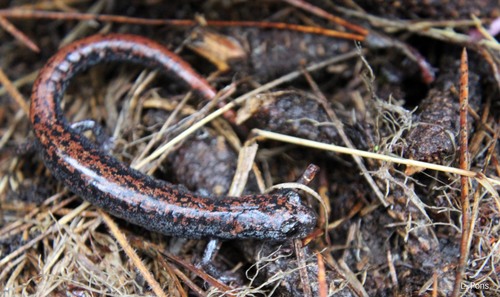
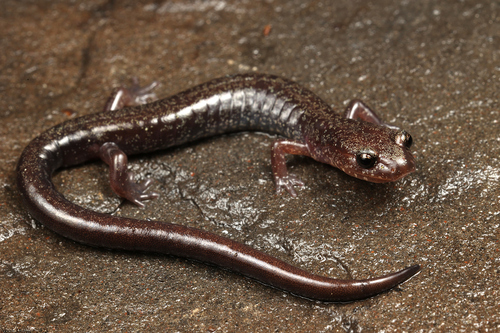
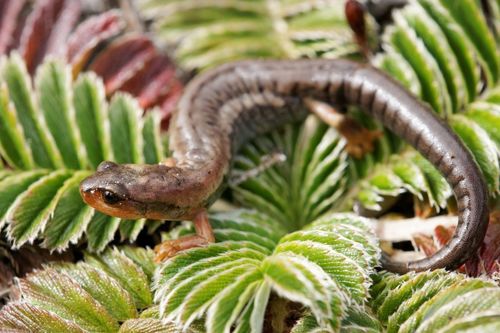
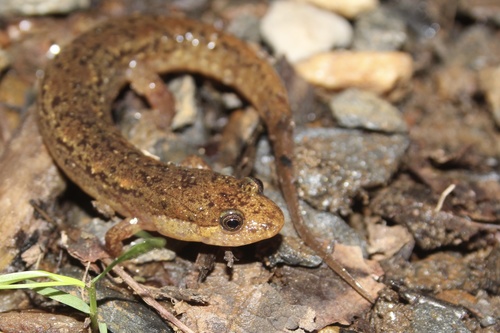
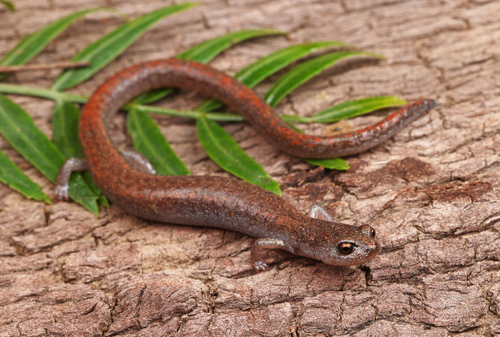
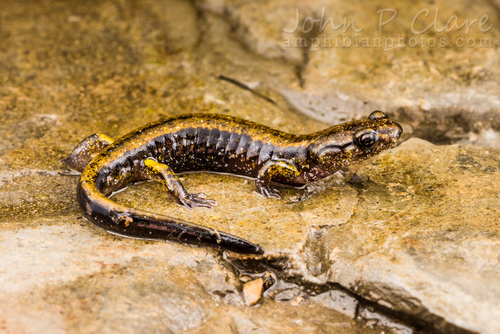
Its body is dark brown or black, with a distinct broad yellowish to olive green dorsal stripe that runs from the head to the tail, stopping before the tail tip.
Lateral Markings
Light spots appear on the salamander's sides.
Melanistic Morphology
Some individual Dunn's salamanders, and even entire populations, are black (a melanistic form).
Melanistic Taxonomy
These melanistic populations were previously described as a separate species, Plethodon gordoni, but they are not genetically distinct from ordinary P. dunni, so they are not currently recognized as a separate species.
Juvenile Traits
This species has no larval stage; juvenile Dunn's salamanders measure 13–16 mm (0.51–0.63 in) in snout–vent length.
Diet Composition
The diet of this salamander consists mainly of small invertebrates.
General Habitat
Dunn's salamander inhabits a range of moist microhabitats.
Specific Habitat Locations
It can be found along shady, cool streams or seepages in wet, rocky areas, as well as in forests, talus slopes, and moss-covered outcrops.
Refuge Sites
It is often found under rocks, logs, moss, and leaf-litter.
Habitat Preference Comparison
This species generally prefers moister microhabitats than sympatric species such as Ensatina or the western red-backed salamander.
Conservation Status
Dunn's salamander is not considered threatened, due to its relatively wide range and lack of sensitivity to habitat modification such as logging.