About Amblyrhynchus cristatus Bell, 1825
Taxonomic Description
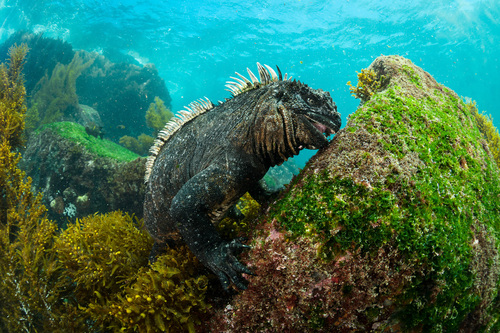
This species, the marine iguana, was first described in 1825 as Amblyrhynchus cristatus by Thomas Bell, who incorrectly believed his specimen originated from Mexico. Its generic name combines two Greek words: Ambly- from amblus meaning "blunt", and rhynchus meaning "snout". Its specific epithet cristatus is Latin for "crested", referring to the low spine crest along the animal's back.
Genus Status
Amblyrhynchus is a monotypic genus, containing only Amblyrhynchus cristatus.
Sexual Maturity Timing
Female marine iguanas reach sexual maturity at 3 to 5 years old, while males reach sexual maturity at 6 to 8 years old. Sexual maturity is marked by the first steep, abrupt decline in bone growth cycle thickness.
Lifespan
Marine iguanas can live up to 60 years, but their average lifespan is 12 years or less.
Reproduction Timing
Reproduction begins in the late part of the cold and dry season: breeding occurs from December to March, and nesting from January to April. Exact timing differs by location, depending on algal growth and the nutrient-rich Cromwell Current, starting earliest on islands including Fernandina, Isabela, Santa Fé, and Genovesa, and latest on islands such as Española.
Breeding Frequency
Adults of both sexes typically breed every other year, though well-fed females may breed annually.
Colony Structure
Marine iguanas live in coastal colonies that usually contain between 20 and 500 individuals, and sometimes more than 1,000. Their bodies often touch, but they do not engage in social interactions like the grooming common in social mammals and birds.
Gregariousness
Females are always highly gregarious, and males are gregarious outside of the breeding season.
Male Territoriality
During the breeding season, large males defend territories for up to three months, and sometimes fight other males in this period. Territories can reach almost 40 m² (430 ft²), but are usually less than half that size, and can be as small as 1 m² (11 ft²). Territories are often marked by geographic features like boulders or crevices.
Lek Arrangement
They usually cluster together adjacent to one another to form a lek, though they may also occur alone.
Non-Territorial Male Behavior
Medium-sized males roam near large males' territories or walk along beaches searching for females, while small "sneaky" males may enter the territories of large males.
Male Threat Displays
To threaten another male, a male bobs his head, walks on stiff legs, raises the spiny crest along his back, and opens his mouth to show its reddish interior. In most cases, the challenging suitor leaves; if the challenger responds with the same threat behavior, a fight begins.
Male Fight Mechanics
During fights, the iguanas typically do not bite, instead thrusting their heads together to push the opponent away. The bony plates on the top of their heads are specially adapted to interlock. Fights between males can last for hours and are often interrupted by periodic breaks.
Fight Resolution
After a winner is determined via headbutting, the loser takes a submissive position and retreats. In general, these fights are harmless and highly ritualized, though males occasionally bite and injure each other.
Female Mate Choice Factors
Females primarily choose mates based on body size, and strongly prefer to mate with larger males. Increased reproductive performance tied to body size is mediated by higher survival of larger hatchlings from larger females, and increased mating success for larger males. Additional factors that influence female mate choice include how often a male performs displays (especially head-bobbing) and the quality of the male's territory.
Preferred Territory Traits
Females prefer male territories that include or are near their own resting places, which females select based on proximity to the sea, access to shade, low midday temperature, and opportunity for sunbathing in the afternoon. Males with territories near the center of a lek generally have greater mating success than males with peripheral territories, but territory size does not affect mating success.
Male Pheromone Use
Large territorial males that display frequently also release higher levels of certain acidic compounds (including 11-Eicosenoic acid) from their femoral pores; these may act as pheromones to improve their chance of attracting females.
Female Movement During Breeding
Females can move freely between different territories, and experience less harassment from opportunistic non-territorial males when inside another male's territory.
Non-Territorial Male Mating Success
Medium-sized males attempt to mate by force, while small males mate using stealth and force, but both have far lower mating success rates than large territory-holding males.
Courtship Behavior
During courtship, a territorial male nods toward the female, may open his mouth, and walks slowly sideways toward her. If the female accepts, the male mounts her while holding her by the neck.
Mating Duration
Mating lasts no more than 20 minutes, most often 3 to 4 minutes.
Sneaky Male Mating Adaptations
Mating is comparatively faster in small "sneaky" males, who are easily overlooked because their size, general morphology, and colors match those of females. This rapid mating is necessary, because large males will chase them out of their territory as soon as they are discovered.
Mating Frequency By Sex
During each breeding season, a male will mate with many females if given the chance, but a female mates only once. After mating, a female rejects other suitors by nodding her head at them.
Clutch Characteristics
Roughly one month after copulation, the female lays between one and six eggs, most often two or three. The leathery white eggs measure about 9 cm × 4.5 cm (3.5 in × 1.8 in) and weigh 80–120 g (2.8–4.2 oz). They are large for iguana eggs; combined, the full clutch can weigh up to one-quarter of the female's total body weight.
Nest Site Location
Nest sites can be located as far as 2 km (1.2 mi) inland, but are typically much closer to the coast. They are occasionally as little as 20 m (66 ft) inland, but must sit above the high tide mark.
Nest Construction
The female digs a 30–80 cm (12–31 in) deep nest in sand or volcanic ash.
Nest Guarding
On islands with few suitable nesting sites and hard, rocky soil that makes digging difficult, the female guards the nest for several days after burying the eggs to prevent other nesting females from digging up the clutch.
Female Aggression During Nesting
Like males defending territories from other males, female marine iguanas defending nest sites start with a threat display. If this does not drive off the opponent, fights between females involve frequent biting and are less ritualized than territorial fights between males.
Nest Guarding Variation
Where more suitable nesting sites are available and the soil is loose, females are far less likely to fight for a location and do not guard their nest after burying the eggs.
Incubation Period
The eggs hatch after approximately three to four months.
Hatchling Size
Hatchlings have a snout-to-vent length of 9.5–13 cm (3.7–5.1 in) and weigh 40–70 g (1.4–2.5 oz).
Hatchling Behavior
Immediately after emerging from the nest, they run for cover, then travel to locations that provide optimal conditions for feeding, temperature regulation, and shelter. Some hatchlings have been recorded moving up to 3 km (1.9 mi) in two days.