About Cyclura ricordi (Duméril & Bibron, 1837)
Taxonomic Identity
Cyclura ricordi is a species of rock iguana.
Sexual Dimorphism in Length
This species is sexually dimorphic: males reach a maximum snout-to-vent length of 460 mm (18 in), while females reach a maximum snout-to-vent length of 430 mm (17 in).
Maximum Tail Length
The maximum recorded tail length for the species is 540 mm (21 in).
Hatchling Size
At birth, the average snout-to-vent length is 96 mm (3.8 in), with an average tail length of 147 mm (5.8 in).
Secondary Sexual Characteristics
Males are larger than females, and also have larger femoral pores on their thighs, which these pores use to release pheromones.
Base Body Coloration
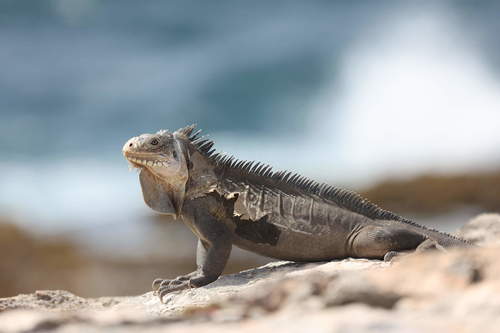
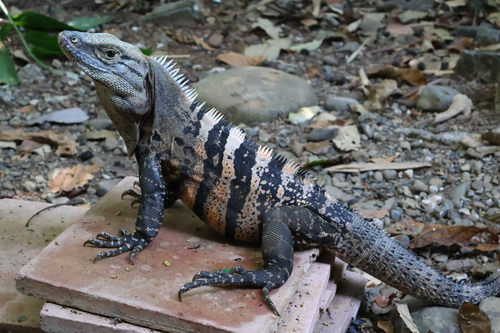
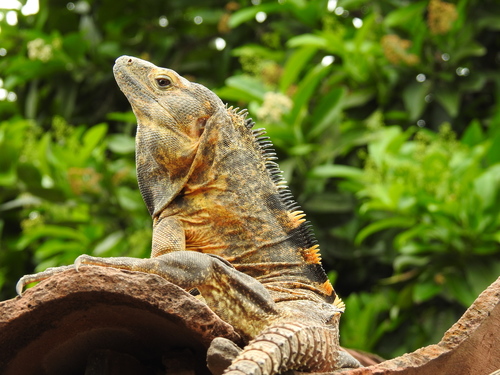
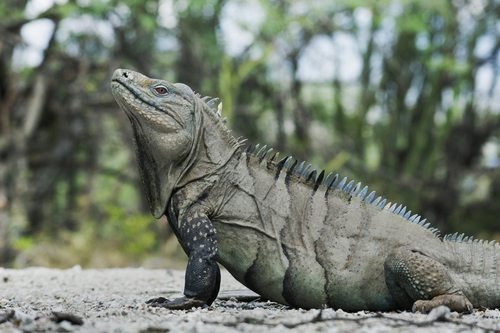
The body has a dull grayish green base color, marked by five to six bold pale gray chevrons that alternate with dark gray to black chevrons.
Age-Related Color Variation
Adult individuals have less contrasting dark chevrons than juveniles.
Eye Appearance
The eyes have a dark, almost black iris, and a red sclera.
Egg Characteristics
Eggs of the genus Cyclura, which this species belongs to, are among the largest eggs laid by any lizard.
Pre-2008 Known Distribution
Until 2008, Cyclura ricordi was thought to only occur in two populations in the southern Dominican Republic.
Dominican Republic Hoya de Enriquillo Population
One of these populations lives in the arid Hoya de Enriquillo, surrounding the hypersaline Lake Enriquillo and its lake island Isla Cabritos.
Dominican Republic Pedernales Province Population
The other lives in the most xeric section of Pedernales Province's coastal lowlands.
Population Separation Barrier
These two populations are separated by the moister Sierra de Bahoruco; three of its peaks rise over 2,000 metres (6,600 ft), forming an ecological barrier between the groups.
Historical Genetic Exchange
It is possible that past drier Pleistocene climates allowed genetic exchange between the two populations.
Sympatric Iguana Species
Throughout its entire range, Cyclura ricordi lives alongside Cyclura cornuta, the rhinoceros iguana.
Caribbean Rock Iguana Endemism Pattern
All other Caribbean islands that host rock iguanas only host a single rock iguana species.
2008 Discovered Haitian Population
In 2008, a third population of Cyclura ricordi was discovered near the town of Anse-a-Pitres in Haiti, close to Haiti's southernmost coast.
Evolutionary Origins
Hispaniola was originally two separate islands; genetic evidence shows C. ricordii evolved on the northern paleo-island and later dispersed southward, while C. cornuta evolved on the southern paleo-island.
Primary Habitat Types
This species lives in dry xeric Hispaniolan dry forests or scrublands.
Rocky Limestone Habitat Features
These plant communities grow on rocky limestone cliffs and terraces, have scattered trees, cacti, and many vines, and occasionally include depressions filled with red soil.
Sandy Soil Flat Habitat
A portion of the species' population occupies flat habitat with 5–6m tall dry forest, where succulents are the dominant plants and the habitat grows on white sandy soil.
Altitudinal Range
Cyclura ricordi occurs at altitudes ranging from 43m below sea level (on Cabritos Island in Lake Enriquillo) up to 439m above sea level.
Haitian Population Habitat
The Haitian population of the species lives on a small karst limestone terrace located near the coast.