About Amazilis amazilia (R.Lesson & Garnot, 1827)
Size Measurements
The Amazilia hummingbird, Amazilis amazilia (R.Lesson & Garnot, 1827), is 9 to 11 cm (3.5 to 4.3 in) long. Males weigh 5 to 6.5 g (0.18 to 0.23 oz), while females weigh 4.5 to 5.5 g (0.16 to 0.19 oz).
Bill Characteristics
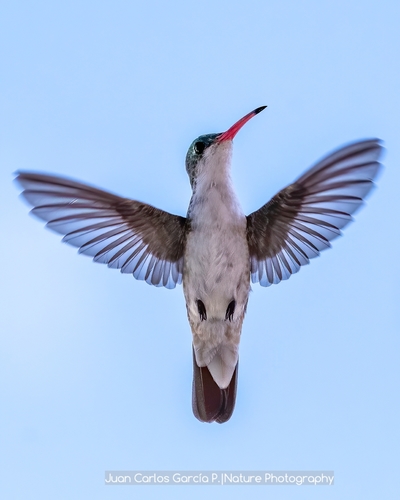
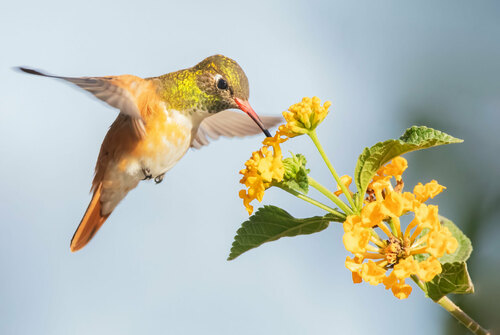
All subspecies of both sexes have a straight, medium-length pinkish-red bill with a black tip.
Nominate Male Upperparts
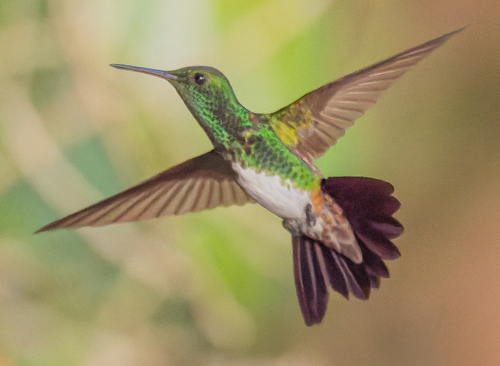
Adult males of the nominate subspecies A. a. amazilia have golden-green upperparts with rufous uppertail coverts. Their tail is mostly rufous, with some bronze-green on the outer feathers.
Nominate Male Underparts
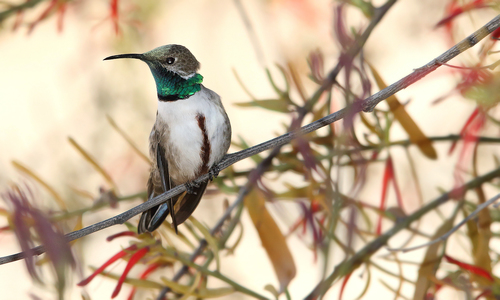
They have a glittering golden- to turquoise-green throat and rufous lower breast and belly.
Adult Female Plumage
Adult females have almost identical plumage to males, with the addition of some white on the chin and throat and a paler rufous belly.
Juvenile Plumage
Juveniles look similar to adult females, and also have brownish edges on their upperpart feathers.
Species Song Characteristics
The song of the Amazilia hummingbird is a variable but typically descending series of 4–10 squeaky notes, repeated at intervals. There are song differences within and between subspecies, especially for A. a. alticola compared to other subspecies.
Call Characteristics
The species produces calls described as "tsip" and a dry "zrrt"; these calls are sometimes extended as stuttering rattles.
A. a. alticola Plumage
Subspecies A. a. alticola has less rufous on the breast than the nominate subspecies and almost no green on the tail.
A. a. azuay Plumage
A. a. azuay differs the most from the nominate: its bill has less red on the maxilla, it has a nearly pure white belly with rufous only on the lower flanks, and its uppertail coverts and tail are paler rufous with very little green.
A. a. dumerilii Plumage
A. a. dumerilii is somewhat smaller than the nominate, with a white chin, throat, and center of the belly.
A. a. leucophoea Plumage
A. a. leucophoea looks almost identical to dumerilii, but has bronze-green upperparts.
A. a. caeruleigularis Plumage
A. a. caeruleigularis has a glittering violet-blue throat, instead of the green throat of the nominate subspecies.
General Distribution
The Amazilia hummingbird is found in western Ecuador and Peru. It does not migrate, but does perform some elevational dispersal after the breeding season.
Subspecies Distributions
The six recognized subspecies have the following distributions: A. a. alticola is found in the Andes of the southern Ecuadorian provinces of El Oro, Loja, and Zamora-Chinchipe; A. a. azuay lives in south-central Ecuador, in the Jubones River basin of Azuay and Loja provinces; A. a. dumerilii occurs in Andean lowlands from western Ecuador into the Tumbes Department of northwestern Peru; A. a. leucophoea is found in northwestern Peru between the departments of Piura and Ancash; the nominate A. a. amazilia is native to western Peru in the departments of Lima and Ica; A. a. caeruleigularis is restricted to the Nazca valley in southwestern Peru.
General Habitat
The Amazilia hummingbird has a different habitat than its close relatives in the genus Amazilia: it occurs in open semi-arid to arid landscapes, and is rarely found deep within forested areas. These landscapes include scrublands, thorn forest, xerophytic steppe, and desert.
Anthropogenic Habitats
The species is also common in cultivated areas, as well as city parks and gardens.
Nominate Subspecies Elevation
The nominate subspecies occurs between sea level and about 1,000 m (3,300 ft).
Mid-Elevation Subspecies Habitat
Subspecies dumerilii, leucophaea, and alticola also occur in the sub-montane zone in savanna, and at the edges and clearings of cloudforest.
Mid-Elevation Subspecies Elevation Range
In terms of elevation, these three subspecies mostly range between 1,000 and 2,200 m (3,300 and 7,200 ft), though leucophaea can reach as high as 2,700 m (8,900 ft).
A. a. caeruleigularis Elevation and Habitat
A. a. caeruleigularis is apparently restricted to near-desert habitat between 600 and 700 m (2,000 and 2,300 ft).