About Oreotrochilus estella (d'Orbigny, 1838)
Size
The Andean hillstar (Oreotrochilus estella) is 13 to 15 cm (5.1 to 5.9 in) long. Males weigh approximately 8.8 g (0.31 oz), while females weigh approximately 8.0 g (0.28 oz).
Bill Morphology
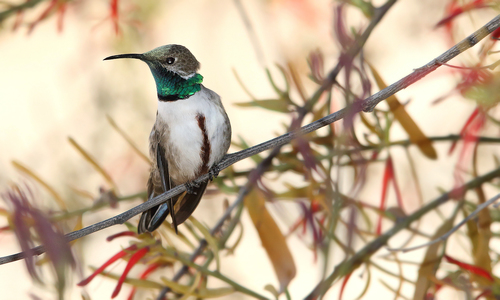
Adult individuals have a medium-length, slightly decurved black bill.
Nominate Male Upperparts
For the nominate subspecies, adult males have drab brown upperparts.
Nominate Male Gorget and Breast
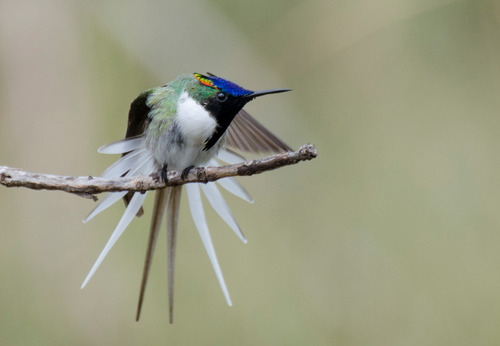
They have a shiny green gorget with a black border that separates the gorget from the bird's white breast and belly. A rufous stripe runs down the middle of the belly into the vent area.
Nominate Male Tail Structure
The bird's forked tail has a central pair of bronzy black feathers; the rest of the tail feathers are mostly white, with bronzy black edges and tips on the outermost feathers.
Nominate Female Upperparts and Underparts
Adult females have dull brown upperparts and dull brown underparts.
Nominate Female Throat and Tail
Their throat is pale with fine dark speckles. Their tail is greenish black, and the outer three or four pairs of feathers have white coloring at their bases and tips.
Juvenile Plumage
Juvenile Andean hillstars are overall more grayish than adults, and juvenile males have a dark blue-green gorget.
O. e. bolivianus Male Trait
Adult males of the subspecies O. e. bolivianus are very similar to the nominate subspecies, but their belly stripe is chestnut with black spots.
Species Native Range
The Andean hillstar is a bird native to the high central Andes.
Nominate Subspecies Distribution
The nominate subspecies ranges from southwestern Peru's Department of Ayacucho south through western Bolivia and northern Chile, into northwestern Argentina as far as Tucumán Province.
O. e. bolivianus Distribution
O. e. bolivianus is restricted to Bolivia's Cochabamba Department.
Habitat Types
The species inhabits puna grasslands, especially areas with rock outcroppings. It also commonly occurs near human houses, in stands of Puya raimondii, and at the edges of Polylepis woodlands.
Elevational Range
Its elevational range is 2,400 to 5,000 m (7,900 to 16,400 ft), and it is most common between 3,500 and 4,500 m (11,500 and 14,800 ft).
Cold Adaptation
The species is unusually well adapted to cold nights and winter; it survives these conditions by reducing its metabolic rate via a state of torpor similar to hibernation, sheltering in caves and deep crevices.
Shelter Function Hypothesis
This shelter is also hypothesized to protect the species from nocturnal predation.