About Microchera cupreiceps (Lawrence, 1866)
Common Name and Size
Microchera cupreiceps, commonly known as the coppery-headed emerald, is approximately 7.5 cm (3.0 in) long and weighs 3.0 to 3.3 g (0.11 to 0.12 oz) on average.
Shared Bill Morphology
Both sexes share a moderately decurved bill, with a pinkish base to the lower mandible.
Adult Male Upperparts
The adult male has a dull coppery bronze crown, bronze green nape, back, and rump, and bright coppery bronze uppertail coverts.
Adult Male Tail Structure
Its central pair of tail feathers is bronze; the next three pairs are white with pale gray tips, and the outermost pair is white with black tips.
Adult Male Underparts
The male's underparts are bright yellowish metallic green with white undertail coverts, and males from the far northern Cordillera de Guanacaste also have an additional purple spot at the center of the breast.
Adult Female Upperparts
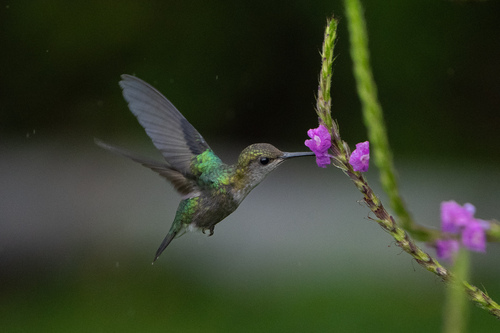
The adult female has metallic green upperparts with bright, somewhat coppery bronze uppertail coverts.
Adult Female Tail Structure
Its central pair of tail feathers is bright bronze; the next three pairs are white with a gray or dusky bar near the tip, and the outermost pair is white with gray or dusky tips.
Adult Female Underparts
The female's underparts are dull white to grayish white, turning fully white at the vent, and it also has metallic green spots along the flanks.
Immature Male Plumage
Immature males closely resemble adult males but have duller overall plumage, and black tips on all tail feathers except the central pair.
Species Endemic Range
This hummingbird is endemic to the highlands of northern and central Costa Rica.
Slope Distribution
Across most of its range, it occurs on the Caribbean slope, though it also occupies the Pacific slope in the far northern part of its distribution.
Habitat Type
It inhabits both the edges and interior of moist to humid montane forest.
Habitat Stratification
Within the forest interior, males are most often found in the canopy and females in the understory; at forest edges and in semi-open areas such as clearings, both sexes can be found at all elevation levels within the vegetation.
Elevation Range
Its overall elevation range is 300 to 1,500 m (980 to 4,900 ft) on the Caribbean slope, while it is seldom found below approximately 1,200 m (3,900 ft) on the Pacific slope.